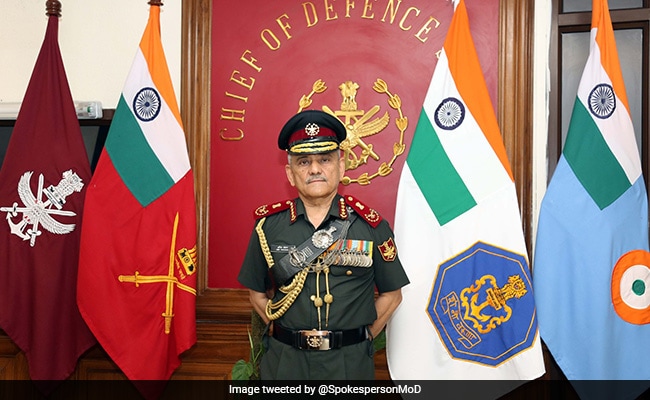
New Delhi, Sep 5 (NVI) China is a “long-term and comprehensive” security challenge for India, while Pakistan will continue to remain a major security concern, particularly through terrorism and proxy warfare, former Chief of Defence Staff (CDS) General Anil Chauhan (Retd.) said today.
Speaking at the 22nd Bharat Ratna Pandit Govind Ballabh Pant Memorial Lecture, Chauhan said India’s security environment was becoming increasingly complex, with conventional military threats intersecting with cyber, technological, economic, informational and societal challenges.
On India’s northern neighbour, Chauhan said the unresolved boundary issue remained a significant source of friction. “The boundary issue remains unresolved, and there’s no mutually agreeable definition even on a Line of Actual Control,” he said.
He said differences in perceptions along the border, combined with infrastructure development and the multiplication of military capabilities, created the possibility of friction and escalation. Maintaining border stability, therefore, would require sustained vigilance, credible capabilities, clear communication and consistent adherence to agreements.
At the same time, Chauhan cautioned against allowing the boundary dispute to define the entire India-China relationship. India and China, he said, are major economies and regional powers that cooperate in some areas while competing for influence in markets and the broader international order.
“There’s a need to engage China in some way,” he said, adding that the future of Asia would depend substantially on how India and China manage their relationship and the wider international system.
On Pakistan, Chauhan said the western neighbour would remain a major security concern for India for the foreseeable future. The presence of nuclear weapons, he said, had created a degree of stability at the strategic level while contributing to instability at lower levels, a dynamic commonly described as the “stability-instability paradox”.
Pakistan’s strategy, according to Chauhan, has been to reduce the space for conventional military operations while expanding the scope for unconventional activities such as terrorism and cross-border operations. Terrorism and proxy warfare have consequently remained central to this approach, he said.
He said non-state actors provide advantages in terms of reliability, lower costs and the ability to generate political and communal consequences. Even when terrorist networks are virtual, he added, their enabling infrastructure, including ideology, recruitment, financing, propaganda and state support, can be developed within a country.
“We must go by this premise that terrorism and proxy war will remain a major challenge for us,” Chauhan said, stressing the importance of credible deterrence. He cited India’s cross-border operations, including Operation Sindoor, as demonstrations of the country’s ability to impose costs in response to terrorism and proxy warfare.
However, he cautioned that deterrence also needed to account for the possibility of overconfidence and miscalculation by Pakistan, making continued preparedness essential.
Beyond its immediate neighbourhood, Chauhan spoke about a broader set of challenges for India arising from a rapidly changing global security environment. He described the international system as being in a period of geopolitical flux, with established balances weakening while the structures of a new order were yet to fully emerge.
Countries, he said, were increasingly pursuing issue-based and transactional alignments. A country could be a trade partner while simultaneously being a technology competitor, or a security partner in one theatre while taking a different position in another.
The rapid pace of technological change was another major challenge. Artificial intelligence, machine learning, quantum technologies, hypersonic systems, robotics, autonomous systems and advanced materials are converging to change the character of warfare, Chauhan said.
Future conflicts would involve both conventional and non-conventional domains, including land, sea and air, as well as cyber, electromagnetic, space and information domains. Cyber operations, electronic warfare, economic pressure, legal instruments and information campaigns could precede, accompany or even substitute physical attacks.
Chauhan also warned about the weaponisation of information and what he termed “cognitive colonialism,” attempts to influence how societies interpret themselves, what they value and whom they trust.
He argued that India’s response must therefore go beyond military preparedness to encompass resilient infrastructure, secure supply chains, food and energy security, technological and industrial capacity, social cohesion and strong institutions.
He called for greater self-reliance in critical capabilities, while clarifying that Aatmanirbharta did not mean producing every item domestically, regardless of cost or quality. Instead, India needed control over critical capabilities and the ability to diversify partnerships and absorb external shocks. (NVI)