
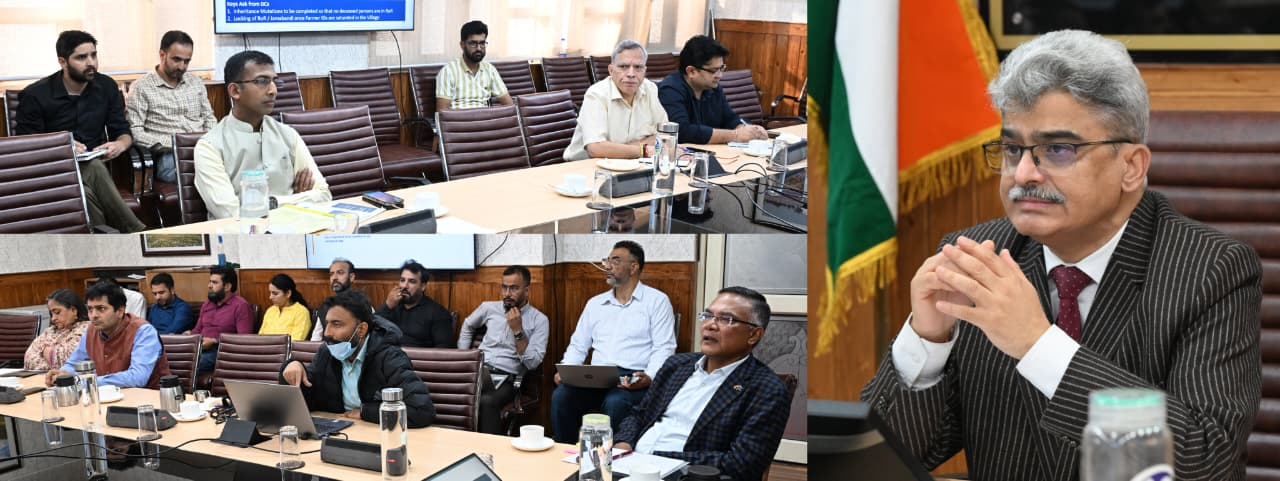
Srinagar, Oct 2 (NVI) Jammu and Kashmir Chief Secretary Atal Dulloo on Friday directed deputy commissioners to ensure that all eligible farmers are covered under AgriStack and Farmer ID registration and furnish certificates to this effect after verification.
Dulloo issued the directions while chairing a meeting to review the progress of digitisation of land records and implementation of AgriStack across the Union Territory, officials said.
The meeting reviewed district-wise progress in creation of Farmer IDs, generation of Unique Land Parcel Identification Numbers (ULPINs), digitisation and integration of cadastral maps through BhuNaksha and the proposed integration of digitised land records with the RBI’s Unified Lending Interface (ULI).
The Chief Secretary sought details from deputy commissioners on delays and gaps between targets and achievements and directed them to fix responsibility wherever undue delays were observed.
He also called for frequent field inspections to monitor the progress and quality of work and directed concerned officers to submit weekly progress reports.
Additional Chief Secretary, Finance, Shailendra Kumar, stressed the need to prioritise farmers available in villages, saying they constitute the overwhelming majority of the target population. He advised field agencies to complete the AgriStack work without further delay and formulate operational guidelines for different situations faced by field functionaries.
Revenue Secretary Kumar Rajeev Ranjan informed the meeting that Jammu and Kashmir has achieved 100 per cent digitisation across its foundational land administrative units, covering all 20 districts, 207 tehsils and 6,818 villages.
As many as 68,62,596 land parcels (Khasras) have been digitised, while the backlog of 6,47,274 mutations has been incorporated across all 20 districts, leaving no pending backlog, officials said.
The department has received 14,48,748 grievances, of which 14,38,571 were non-quasi-judicial. As many as 14,27,576 non-quasi-judicial grievances have been resolved, they said.
Against a base of 71,04,737 Khasras across 6,818 villages, data entry for AgriStack has progressed with 65,77,944 Khasras submitted, 58,17,502 verified and 57,30,681 approved, representing 80.7 per cent of the total base.
In Jammu division, 2,770 of 3,750 villages have been fully approved, with an overall Khasra approval rate of 80.8 per cent, while Kashmir division has fully approved 1,945 of 3,068 villages, with an approval rate of 80.5 per cent.
A total of 1,21,472 Farmer IDs have been generated across 1,663 villages. Kashmir division accounts for 70,979 Farmer IDs across 836 villages, while Jammu division has generated 52,751 IDs across 827 villages.
The Digital Crop Survey for Kharif 2026 is being undertaken across 5,714 villages covering around 30.61 lakh agricultural plots. The survey has been completed for 30,61,696 plots, representing 96.55 per cent progress, while supervisors have approved 27,27,189 plots.
ULPIN generation has also gathered momentum, with coverage expanding to 5,275 villages as of September 25 from 4,078 villages earlier. The number of ULPINs generated increased to 33,47,011, an addition of 4,08,887 since the previous review.
The meeting also reviewed the implementation of BhuNaksha and integration of cadastral maps with digitised land records.
Of the 6,818 village maps, 6,468 have been handed over to BISAG-N, while 6,049 have been received back. Geo-referencing of 425 maps is pending and attribute tables for 5,754 maps have been completed.
The proposed integration of J&K’s digitised land records with the RBI’s ULI through specialised APIs was also discussed.
The integration is expected to facilitate secure access to land and farm-related information for agricultural lending, including landowner and land parcel details, farm parameters, mortgage details, crop information and existing loan details.
Dulloo directed all concerned agencies to work against fixed timelines with clearly assigned responsibilities.
Deputy commissioners have been asked to complete locking of Record of Rights (RoR)/Jamabandi within one month of Farmer ID generation, complete Farmer ID generation in all bucketed villages and address unclaimed buckets and cross-district land parcels within two months.
The Chief Secretary said the digitisation exercise should translate into accurate, updated and field-validated land records to enable faster citizen services, transparent land administration and easier access to institutional agricultural credit for farmers.—(NVI)