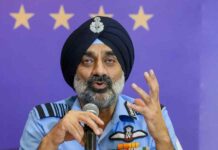

New Delhi, Oct 3 (NVI) Pakistan’s possible acquisition of fifth-generation fighter aircraft in cooperation with China is a “cause of worry” but India has got the capabilities to respond in case of any threat, Indian Air Force (IAF) Air Chief Marshal Amanpreet Singh said here today.
He said the effectiveness of such a platform would ultimately depend on how well it is integrated into a country’s broader military system, pointing to the experience of Operation Sindoor in 2025.
“We are getting the information that Pakistan is going to acquire a 5th Generation Fighter jet and that their pilots have already been training in China. So, it is a cause of worry, no doubt. But is it a total no-go situation? I will not agree with that. We do have capabilities,” Singh said at the annual press conference ahead of Air Force Day on October 8.
The Air Chief said the acquisition of an advanced aircraft alone does not determine the outcome of an air campaign. “It is not just one platform that matters, but the integration of that platform in your own system,” he said.
Referring to the 2025 Operation Sindoor in retaliation to the Pahalgam terror attack, he said Pakistan had other platforms available but “when we carried out Operation Sindoor, they could not do anything notable or special with that”.
“If we are able to integrate well the platforms that we have been inducting into our own system, we should be able to ward of this threat for the time being till they integrate it into their system very well,” he said, while stressing the need for a long-term vision and timely decisions.
He also acknowledged the pressure created by the declining number of fighter squadrons in the IAF.
Singh said the IAF needs at least 36 to 40 aircraft annually in the coming years and that delays in induction “are going to hurt us”. However, he said the force was hopeful that the capability gaps would be addressed.
The Hindustan Aeronautics Limited (HAL), he noted, has indicated production of more than 24 aircraft annually, while the proposed Multi-Role Fighter Aircraft (MRFA) programme is expected to add to the numbers.
On the MRFA programme, Singh said the deal is expected to be signed during the current financial year, subject to the completion of due process and work by both sides.
India had earlier cleared a proposal to procure 114 Rafale fighter jets under a government-to-government framework with France, with price negotiations and other issues currently being worked out.
The Air Chief also said Russia has offered its Su-57 fifth-generation fighter to India, but “no decision has been made on it”. He added that India may have to consider another aircraft platform if the Advanced Medium Combat Aircraft (AMCA) programme faces delays.
Singh emphasised that air power remains a critical component of overall military strength, but stressed that future conflicts will require joint operations.
“It is a joint force which is required, and we’ve shown this in Operation Sindoor,” he said. He also underlined the IAF’s role in humanitarian assistance and disaster relief operations, multinational exercises and support to other countries.
Self-reliance, he said, is essential for combat readiness. The IAF is supporting indigenous programmes involving HAL and the Aeronautical Development Agency, including Tejas, AMCA, missiles and radars. He also stressed the need for India to develop a fighter aircraft engine domestically.
Looking ahead, Singh said the IAF needs to become an “AI-augmented force”, with artificial intelligence assisting operations while humans remain in the decision-making chain.
On space warfare, he said work is underway on space awareness, operational support and space weapons.
Air Chief Marshal AP Singh, who will retire at the end of this month, assured the public that the IAF would remain prepared for emerging challenges and said he was willing to take responsibility for areas where the force had fallen short.
With Pakistan potentially moving towards fifth-generation fighter capability and China rapidly expanding its own stealth fleet, the IAF’s immediate priorities will remain timely fighter inductions, integration of modern weapons, strengthening indigenous production and developing future technologies.
The progress of the MRFA programme, the AMCA project and efforts to build an indigenous fighter engine are therefore likely to remain central to India’s air-power modernisation. (NVI)