By Ajay Kaul
New Delhi, Oct 7: It is now four months since a mass uprising began in Pakistan-occupied Jammu and Kashmir (POJK) against the illegal Pakistani rule and there are no signs of it ending anytime, at least in the near future.
The Pakistani regime continues to make all desperate attempts to crush the mass movement by unleashing brutal force and other oppressive means but people of POJK have refused to yield despite even after more than 100 men, women and children have been killed and hundreds of others injured.
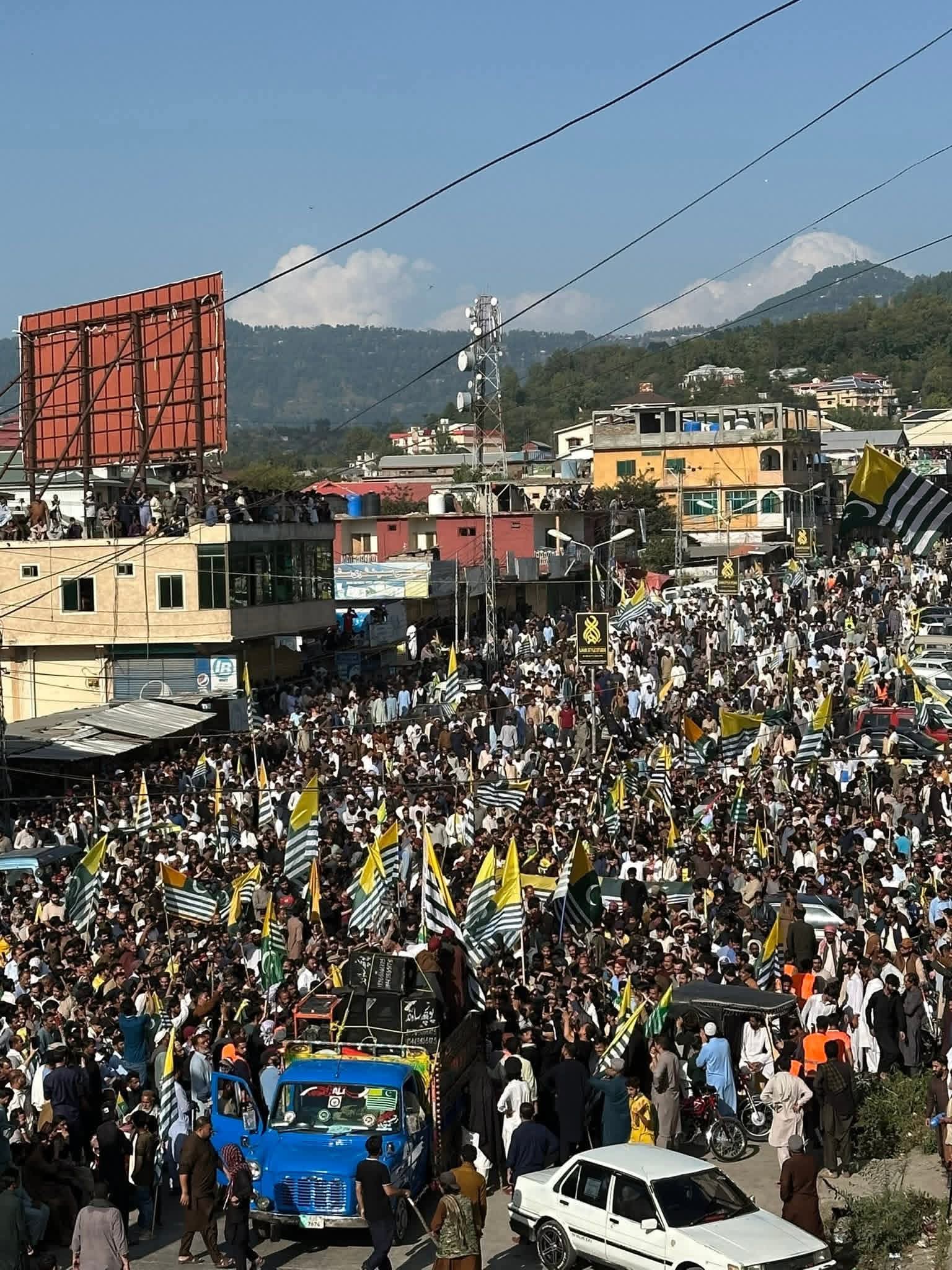
Mass rallies, demonstrations and processions continued unabated throughout POJK, with the Kashmiris, including women, braving the bullets of the Pakistani forces.
Although it has not been named so, the agitation is essentially is a full-fledged revolt against the illegal Pakistani occupation, with the bedrock being the demands for basic rights.
It was originally-planned as a ‘Long March’ to Muzaffarabad from all parts of POJK, a part of Jammu and Kashmir which was militarily occupied by Pakistan in October 1947 before accession of the princely state to India.
Lakhs of people, including women and elderly, zealously participate in non-stop rallies, demonstrations and processions where the Pakistani regime and its demonic military are slammed and cursed for the oppression continuing since the last 78 years.
The resolve of Kashmiris is unwavering even as Pakistani forces have been killing and maiming peaceful protesters through direct firing, arresting thousands, including top leaders of the agitation and resorting to other criminal acts.
The Pakistani regime has resorted to the inhuman act of ‘economic blockade’ on the landlocked POJK by preventing supplies of even essential items like food grains and medicines.
The Pakistani forces also sealed shops and business establishments in several parts of POJK to punish their owners for participating in the peaceful agitation. Bank accounts of many locals have been frozen.
Internet has also been shut down by the Pakistani regime in an attempt to prevent the visuals of its atrocities from going into circulation.
But the undeterred Kashmiris have pledged not to relent before the Pakistani forces, being described as “Zionist”.
Long March
The call for ‘Long March Towards Muzaffarabad’ had been given by J&K Joint Awami Action Committee (JKJAAC), a conglomerate of several non-political organisations of the occupied region.
The ‘Long March’ was slated to begin on 9 June 2026 but began two days earlier because of the criminal attempts by the Pakistani regime to scuttle it.
Ahead of the D-day, Pakistan sent tens of thousands of its military personnel to POJK, adding to the lakhs of those already present and they started a brutal crackdown on leaders and activists of JKJAAC and imposed curfew.
Rawalakot in particular witnessed bloodshed caused by the Pakistani forces on June 7 itself.
Despite that, lakhs of protesters reached Rawalakot on 10 June, intending to continue towards Muzaffarabad. Peaceful sit-ins were subsequently established in and around Rawalakot, which became the epicenter of the agitation.
Since then, 100 days have passed but the sit-ins continue day and night and the public participation has continued to swell.
Demands
The agitation was launched for the due rights of the locals for cheaper electricity, subsidised wheat/flour and an end to Pakistani interference in political affairs.
The demand related to end of political interference is about reservation of 12 seats in 53-member POJK Assembly for so-called ‘refugees of Jammu and Kashmir living in Pakistan’.
The voters and candidates of these 12 controversial seats are dubious and linked to Pakistani establishment, i.e, the Pakistani military.
Thus, these 12 seats form the key for the Pakistani establishment to make or break the local governments in POJK, amounting to gross interference in the political affairs of the occupied region.
Kashmiris also say that electricity produced from the rivers of POJK is looted by Pakistan and the locals get no benefit. They want it to be corrected.
It is increasingly becoming clear that people of Pakistan-occupied Jammu and Kashmir are not willing to suffer subjugation anymore and are ready to do take on the occupying regime head on.
The façade of “Azad Kashmir” has fallen and the agitation has grown into an uprising against the illegal rule of Pakistan which militarily occupied these parts of Jammu and Kashmir in October 1947 through an invasion.
The people of the POJK, who have remained subdued and submissive for the last 78 years of Pakistani occupation, have finally resolved to chart their political future by breaking the chains of subjugation. And they declare it openly. (NVI)