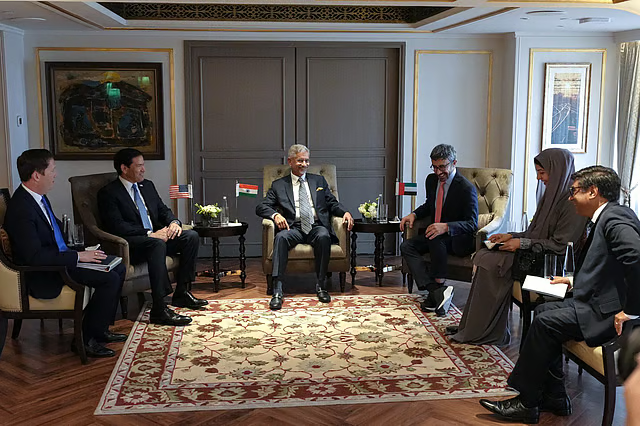
Mumbai, Oct 20 (NVI) Amid strains in the India-US ties, External Affairs Minister S Jaishankar and US Secretary of State Marco Rubio met here today and discussed ways to expand the strategic convergence between the two countries and enhance cooperation in trade, energy, technology and defence.
Rubio emphasised that India can diversify its energy supply chains and meet its substantial consumer demand by having greater energy trade with the United States.
In a statement, the US State Department said the two leaders discussed regional and global developments, including the situation in the Middle East.
After the meeting, Jaishankar said the two sides had exchanged views on advancing bilateral ties, with a focus on trade, energy, technology, defence and people-to-people relations, besides discussing regional developments.
Terrorism also figured in discussion with the minister reiterating India’s position that its partners must take a firm stand against cross-border terror.
“We expect our partners to show zero tolerance on terrorism,” he said, adding, “We are clear on the right to defend ourself against terrorism.”
Jaishankar also welcomed the extradition of Tahawwur Rana, a key accused in the 2008 Mumbai terror attacks, a development significant to India’s long-standing efforts to bring those responsible for the attacks to justice.
Later, at a reception to mark the US initiative Freedom 250, Rubio described India and the United States as two major powers with substantial alignment on issues shaping the 21st century, while acknowledging that disagreements between the countries were inevitable.
“No two nations on Earth will ever be perfectly aligned on every issue, and there will be times and points of disagreement,” Rubio said.
“But on the core issues that matter, the core issues that define the national interests of both India and the United States, the alignment between our countries is extraordinary.”
Rubio said decisions being made today in geopolitics, economics, trade and commerce would shape the lives of future generations. He also highlighted shared commitments to individual dignity, democratic principles and the rule of law.
Energy cooperation emerged as another key issue during Rubio’s Mumbai visit. Asked whether Indian companies could refine more Venezuelan crude oil, he said they could, citing India’s refining capacity.
“We will be talking to Reliance about this tomorrow,” Rubio said, referring to his planned visit to Jamnagar. He said Reliance had the capability to refine heavy crude and noted that Indian companies already had oil concessions in Venezuela.
Addressing questions about India’s purchases of Russian oil and its efforts to reduce them, Rubio said New Delhi had repeatedly expressed its intention to diversify its energy sources.
“I think what India has expressed repeatedly is its desire to diversify their energy portfolio, which is a smart thing to do. Obviously, it’s not easy to do that from one day to the next day,” he said.
Rubio said India had made “substantial progress” in diversifying its energy supplies and that Washington was willing to contribute to the country’s energy requirements.
He said the discussions had also covered Venezuela, adding that a diversified energy portfolio would serve the interests of both countries.
“Obviously, we’ve discussed Venezuela and other countries, and I think it’s in our interest to have a strong ally with a diverse energy portfolio,” he said.
Describing India’s refining capacity, Rubio said the country had the infrastructure and expertise to process crude oil and noted that some Indian companies held existing oil concessions in Venezuela.
“I’m not claiming to you that Venezuela alone can fill the hole that could be caused by some of the things that are happening around the world, but I think over time, it most certainly can, and in the short term, it can certainly provide the means,” he said.
Rubio said energy security was closely linked to national security and economic stability, explaining his planned visit to the Jamnagar refinery.
“Energy is related to national security. Countries fight wars over energy; economies collapse over lack of energy. We’re going to go see a company that has a tremendous amount of refining capability. It makes all the sense in the world to talk to them about it,” he said.
He also cited geopolitical developments, including the situation in the Strait of Hormuz and Houthi attacks on energy infrastructure in Saudi Arabia, as factors affecting global supplies. Several countries were facing diesel shortages amid disruptions to energy markets, he said.
Last week, US President Donald Trump suspended certain sanctions against Russia and five of the biggest buyers of Russian oil, including India. Trump also announced an agreement with Russian President Vladimir Putin to release hundreds of thousands of tonnes of Russian diesel into the global market.
India-US ties have faced a downturn since Washington imposed punitive tariffs on Indian goods last year. Relations were further strained by Trump’s claims about his role in de-escalating the India-Pakistan military clashes in May 2025, which drew sharp reactions from Indian officials.
Washington’s immigration policies and its decision to raise H-1B visa fees also contributed to tensions. More recently, the US moved to restrict a key green-card processing programme used by major global and Indian IT companies, including Tata Consultancy Services and Wipro. (NVI)