Column
By Sanchita Bhattacharya
On January 14, 2026, the Karkardooma Court in Delhi convicted Dukhtaran-e-Millat (DeM) ‘chief’ Asiya Andrabi, Sofi Fehmeeda ‘press secretary’ of DeM, and Nahida Nasreen ‘general secretary’, for their involvement in a terrorist conspiracy, seditious activities and promoting secession of Jammu & Kashmir (J&K).
Additional Sessions Judge, Chander Jit Singh found Andrabi and her associates guilty under Sections 18 (conspiracy for terrorist act), 20 (membership of a terrorist gang), 38/39 (claiming membership in a terrorist organisation with the intent to further its activities), of the Unlawful Activities Prevention Act (UAPA).
The Court has also held them guilty under Sections 120B (criminal conspiracy), 121 (waging war against the government of India), 153A/153B (promoting enmity/imputations, assertions prejudicial to national-integration) and 505 (public mischief) of the IPC.
The Judgement observed:
Interestingly, the accused are claiming that they have a right to self determine on the basis of resolution of UN, however, at the same time, they are claiming that Kashmir is already a part of Pakistan and India has illegal occupation the Kashmir (sic).
Therefore, it is clear that the accused do not bear an allegiance to Constitution of India and they do not believe in Constitution of India and are also not ready to uphold it and the sovereignty of India as they are seeking secession of an integral part of India…
The case arose from an NIA investigation initiated on the directions of the Union Ministry of Home Affairs (UMHA), following intelligence inputs in 2018 that DeM operatives were using social media, speeches, and rallies to advocate Kashmir’s merger with Pakistan.
Andrabi and her associates were arrested after the filing of an FIR on April 18, 2018.
NIA found several incriminating videos and posts on cyberspace, in the open source. During investigation, details of Gmail accounts and Facebook profiles used by the three accused were obtained.
Dukhtaran-e-Millat or Daughters of the Nation/Faith was founded in 1987 by Asiya Andrabi – a selfproclaimed “Islamic feminist”. During the 1990s, DeM assumed an increasingly visible role.
By January 1990, for instance, all 15 operational cinema halls had been forcibly shut down in Kashmir, with Andrabi playing a major role in their closure.
In May 1993, DeM issued warnings to women in Srinagar not to venture outside their homes without the Burqa (full body veil).
In September 1995, DeM was held responsible for a bomb blast that killed Mushtaq Ali, a photographer from Agence France Presse, in Srinagar.
In May, 2001, DeM claimed that Pakistani terrorists active in J&K were alone the “true representatives of the Kashmiri people” and no one else had the right to initiate talks with the India’s Union Government.
DeM was banned under the Prevention of Terrorism Act (POTA) on June 27, 2002, on the grounds that the organization was involved in terrorist activities.
Later, when POTA was repealed in September 2004, DeM was designated as terrorist organisation on December 30, 2004, under UAPA.
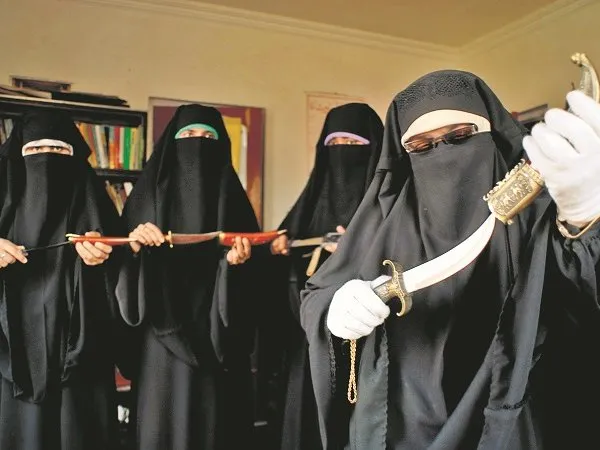
Despite the ban, in September 2005, DeM formed its ‘Maryam Squad’, an all-women vigilante unit acting as moral police.
The Squad represented a new version of religious police or the so called “Committee for the Propagation of Virtue and the Prevention of Vice”. Its membership was restricted to married women, whose identities were hidden from public. The squad declared a campaign against “immoral practices”.
DeM has provided assistance and support to terrorist organizations as well. For instance, as
reported in August 2005, Andrabi was suspected of receiving money from Pakistan’s Inter-Services Intelligence (ISI) through UK based Kashmiri expatriate Ayub Thakur and his local conduit Imtiyaz Bazaz. The money was reportedly meant for the Jamait-ul-Mujahideen terrorist outfit.
Interestingly, two of her nephews were arrested in Rawalpindi, Pakistan, in September 2013.
The Pakistan Police cited their links with the DeM ‘chief’ and claimed to have recovered a huge cache of arms and ammunition from them.
On December 27, 2015, three men from Hyderabad, Mohammad Abdulla Basith, Syed Omer Farooq Hussaini and Maaz Hasan Farooq, were arrested on charges of planning to join the Islamic State of Iraq and Syria (ISIS, also Islamic State, IS).
The three, related to the former president of the Students Islamic Movement of India (SIMI), late Syed Salahuddin, confessed to having decided to meet Andrabi, and seek her help to cross the border to enter Pakistan occupied Kashmir (PoK).
Also, in 2010, Masarat Alam Bhat, who was considered to be the main planner of stone-pelting rallies across Kashmir, was given support by the village networks of DeM operatives.
Andrabi’s husband, Ashiq Hussain Faktoo alias Dr. Muhammad Qasim also had a long association with Hizbul Mujahideen (HM) and is serving a life-term in a murder case.
Andrabi has regularly featured in Jamaat-ud-Dawa’s (JuD’s) anti-India or pro-Kashmir rallies in Pakistan through audio/video conferencing.
For example, on August 14, 2015, she greeted the people of Pakistan on their Independence Day in her telephone address to a rally held in Lahore.
Hafiz Muhammad Saeed, Amir of JuD and Lashkar-e-Toiba (LeT) was seen sitting on the stage during her speech, in which she declared:
“Following the theory of Pakistan in letter and spirit is very important for the dreamland to exist on the lines it was thought to be. Pakistan should not forget that its jugular vein is still under the military boots of India and the movement of Pakistan is incomplete until Jammu Kashmir is freed and the natural merger done.”
In a June 2017 article for JuD’s Invite magazine, Andrabi glorified Saeed as a beacon of hope for ‘oppressed Kashmiris’.
Under Andrabi’s leadership, DeM has pursued a dual strategy: first, to support militant activities with the aim of facilitating the accession of J&K to Pakistan; and second, to reshape Kashmiri society by promoting and enforcing a radical moral and social codes, directed in particular at women within the local population.
A radically motivated women’s group in the Valley, DeM enabled separatist mobilisation, resource flows, logistical coordination, and militant networking in Kashmir.
In spite of the present conviction, DeM retains the potential to leverage religious symbolism to mobilize women within Kashmir’s broader Islamist militant ecosystem.
(Sanchita Bhattacharya is a Research Fellow at the Institute for Conflict Management)