Column
By Ajay Kaul
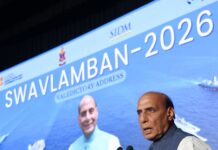
“Everything which happens on the part of any player who is not well disposed towards me, of course counts in my calculation.”
This is what External Affairs Minister S Jaishankar said when asked to comment on the recent trilateral defence agreement signed by Pakistan, Turkiye and Saudi Arabia.
“In my calculus, everything counts, everything will have a weight…and sometimes things need to play out,” he added.
Jaishankar’s comment at an event here makes it clear that India is not turning a blind eye to the deal.
In fact, it cannot afford to ignore any such act of Pakistan, considering Islamabad’s ever-continuing attempts to hurt India, in which it has found Turkiye as a willing accomplice.
Jaishankar’s remarks came amid reports that transport planes of Turkish Air Force made several sorties to Pakistan over the last week or so.
According to open source flight trackers and intelligence reports, C-130 Hercules and Airbus A-440M Atlas transport aircraft of Turkish Air Force made trips to Pakistan’s Nur Khan Airbase in Rawalpindi, Masroor Airbase in Karachi and Murid Airbase in Lahore.
It is suspected that these heavy-lift aircraft may have transported consignments of military drones and some other military hardware.
Turkish drones were used by Pakistan during the military confrontation with India in May last year.
It is believed that under the trilateral agreement signed on August 7, Pakistan might by stockpiling the Turkish drones as part of its efforts to build military capacities.
Defence Agreement
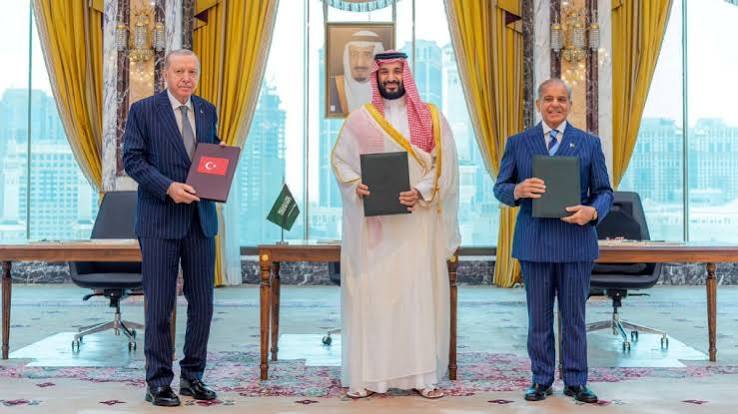
The trilateral agreement was signed in Mecca by Pakistan Prime Minister Shehbaz Sharif, Saudi Crown Prince Mohammed bin Salman and Turkish President Recep Tayyip Erdogan. It is thus being called the ‘Mecca Agreement’
A joint statement issued after signing of the agreement said the pact is based on their shared strategic interests and longstanding defence cooperation.
“The agreement is intended to strengthen collective deterrence against any act of aggression, and stipulates that any armed attack against any one of the three states shall be regarded as an attack against them all,” it said.
“It further provides for the enhancement of all aspects of defence cooperation among the three states,” the joint statement said.
The Mecca agreement marks expansion of a bilateral defence pact between Pakistan and Saudi Arabia signed in September last year.
Turkish Foreign Minister Hakan Fidan later said that the core provision of the agreement that “any armed attack against any one of the three states shall be regarded as an attack against them all” is “technically the same” as NATO’s Article 5.
The allies would determine through consultation the degree and form of assistance provided, he elaborated.
Under the agreement, the three countries will carry out military inter-operability and conduct joint exercises.
The symbolic significance of the agreement is: Pakistan is a nuclear country, Saudi Arabia is an affluent energy giant, and Türkiye is NATO’s second-largest military member country.
Will The Agreement Work?
The agreement is surely significant in the symbolic sense but it will have to be seen how much it will be, or can be, implemented in the practical terms.
It will have to be seen if the parties to the Agreement actually associate with each other in military terms in case any of them is “attacked”, as mentioned in the pact.
If the past record is considered, Pakistan has not implemented a similar agreement it signed with Saudi Arabia in September last year.
The ‘Strategic Mutual Defence Agreement’ between the two countries has a provision, similar to the trilateral agreement, that an act of aggression against one country will be considered an act of aggression against both.
It would mean that if one country is attacked, the other will come to its help militarily since it establishes a collective security framework.
However, when Saudi Arabia was repeatedly attacked by Iran since February 28 this year, Pakistan never came to its help in real sense.
Pakistan did depute around 8,000 troops, fighter aircraft (including JF-17s), drone squadrons, and an HQ-9 air defense battery to Saudi Arabia.
It was largely a symbolic exercise since it did nothing to save Saudi Arabia from the Iranian attacks that caused widespread destruction to the Gulf country’s economic and other assets.
Had Pakistan been serious to implement the spirit of its agreement with Saudi Arabia, it should have carried out counter-attacks on Iran on behalf of its pact-partner. But it did not do anything like that, leaving Saudi Arabia to fend for itself.
So, Pakistan has already failed in the test of fulfilling its commitment made to Saudi Arabia in a written agreement. How then can Saudi Arabia trust Pakistan?
Similarly, can Pakistan count on Saudi Arabia for military help in case of a war with India?
Saudi Arabia has excellent all-round relations with India. Its economic and commercial engagement with India is growing rapidly at a massive scale. Will it spoil that by associating militarily with Pakistan if the latter has a military confrontation with India?
It is hugely unlikely, particularly since Saudi Arabia has nothing to gain from Pakistan, while the friendly relationship with India has massive benefits for it.
Previously, Saudi Arabia would get swayed by the religious angle given by Pakistan, but lately that factor is not working.
Saudi Arabia has already demonstrated that it will no more take an adversarial position towards India, much to the chagrin of Pakistan.
In August 2019, when the applicability of Article 370 in Jammu and Kashmir was abolished, Pakistan desperately pleaded for urgent convening of the meeting of Organisation of Islamic Cooperation (OIC), a grouping of 57 Muslim countries.
Pakistan wanted OIC to condemn India’s action. However, Saudi Arabia, which was the Chair of the grouping at that time, stonewalled the pleas of Pakistan, leaving it angry and hugely disappointed.
Pakistan even threatened to exit OIC and form a separate grouping of Islamic countries. But it never carried out the empty threat and had to eat the humble pie.
As regards Türkiye, it is also unlikely to openly associate with Pakistan against India, considering the stature and importance of the latter at the global level.
However, possibly, it will clandestinely help Pakistan militarily, like supplying drones and other hardware.
The two countries have already announced plans for cooperating in the area of defence technologies.
But, be as it may, it is highly unlikely that the trilateral agreement will result in any serious military threat to India, in practical terms.
But India will definitely keep a close watch on how the agreement plays out in the coming times.