By Ajay Kaul
New Delhi, Sept 16 (NVI) As the Islamic Holy city of Mecca faced security threat for the first time ever, it has put a huge question mark on the utility of Saudi Arabia’s much-touted defence pact with Pakistan and the latter’s intentions to implement it.
Saudi Arabia said the city of Mecca was targeted by a drone fired by the Houthi militia of Yemen on Tuesday evening and it was intercepted, averting any damage.
“The Royal Saudi Air Defense Forces intercepted and destroyed a hostile drone launched by the Terrorist Houthi Militia before it entered the prohibited airspace of the Holy City of ‘Makkah Al-Mukarramah’,” Saudi coalition spokesperson Turki al-Malki posted on X.
The security alerts were sounded not only in Mecca but various other parts of Saudi Arabia, including Jeddah and Taif regions.
Saudi Arabia has lately faced increased aerial attacks from the Houth militia in response to the military air strikes by the Saudi forces.
Mecca Agreement Useless?
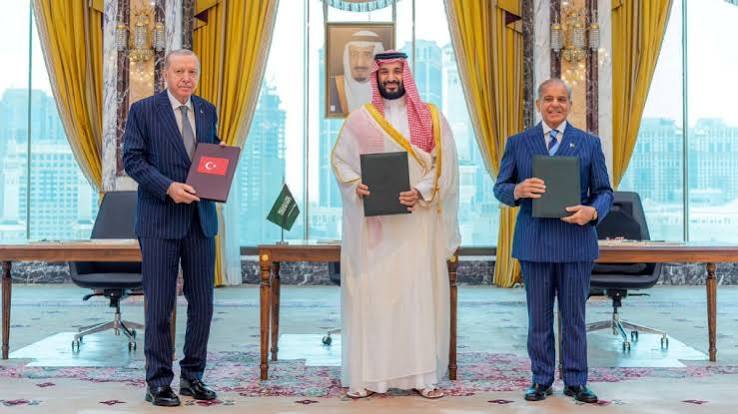
These attacks have put under scrutiny a trilateral mutual defence pact signed by Saudi Arabia, Pakistan and Turkiye on August 7.
The agreement was signed in Mecca by Pakistan Prime Minister Shehbaz Sharif, Saudi Crown Prince Mohammed bin Salman and Turkish President Recep Tayyip Erdogan. It is thus called the ‘Mecca Agreement’.
In fact, this trilateral pact was an add-on to an already existing bilateral agreement between Saudi Arabia and Pakistan, with the same provisions, which stipulate that “any armed attack against any one of the three states shall be regarded as an attack against them all.”
However, even as Saudi Arabia has been suffering repeated attacks for days now, Pakistan has not joined it either in defence or in counter-offensive against the Houthis.
Pakistan has clearly been shying away from implementing its commitments made to Saudi Arabia under the Mecca Pact. Perhaps, it is scared of inviting the wrath of Iran which is supporting the Houthis.
A week ago, even after Houthis carried out a barrage of attacks on Saudi Arabia, Pakistan’s Defence Minister Khawaja Asif said any attack on the Kingdom could activate the Mecca agreement.
“If there is unprovoked aggression, or a spillover of whatever is happening in Yemen into Saudi Arabia, definitely the Mecca agreement will become operational,” he told Geo News TV channel of Pakistan on September 9.
“There should be no doubt about that. We are bound by the terms and conditions of this pact, and … we will honour them in case there is a need,” he added.
Despite that assurance, Pakistan is yet to come to the defence of Saudi Arabia, at least openly.
Today, Pakistan Military spokesperson Lieutenant General Ahmed Sharif Chaudhry, during an interview to Al Arabia, was asked about his country’s position in the wake of repeated attacks on Saudi Arabia over the last week or so.
He evaded a direct reply and merely said that Pakistan, Saudi Arabia and Turkiye will decide “how to operationalize” their defence commitments under the trilateral agreement.
“It is defensive, as the word also implies…. It is a collective deterrence,” he said.
Pakistan’s Foreign Office, a few days back, said the possibility of Pakistani forces striking Houthi targets inside Yemen was only a “hypothetical” situation.
Lip Service
After the Mecca incident, Pakistan’s Prime Minister Shehbaz Sharif did offer the customary lip service through social media.
Pakistan, Sharif said, “condemns in the strongest possible terms the dastardly and heinous attempted drone attack against the Holy Site of Makkah Al-Mukarramah.”
He added, “Pakistan stands unwaveringly, shoulder to shoulder with the brotherly Kingdom of Saudi Arabia, in the defence of its sovereignty, and territorial integrity, as well as for the security and sanctity of the Haramain Sharifain – a duty that every Pakistani carries close to their heart.”
The military fight between Saudi Arabia and Iran-backed Houthi militia has put Pakistan to a severe test in terms of its commitments.
If Pakistan joins Saudi Arabia, it will mean becoming a target for the Houthi militia and spoiling relations with Iran.
In any case, Pakistan is known for not keeping its commitments and Saudi Arabia is realizing it the hard way. (NVI)