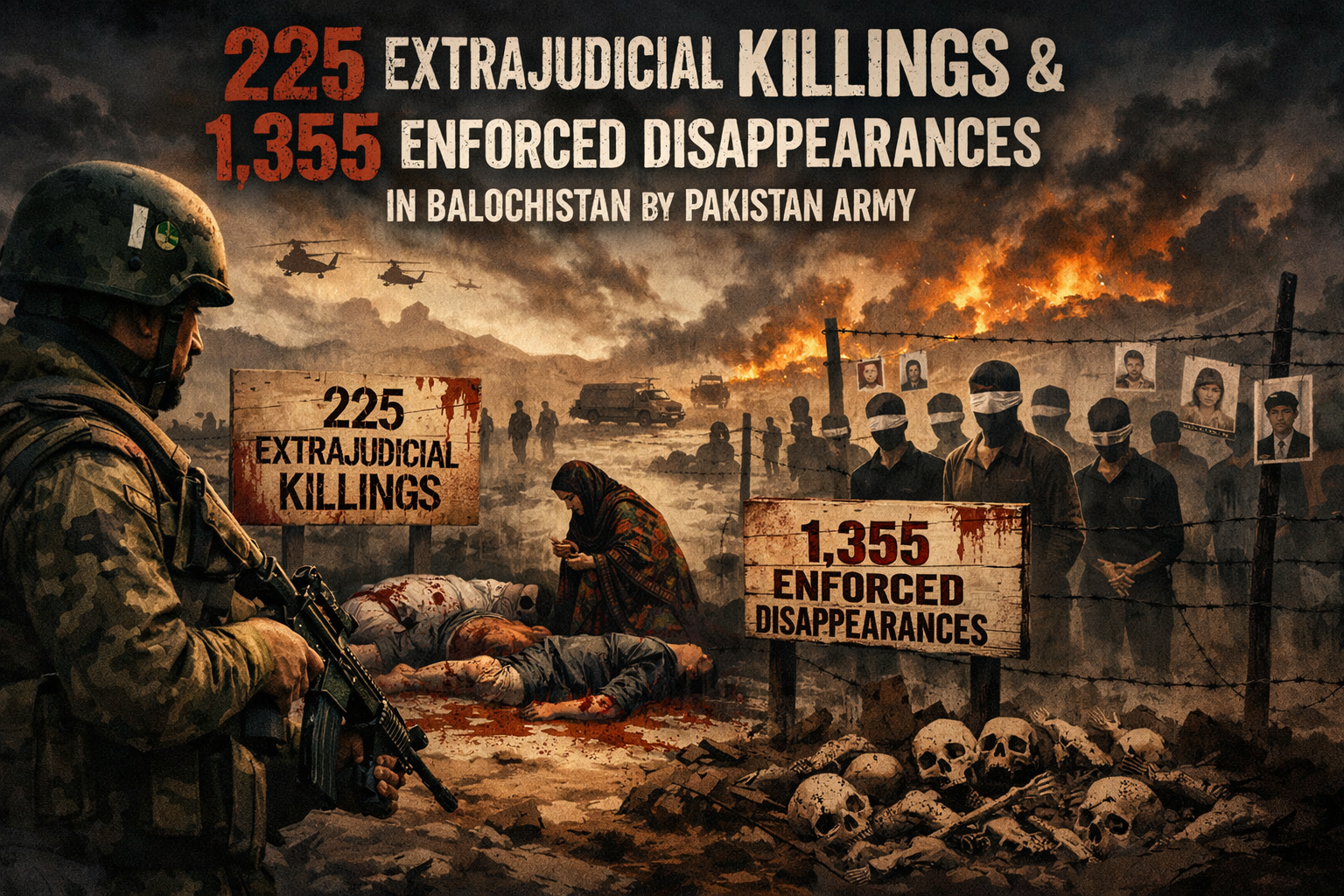
Quetta, Feb 11 (NVI) Pakistani military and affiliated agencies killed 225 Baloch people in an extra-judicial manner and abducted 1,355 others in Balochistan during the last year, according to a human rights body.
In its detailed annual report, it notes that Pakistan Army, intelligence agencies, and the paramilitary force Frontier Corps (FC) have been systematically targeting students, activists, and local intellectuals, as a deliberate strategy to dismantle the cream of the Baloch nation.
Drone strikes, helicopter gunship operations, and a ‘kill-and-dump’ policy have become routine, while anti-terrorism laws and the Maintenance of Public Order Ordinance (MPO) have been used to criminalize peaceful civic movements such as the Baloch Yakjehti Committee (BYC), says the report by Paank, the human rights organisation of Baloch National Movement (BNM).
“These widespread human rights violations represent a clear state policy of collective punishment against the Baloch nation,” it says.
Paank’s report highlights the intensification of Pakistani repression against the people of occupied Balochistan.
According to the report, the Pakistan Army has not limited itself to traditional, low-intensity actions but has deployed full-scale military force against civilians, including aerial attacks.
“The first half of 2025 saw the highest number of enforced disappearances, with 785 cases, reflecting state policies aimed at suppressing growing peaceful political activity and crushing leadership,” says Paank.
In the later months, the number of disappearances declined, but extrajudicial killings increased.
It says 407 forcibly disappeared individuals were released after detention in torture cells, with many suffering severe physical and psychological trauma, demonstrating the use of state terror.
The report records key incidents, including a drone attack in Buleda on 29 October, where four young people celebrating a picnic were killed despite having military permits; an aerial bombardment in Zehri on 17 September, which killed three civilians and injured a child; and an attack at Chiltan hills on 28 October, in which several teenage youths were seriously injured.
“These incidents constitute repeated violations of international human rights law,” Paank underlines.
The report highlights the extensive misuse of law and state terrorism as a tactic to silence dissent.
Prominent BYC activists, including Dr. Mahrang Baloch, Sabghatullah, Bibgar, Bibo, and Gulzadi, were arbitrarily detained under the MPO and Anti-Terrorism Act, often exceeding the 90-day legal limit of the MPO.
Thirty-two activists were placed under the Fourth Schedule of the Anti-Terrorism Act, restricting their freedom of movement.
“Pakistan accelerated measures to curtail civil rights, including blocking ID cards, suspending SIM cards, restricting travel, and freezing bank accounts,” the report highlights.
Paank urged the international community to recognize that despite abundant resources, the local population of Balochistan faces the greatest deprivation.
“Projects such as Reko Diq, Sandak, and Gwadar Port exploit Baloch resources, while locals demanding basic rights are crushed through military pressure and atrocities,” the human rights organisation says.
“The European Union’s GSP Plus monitoring mission in 2025 expressed concern over enforced disappearances, freedom of expression, and misuse of the Anti-Terrorism Act, confirming the deteriorating human rights situation in Balochistan,” it says.
The report calls for the end of enforced disappearances, halting extrajudicial killings, stopping aerial attacks on civilians, repealing oppressive laws, and releasing political prisoners.
It observes that without international intervention, human rights violations in Balochistan will continue, setting a dangerous precedent for authoritarian regimes worldwide. (NVI)