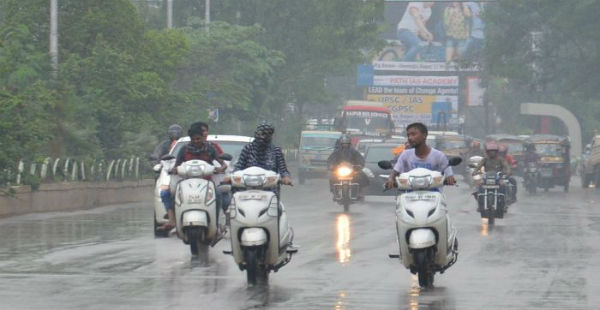
New Delhi, May 30: In a piece of bad news, the India Meteorological Department (IMD) has revised its Monsoon rainfall forecast downward to 90% from 92% of the Long-Period Average (LPA) and predicted a 60% probability to a deficient season.
If the forecast proves correct, the total rainfall during the Monsoon season, which is about to begin, may fall much below the threshold.
The Government weather forecaster said the below-normal rainfall could lead to challenges for agriculture, water availability, hydropower generation and ecosystem sustainability.
There is increased risk of drought, heat stress and pressure on drinking water resources.
The LPA for the June-to-September season, calculated over the 1971–2020 period, is 87cm and if the prediction proves correct, this would mean the lowest Monsoon season rainfall in 11 years.
The new forecast, which revises the one made in April, carries a model error of ±4%.
IMD also assigned a 24% chance of a below-normal monsoon (90–95% of LPA), 14% for normal (96–104%), 2% for above-normal, and zero for excess. Combined, there is an 84% probability of below-normal rainfall or worse.
The Monsoon season generally begins around June 2 every year and immense expectations are attached to the rainfall during this period, particularly in respect of the Agriculture sector.
NorthWest India
The sharpest deficit is forecast for Northwest India at below 92% of LPA.
The Monsoon Core Zone — the belt of rainfed agriculture across central India — is also forecast at below 94% of LPA.
Central and south Peninsular India face a similar below-normal outcome. Northeast India alone is forecast at normal (94–106% of LPA).
Timetable
The onset itself is now in doubt. IMD had forecast on May 15 that the monsoon would arrive over Kerala on May 26, six days ahead of the June 1 normal date.
That timeline has been pushed back: IMD’s extended range forecast now shows largely dry conditions over Kerala between May 28 and June 4, with only a marginal improvement between June 4 and June 11.
June will be hotter than previously estimated.
Rainfall is expected to pick up only after June 11.
IMD has forecast above-normal heatwave days over many parts of Uttar Pradesh, Haryana, Punjab, Bihar, Odisha, Chhattisgarh, Gujarat and Andhra Pradesh, and over isolated regions of Maharashtra, Telangana, Himachal Pradesh and Tamil Nadu.
Some of these regions are expected to record around five to six heatwave days in June against a normal of three.
“Normally 3 heat wave days are expected in these regions. But we are expecting 2-3 additional heat wave days in June,” said M Mohapatra, Director General of IMD.
Below-normal heatwave days are expected in Rajasthan and Jharkhand.
Reasons
The downward revision is being attributed to two adverse climatic developments since the April forecast and El Niño is one of those. It is expected to arrive earlier and hit harder than previously assessed.
The Met Department said El Niño conditions are likely to evolve into moderate category through the monsoon season, and strong category post-monsoon.
The second significant factor is the disappearance of the IOD (Indian Ocean Dipole) buffer.
The IOD, in a positive phase, can partially offset El Niño’s suppressive effect on the Monsoon by warming the western Indian Ocean and drawing moisture towards India.
Currently, it is in a neutral state and is likely to remain so through the season, IMD said.
This removes a mitigating factor that had earlier offered some comfort.
Nearly half of India’s net-sown area lacks irrigation access, and the Monsoon replenishes 91 natural reservoirs that supply power generation, industry and drinking water.
The season arrives as cultivators already face a potential shortfall in fertiliser supplies caused by the war in West Asia.
The earlier assumption that rainfall in June would be relatively unaffected has also been overturned.
IMD now projects below-normal rainfall for the country as a whole in June, at below 92% of LPA — a significant shift from the April picture.
Below-normal monthly rainfall is very likely over most parts of the country, except parts of Northwest India, Northeast India, the southern Peninsula and isolated pockets of central India.