Column
By Ajay Kaul
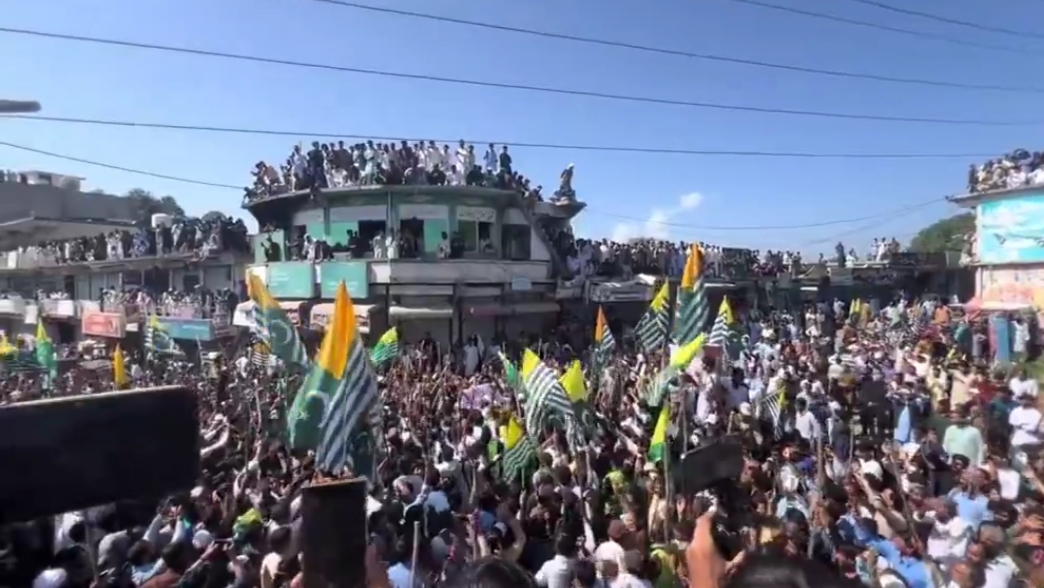
For the last 78 days, Pakistan-occupied Jammu and Kashmir (POJK) has been witnessing a massive agitation against Pakistan and its oppression and there are no signs of it ending anytime soon.
After 78 years, people of the occupied region have finally found voice, and a very powerful one, to challenge the Pakistani regime which has been illegally holding these territories since 1947.
For all these decades, people of POJK, generally called ‘Kashmiris’, have remained subdued because of the fear of the Pakistani repression. In fact, due to this fear of reprisal, many of these Kashmiris have been declaring their support for Pakistan, and even claiming to be Pakistanis. It is all because of the duress.
But that fear has vanished now and it has been loudly demonstrated by Kashmiris through their relentless mass agitation since June 5 despite extreme forms of repression by the Pakistani forces which have killed 100 people and injured hundreds of others injured, including infants and women.
The Pakistani forces have been firing directly at people participating in peaceful protests at multiple places in POJK, with Rawalakot being the worst hit.
Even devotees going for ‘Namaz’ have not been spared, neither have been ambulances.
Womenfolk have been attacked and molested inside their homes by the brutal Pakistani forces.
Pakistan also imposed an economic blockade, halting supplies of even food grains, medicines and other essential items to the landlocked POJK.
Thousands of leaders and protesters have been illegally detained, with the whereabouts of many of them not known.
The monstrous Pakistani forces have attacked even hospitals and clinics, seizing and disappearing bodies of those killed by them in firing. Several medical centres have been shut by them to deny treatment to the injured people.
Despite all these acts of repression by Pakistan, the agitation continues, with the masses, under the leadership of Joint Awami Action Committee (JAAC) pledging not to back down “till the last man is alive”.
JAAC is a conglomerate of several non-political organizations of POJK, which launched the agitation demanding end to interference by Pakistan in political and other matters related to the region.
Repeat of 1947
The kind of repression being undertaken by Pakistan in POJK is reminiscent of the crimes it committed in 1947 when it launched a military invasion on the region on October 22 that year.
The region was a part of princely state of Jammu and Kashmir under the rule of Maharaja Hari Singh.
During the partition of India, all princely states had a choice of joining either the Indian dominion or newly-created Pakistan.
Hari Singh was undecided and wanted more time to think.
So, he proposed, on August 12, 1947, a ‘Standstill Agreement’ with both India and Pakistan, which entailed maintaining of status quo while a final decision was taken about the political future of the state.
There was provision for trade, travel, and postal services.
Three days later, Pakistan accepted the proposal and conveyed its acceptance to Hari Singh in writing (through a Telegram).
India, on the other hand, wanted discussions on the proposal.
However, Pakistan soon after, stopped supplies of essential items like food and fuel to Jammu and Kashmir, snapping the traditional practices.
This was seen as an arm-twisting tactic to force Hari Singh to join Pakistan.
As the Maharaja did not budge, Pakistan launched an invasion on the state on October 22, 1947 to capture it militarily.
What followed in the subsequent days was similar to the events that have been taking place in POJK over the last 78 days.
Like now, Pakistani forces indulged in rampant killings and torture of the people of the region to subjugate them. The Pakistani invaders committed massacres after they entered the territory of Jammu and Kashmir and moved towards Srinagar.
The state had very weak defence forces in the shape of Maharaja’s militia, which were not able to counter the onslaught.
In view of this, the Maharaja requested for help from the Indian government, which told him it won’t be possible until the state acceded to the Indian dominion.
So, the ‘Instrument of Accession’ was signed on October 26.
The very next morning, Indian troops started arriving in Srinagar and launched an operation to drive out the Pakistani forces.
But while the Indian forces were still in the process of driving out Pakistani invaders, the UN Security Council (UNSC) ordered a ceasefire, thus, dividing Jammu and Kashmir.
As a result, Pakistan retained control over certain areas of Jammu and Kashmir and Gilgit-Baltistan and kept the people of the region subjugated by force.
For 78 years, it managed to keep the region quiet under duress.
The forces who indulged in those acts of oppression in 1947 are the same ones doing it now.
But now, the people of POJK are not ready to accept the shackles anymore and want an end to the Pakistani rule.
The protest rallies and demonstrations, each day, resonate with slogans like “Kashmir is not Pakistan”, “We don’t want Pakistan here” and “We want to choose our own destiny”.
The leaders at these rallies underline that “victory and peace against a hostile state are acquired not by begging, but through hard strength and real resistance.”
People of POJK say that “the success of this movement will be possible only if we continue to resist and move forward until the point where the Pakistani state capitulates and feels it is unviable to for them to continue here.”
They emphasise that Pakistan will succumb only through force and presence on the ground.
“This war must be fought with a ‘Karbala-like’ offensive with ‘do-or-die’ approach,” said a local leader of POJK.
So, clearly, the people of the occupied region have made up their minds, and firmly, to break free from continued oppression, injustice and exploitation.
Even if the current agitation on the roads and streets ceases after some time, the fire of dissent and rebellion that has been ignited in the hearts of the locals in POJK by the worst kind of brutalities unleashed by the Pakistani forces will not die down.
The die has been cast.