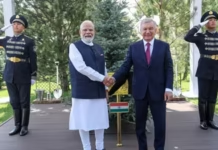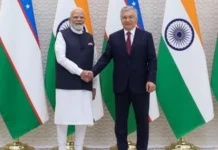
New Delhi, Aug 30 (NVI) In a boost to their bilateral ties, India and Uzbekistan today elevated their relationship to the level of Comprehensive Strategic Partnership, encompassing longe-term cooperation in nuclear field and expansion in the areas of trade and commerce.
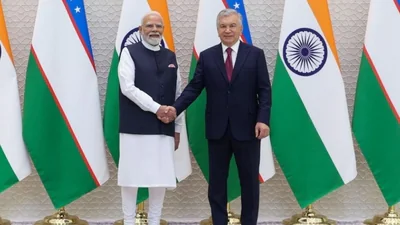
At a meeting between Prime Minister Narendra Modi and Uzbekistan President Shavkat Mirziyoyev in Tashkent, the two nations set a target of $5 billion in annual trade by 2030.
“Uzbekistan is at the heart of Central Asia and is at the heart of India’s engagement in the region,” PM Modi said at the meeting with Mirziyoyev.
“A stronger India-Uzbekistan partnership will be a powerful force for peace, progress and prosperity in Central Asia,” he added.
PM Modi shared the key outcomes of the meeting with President Mirziyoyev in Tashkent in a post on X (formerly Twitter).
“Elevation of India-Uzbekistan relations to a Comprehensive Strategic Partnership. Boost trade to over 5 billion dollars by 2030. Increase cooperation in infrastructure, DPI, AI, critical minerals, energy, space and more. Enhance market access, connectivity, banking and payments,” the PM posted.
India and Uzbekistan set a bilateral trade target of $5 billion annually by 2030, up from the present of over $1 billion.
Speaking about trade and investment, the Prime Minister said that matters including market access, connectivity, banking, and payment systems will be addressed in a structured manner.
The discussions between the two leaders focused on trade, investment, infrastructure, digital public infrastructure (including UPI), information technology, critical minerals, defence and security, education, pharmaceuticals, and agriculture.
The two nations agreed to establish a framework for long-term supply of uranium from Uzbekistan to India in line with cooperation in the civil-nuclear energy sector.
After the meeting, Secretary (West) in the Ministry of External Affairs Sibi George told media persons that the two nations are close to signing an agreement.
“Positive discussions have happened on a long-term arrangement for the supply of uranium to India. We are close to signing an agreement very shortly,” George said.
“The level of bilateral ties between the two countries has been raised to a Comprehensive Strategic Partnership, which includes a Foreign Minister-level Coordination Group and raising the level of the Joint Commission Meeting, or the Intergovernmental Commission, from the Secretary level to the Ministerial level,” the official said.
“The close defence and security cooperation between our two countries reflects our deep mutual trust. In the future, we will promote direct linkages, co-production, and co-development between our defence industries,” PM Modi said.
“We believe that terrorism, extremism, and separatism pose serious challenges to the entire region,” he emphasised.
“Maintaining a policy of zero tolerance against these threats has been, and will continue to be, our shared resolve,” the prime minister added.
The leaders announced the elevation of strategic ties to a Comprehensive Strategic Partnership to reflect the expanding scope and depth of bilateral cooperation.
“We will establish a Coordination Council at the level of foreign ministers to provide direction to all aspects of our cooperation through close coordination,” PM Modi also said.
Furthermore, he said that both sides will also elevate their existing joint commission from the level of secretaries to the ministerial level.
The two nations will also organise a bilateral business summit featuring industry leaders from both sides.
“Both sides will jointly organise a business summit featuring business leaders from both nations,” he continued.
Modi landed in Tashkent yesterday morning on a two-day visit.