
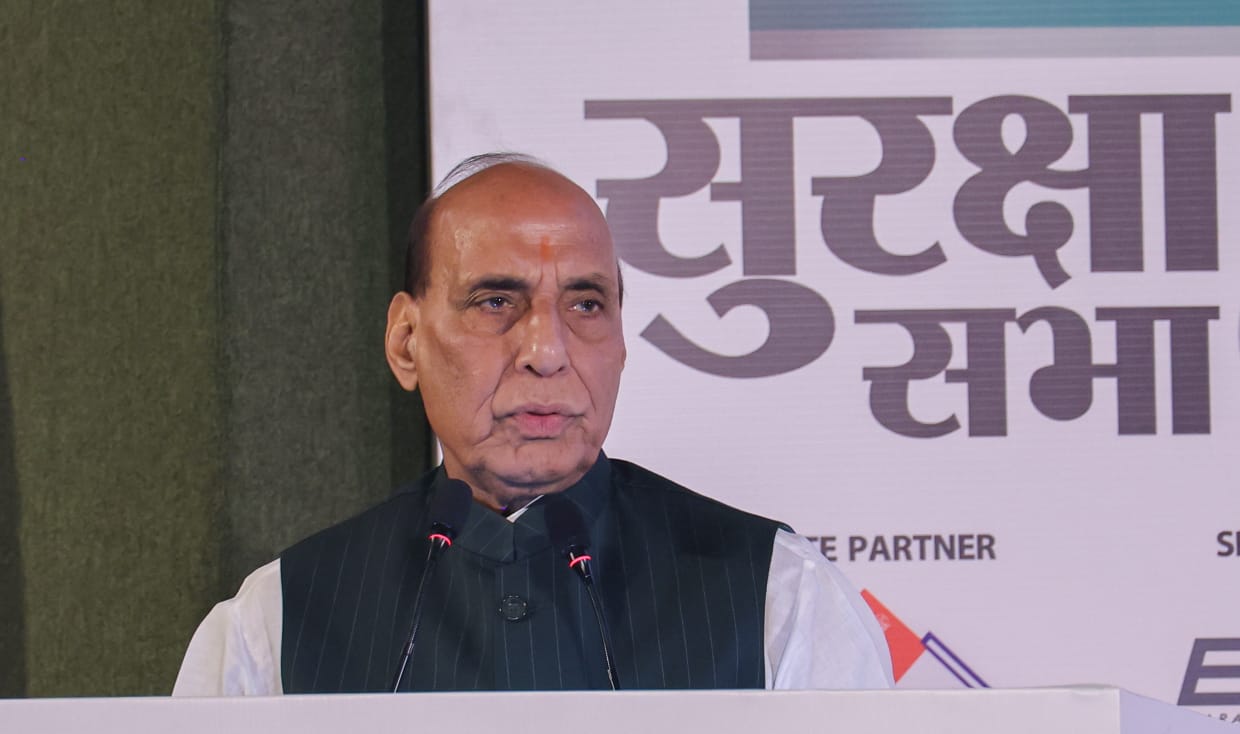
New Delhi, Sept 7 (NVI): Defence Minister Rajnath Singh on Monday said the armed forces have been given both the freedom and resources to respond decisively to threats, including by striking adversaries inside their own territory.
Addressing an event in New Delhi, Singh said India believes in peace but there is a clear distinction between peace and weakness, asserting that terrorism against the country will be met with a befitting response.
He said the government under Prime Minister Narendra Modi has foiled attempts by adversaries to undermine India’s security by misleading youth in Jammu and Kashmir, funding anti-India activities, spreading violence and terrorism and creating divisions in society.
The defence minister said efforts to bring misguided youth into the mainstream, along with rehabilitation, de-radicalisation and creation of employment opportunities, have helped counter such designs.
Singh said Jammu and Kashmir has witnessed “unprecedented progress” since the abrogation of Article 370, with new opportunities opening up for the youth.
He highlighted India’s military response to terrorism, including the surgical strikes, Balakot airstrike and Operation Sindoor, saying these operations targeted terrorists and their handlers.
“The suspension of the Indus Waters Treaty sent a clear message that blood and water cannot flow together,” he said.
Singh asserted that India does not desire war or seek to occupy the territory of any country, but stressed that terrorism sponsored against India would invite a strong response.
“We’ve made it clear that if any country promotes terrorism against India, there will be no dialogue; instead, our defence forces will deliver a befitting response,” he said.
On the changing nature of warfare, Singh said space and cyberspace have emerged as new domains of conflict alongside land, air and sea. Artificial intelligence, drones, autonomous systems and precision weapons are transforming modern battlefields, he added.
The government is working to make India’s defence strategy and security apparatus future-ready, with a focus on developing advanced technologies indigenously, Singh said.
He said India’s defence policy has moved from a reactive approach to a proactive one, citing India’s entry into the Missile Technology Control Regime in 2016 as an important development that facilitated efforts to extend the range of the BrahMos missile.
Singh also highlighted the transformation of India’s defence manufacturing sector, saying defence production has increased from around Rs 40,000 crore before 2014 to approximately Rs 1.80 lakh crore, while defence exports have grown to over Rs 38,000 crore.
He said India has reduced its dependence on imports and is focusing on indigenous defence manufacturing under the Aatmanirbhar Bharat initiative.
The minister cited systems and platforms such as Akashteer, Akash, Pinaka, Astra, Prachand, Dhruv, Tejas, Arjun and indigenous drone and counter-drone systems as examples of India’s growing defence capabilities.
He also pointed to the induction of India’s first indigenous aircraft carrier, INS Vikrant, and said the country is pursuing the development of sixth-generation fighter aircraft.
India aims to achieve defence exports worth Rs 50,000 crore by 2029, he said.
Singh said all 16 Defence Public Sector Undertakings are now operating without losses and are increasing investments in research and development while exploring new export opportunities.
He said India’s defence budget has risen from around Rs 2.5 lakh crore 12 years ago to approximately Rs 8 lakh crore, with the funds being utilised to strengthen national security with transparency and accountability.
Linking economic strength with national security, Singh said a strong economy is essential for developing modern military capabilities and maintaining strategic autonomy.
Despite global economic uncertainties, India is moving ahead with a growth rate of 7.8 per cent while strengthening supply chains, promoting self-reliance in critical sectors and expanding indigenous manufacturing, he said.
“Amidst geopolitical uncertainties, many nations are being compelled to choose sides or are forced to align with specific blocs. However, India is moving forward with independent agency and strategic autonomy by focusing on its own priorities, which is why, today, when we speak, the world listens,” Singh said.
He said more than 16,000 MSMEs are currently involved in the defence sector, while investment proposals worth around Rs 70,000 crore have been received for the defence industrial corridors in Uttar Pradesh and Tamil Nadu.
The minister said defence start-ups have increased from a few dozen in 2018 to more than 2,000, with initiatives such as iDEX and iDEX-Prime promoting innovation.
Calling upon the youth to become job creators and innovators, Singh assured them of the Ministry of Defence’s support for promising ideas.
He also lauded DRDO’s efforts to bring industry, academia, start-ups and scientists together to strengthen self-reliance in defence.
Singh described the successful testing of a scramjet combustor in May as an important step towards the development of hypersonic missile technology.
He said the government’s decision to transfer DRDO-developed missile technologies to Indian industry would enable private companies to manufacture such systems and ensure their timely availability to the armed forces.
The defence minister said the government’s objective is to achieve Aatmanirbharta in defence and build an ecosystem that strengthens national security, drives economic growth and enhances India’s role in the global security architecture.
He expressed confidence that by 2047, India would not only achieve the goal of Viksit Bharat but also emerge as a global leader in technology, economy and defence.—(NVI)