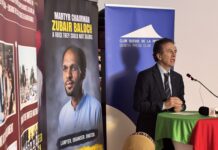
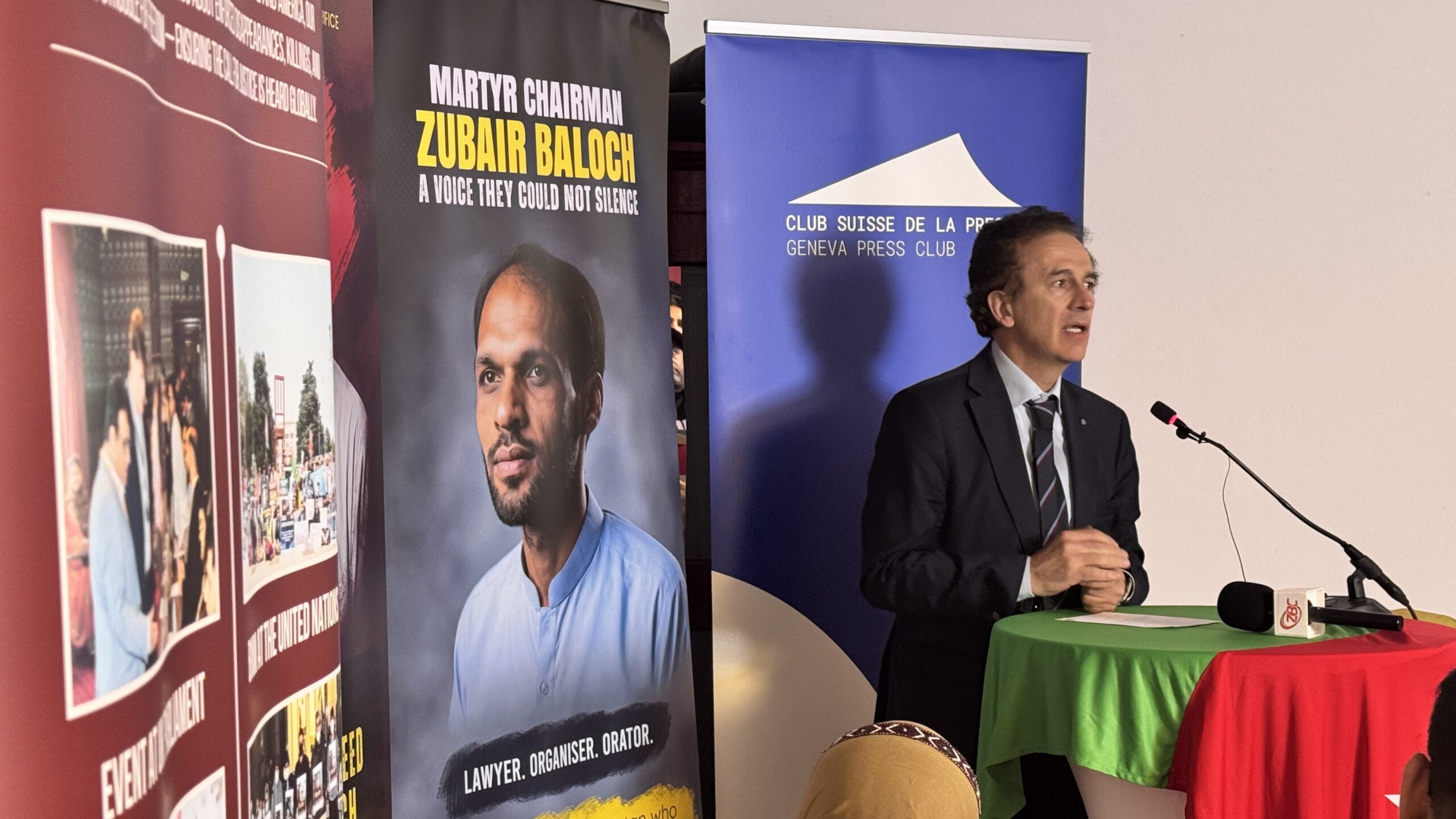
Geneva, Sept 26: Antonio Stango, president of the Italian Federation for Human Rights (FIDU), has recognised that tens of thousands of people in Balochistan have been forcibly disappeared and thousands have been killed by the Pakistani forces and urged the international bodies to act.
In recent years, there have been hundreds of enforced disappearances in Balochistan, he said, addressing the Baloch National Movement’s (BNM) 12th Balochistan International Conference in Geneva.
Stango, who is professor of international organisations and human rights at Rome Link Campus University, noted that millions of people in Balochistan live in misery, even though their historical land is rich in natural resources.
He said the gap between the theory of international human rights and the reality of their violation is widening, and that peoples whose collective rights are taken from them still too often do not get access to United Nations rooms.
He added that he had spent most of his life working on this subject as a civil-society expert and had not remained confined only to academic circles.
He said that on the one hand we should study the theory of international human rights thoroughly, and on the other we should look at what the reality is. More and more often the reality of respect for human rights or rather, the reality of human-rights violations is very far from the theory.
He said this is true for individuals and for peoples as well. Most of you have been victims of specific violations of the rights of the Baloch nation.
He pointed to those provisions that on paper protect the rights of groups who share a language, history, religion or other ethnic features, including Article 27 of the International Covenant on Civil and Political Rights. He said states have begun to forget these articles.
He said that in Europe history has mostly been understood as the history of Western empires. Some speakers mentioned Pakistani imperialism. This is something we in Europe do not know. People read only a few headlines. They open television and social media and see titles and slogans, which do not go deep into the major problems of our planet.
He said when it is a matter of millions of people whose collective rights have been systematically violated for decades, I believe this should be a concern not only for those directly affected, but for all of us.
He said human rights are universal and belong to every person from birth. Authoritarian governments of different political types reply that rights are universal, but that they should be applied in a “regional or relative” way. In his view, relativism is a major danger to respect for human rights.
He said engagement with the UN system is both necessary and difficult.
“It is no coincidence that the meeting is being held at the Geneva Press Club, not in the nearby United Nations conference hall. I suspect some governments would oppose holding such a meeting there,” the activist said.
Recalling the organisation of UN side events for non-governmental organisations, he said that when representatives of peoples whose collective rights have been violated are invited, official representatives ask why they are in the room. They are terrorists. They should be imprisoned; they should not be allowed to speak at a UN forum.
He said there is a diplomatic confrontation with the UN system, even though that system in theory at least allows every voice to be heard and should give every people the chance to speak about their conditions.
He said he fully agreed with the point put to the conference: there is no lasting peace without justice; there is no reconciliation without trust.
He said we all share this need and this strong hope that there will be peace in your country as well, as in other parts of the world. But we know there can be no peace without justice.
He said that about thirty years ago he was part of the movement that helped create the International Criminal Court in The Hague. One organisation in that movement was called No Peace Without Justice. It still exists, and work still remains.
He said more states are leaving that court because governments fear being judged. In his view the court does not decide on a political basis. It hears only the gravest international crimes: genocide, crimes against humanity, war crimes and, in some cases, aggression. States should not be afraid of standing before international justice.
He also mentioned the theoretical possibility that a person can be tried for crimes against humanity even in a state of which he or she is not a citizen. He said: “International justice must work. A great deal remains to be done to reach effective international justice.”
Restating his commitment, he said FIDU and the Italian Helsinki Committee want close cooperation between civil society, international organisations and national liberation movements, however difficult that may be.