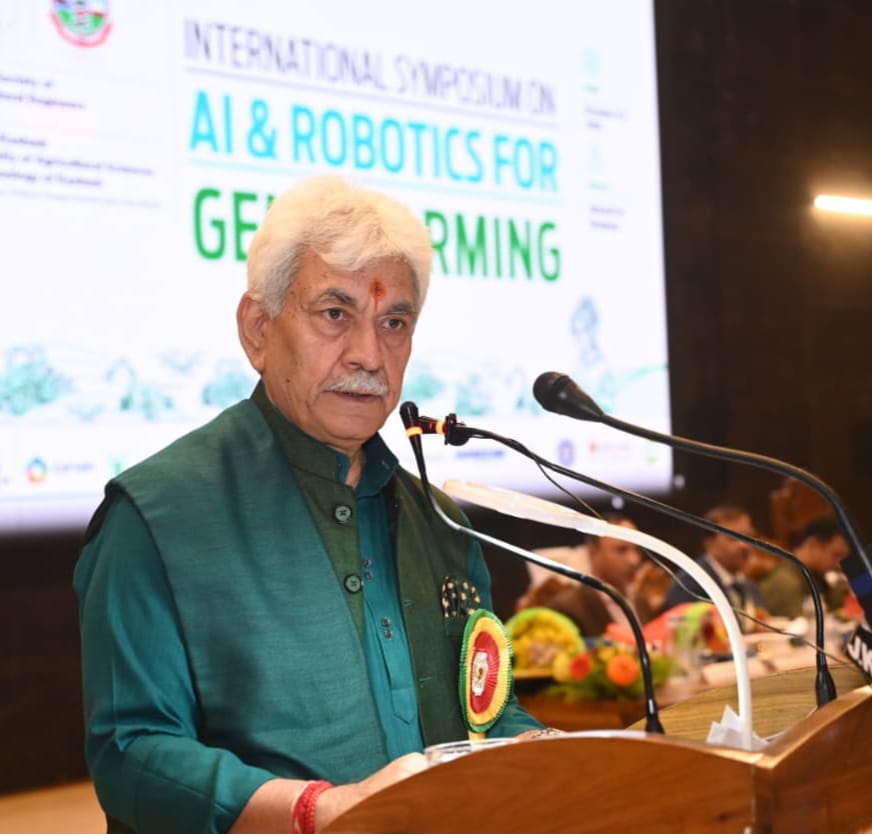
Srinagar, Oct 5 (NVI): Jammu and Kashmir Lieutenant Governor Manoj Sinha on Monday urged agricultural engineers and innovators to develop technologies that can withstand real field conditions and remain affordable and accessible to small and marginal farmers.
Addressing the 60th Annual Convention of the Indian Society of Agricultural Engineers (ISAE), co-hosted by Sher-e-Kashmir University of Agricultural Sciences and Technology (SKUAST), Kashmir, Sinha said the success of agricultural technology should not be measured merely by patents or research publications but by its long-term impact on farmers.
“Create technology that can endure in real fields, under real monsoon conditions, and within the limited budgets of real farmers. Do not measure your success solely by patents or published research papers. Measure it by whether, five years later, a small farmer in Anantnag, Amritsar or Akola is genuinely better off because of your tools,” he said.
Congratulating the ISAE on completing six decades of service to the nation, the LG said Jammu and Kashmir, with its rich agricultural heritage and challenging terrain, was an appropriate venue for deliberations on smart farming, artificial intelligence and robotics.
Reflecting on the evolution of agricultural engineering since the society’s inception in 1960, Sinha recalled the contribution of scientists and engineers to the Green Revolution through mechanisation and innovations that helped reduce post-harvest losses.
He called upon the younger generation to draw inspiration from these achievements while addressing emerging challenges such as climate change, resource scarcity and sustainable farming.
The LG also stressed the need to empower women innovators and ensure greater participation of women in agricultural technology.
Citing the significant contribution of rural women to farming and allied activities, he called upon institutions and private-sector stakeholders to support women-led start-ups and establish laboratories, fellowships and incubation platforms for young women engineers and scientists, particularly those from rural areas.
“Women-led start-ups in agricultural technology should receive financing with the same confidence with which any other start-up is provided the necessary support and facilities,” Sinha said.
He said engineering colleges and agricultural universities should actively nurture women innovators and help them progress towards positions of technological leadership.
On artificial intelligence and robotics, the LG said such technologies must be developed with affordability and accessibility at their core so that innovations do not remain confined to large landholding farmers.
He said nearly 86 per cent of India’s farming community comprises small and marginal farmers and called for developing tools that can operate on ordinary smartphones even in low-bandwidth rural areas.
Sinha also advocated collective ownership and leasing models through Farmer Producer Organisations (FPOs) to make advanced agricultural technologies accessible to farming communities.
Citing drones, Internet of Things-based sensors and machine-learning models as examples of technologies transforming agriculture, he urged innovators to focus on practical solutions rather than technologies designed merely to impress at conferences.
The LG said Jammu and Kashmir’s Holistic Agriculture Development Programme (HADP) could serve as a replicable model for other states and expressed confidence that agricultural scientists and engineers from across the country would draw lessons from the Union Territory’s experience in precision agriculture and sustainable resource management.
Sinha also felicitated recipients of ISAE awards during the event.
Agriculture Production, Rural Development and Panchayati Raj Minister Javid Ahmad Dar, Additional Chief Secretary Agriculture Production Ashish Chandra Verma, SKUAST-K Vice Chancellor Nazir Ahmad Ganai, ISAE president S N Jha, Texas A&M University’s V P Singh, ISAE Secretary General P K Sahoo and other researchers, academicians, technocrats, innovators, industry representatives, faculty members and students attended the convention.—(NVI)