
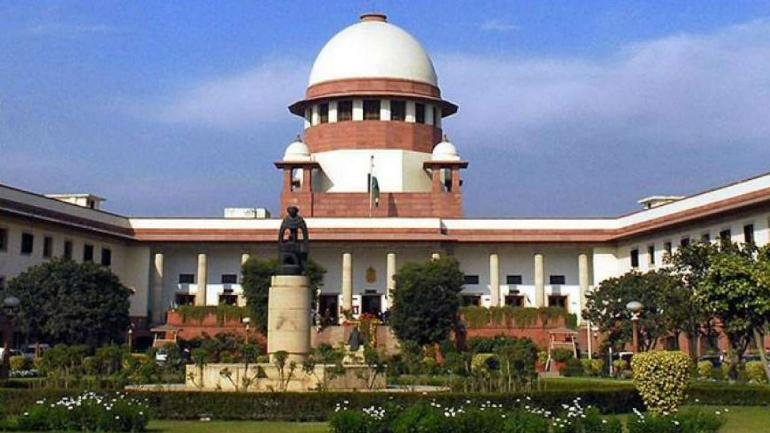
New Delhi, Oct 18 (NVI) In a landmark ruling, the Supreme Court has declared that the right to access and use the internet is a fundamental right of every individual, including children irrespective of their age.
A two-judge bench of Justices JB Pardiwala and K Vinod Chandran said the right flows from Article 21, which guarantees the right to life and personal liberty, read with Article 19(1)(a), which protects freedom of speech and expression.
“We have no hesitation in saying that the right to access and use the internet is a fundamental right of every individual under Article 21 read with Article 19(1)(a) of the Constitution,” the court said in its 136-page order.
“Our children, irrespective of their age, enjoy the same rights, and to deny the same altogether would be as absurd as saying children below a certain age do not have a conscience worth protecting or a freedom of speech worth expressing. The safety of our children and their freedom are not at odds with each other. Our children are entitled to both,” it added.
The court was considering applications filed by the NGO Just Rights for Children Alliance in proceedings arising from its September 23, 2024 judgement, which dealt with the circulation of child sexual exploitation and abuse material online.
The organisation had raised concerns about continued lapses by social media intermediaries and other online platforms in complying with the earlier directions.
The bench expressed disappointment at the lack of meaningful progress in tackling the circulation of such material despite its judgement two years ago.
It added that recent reports placed before it had revealed “an even more unsettling reality” concerning the safety and wellbeing of children online.
The court noted that reports of paid promotions of Child Sexual Exploitative and Abuse Material (CSEAM) through redirect links and websites were only a rare instance of such activities being detected and brought to light.
“There are millions more such incidents freely available on social media platforms that may never come to the knowledge of the proper authorities if no collective action is taken today by all stakeholders,” it said.
The court said it could not “afford to wait any longer” for regulatory authorities and intermediaries to take meaningful action and issued directions to strengthen detection, reporting and removal of such material.
Access to Children
A significant part of the order examined whether children should be prevented from accessing the internet or social media platforms to protect them from online abuse and exploitation.
The bench acknowledged a growing, although short-lived, tendency in different parts of the world to restrict internet access for children below a certain age, particularly on social media platforms.
“We too gave this our anxious consideration, and only thereafter, we decided consciously not to endorse the same,” the court said.
“We do not, for a moment, doubt the bona fides with which such measures are usually proposed. We are also conscious of the fact that the internet, as it exists today, is far from safe for our children. The very necessity of the present proceedings is proof enough of the same,” the bench said.
The court clarified that this did not mean the internet was safe for children; rather, protection should target harmful content and those who create and circulate it, not the children exposed to it.
The court said that, in cases involving CSEAM, the wrongdoers were those who created, circulated, sold or sought out such material, as well as intermediaries that failed to detect and remove it.
“To keep the child away from the internet on account of such failures would be to mistake the victim for the problem,” it said.
The bench also raised concerns about the implications of age-based restrictions that require the identification and verification of every user’s age. Such measures could entail the continuous collection and monitoring of sensitive personal data and create a disproportionate risk of misuse and surveillance, it said.
The court explained that the right to freedom of speech and expression was not limited to the ability to speak but also included the right to know, receive and impart information and ideas.
“The internet is, without a doubt, the marketplace of ideas, creative expression and information. Its value is priceless, not merely in the information it holds, but in the access it affords to adults and children alike,” it said.
For many children, particularly those living in remote areas, the internet was often the only source of learning and information. For children with special needs, it could also be the only place where they could find companionship with others like them.
The court referred to its 2020 judgement, which recognised that the freedom to carry on trade or business through the internet was constitutionally protected. However, that judgement had left open the question of whether access to the internet was, by itself, a fundamental right.
It also referred to the 2025 judgement which recognised digital access as an intrinsic component of the right to life under Article 21 in the context of accessibility barriers faced by persons with disabilities.
The court said experience from other jurisdictions had not established that blanket restrictions made children safer online, particularly if platforms failed to put proper safeguards in place and take earnest steps to identify and remove CSEAM.
“Children do not cease to use the internet merely because the law prohibits them from doing so,” it observed. Instead, they could continue using it without their parents’ or authorities’ knowledge and move to unregulated platforms and websites that might be even more unsafe.
The bench also warned that restrictions could discourage children who were being enticed or threatened online from reporting such incidents to their parents, guardians or other trusted adults because they feared being reprimanded for using the internet.
“This would significantly undermine the safety of our children, who are already apprehensive about confiding such incidents, even without such restrictions, and defeat the avowed object of the POCSO Act,” it said, referring to the Protection of Children from Sexual Offences Act.
The court said such restrictions could not substitute for efforts by intermediaries, law enforcement agencies, the Ministry of Electronics and Information Technology and the courts.
The court nevertheless clarified that rejecting blanket bans did not mean that age-appropriate safeguards were unnecessary. It suggested a system placing greater emphasis on parental consent, guidance and supervision of children’s access to social media, alongside a dedicated “child mode” for their accounts.
Such measures could include making children’s accounts private by default, restricting contact and messages from unknown adults, and moderating advertisements and content accessible to children. The court said these measures could be implemented for pre-teens through reasonable and proportionate methods of verifying parental consent.
It also clarified that its observations did not prevent the Union government from restricting children’s access to specific categories of content or services that were inherently harmful to them, including adult-content websites.
The court issued a series of directions to the Union government and online intermediaries.
It noted that the existing system relied heavily on individual complaints and reports, with platforms often maintaining separate mechanisms for detecting and removing harmful material. As a result, content removed from one platform might continue circulating on others until it was independently detected there.
The bench said that widely used technological tools could help address this problem, but their effectiveness depended on uniform adoption across platforms.
It directed the Union government to frame comprehensive guidelines specifying the technological measures that intermediaries must deploy to detect and remove CSEAM, including perceptual hash-matching and URL listing. The government was also asked to indicate whether these tools could be adopted across the industry and to make suitable amendments to the Information Technology Rules wherever necessary.
Hash-matching identifies digital fingerprints associated with known harmful material, allowing platforms to detect matching content even when it is uploaded again. URL listing, meanwhile, helps identify and block links directing users to locations where such material is hosted.
The court also directed the Union government to establish a National Hash and URL List Database exclusively for detecting and removing CSEAM. This could be created within the existing Sahyog Portal or as a separate repository.
The database would contain the hash identifiers and URLs of material verified as CSEAM, rather than the material itself. It would allow intermediaries and law enforcement agencies to cross-check content against a common list, enabling its detection and removal across platforms.
The court prescribed multiple levels of verification before material could be included in the database. Specialised software could conduct preliminary screening, but the final assessment would have to be made independently by at least three trained human analysts.
Once material was confirmed as CSEAM and its identifiers entered into the database, intermediaries would have to immediately disable and remove matching content without waiting for further verification at their end.
The bench also required safeguards against erroneous removals. Platforms must display a notice explaining whether material was removed following their own detection or because it matched an existing database entry. The court directed the Union government to establish grievance redressal mechanisms for people challenging removals, with the appropriate authority depending on how the content was identified.
The order further required intermediaries to report CSEAM to the relevant authorities, including the Special Juvenile Police Unit, local police or the cybercrime portal, as prescribed under the law. In cases involving material of unknown origin, the court specified a two-hour reporting deadline in the circumstances set out in its directions. Removals triggered by matches against the national database would be reported to the database authority through consolidated weekly reports.
Every platform must prominently display the contact details of its grievance officers and explain how users can file complaints. A dedicated category for reporting CSEAM must be available within two steps of the relevant content, profile, group or link.
The bench said complaints must be examined in their entirety, including accompanying text, captions, keywords, links and the function of any tool or application being promoted, to determine whether they facilitate or are likely to result in the exploitation or abuse of children.
Grievance officers responsible for such complaints must be adequately trained to identify CSEAM, including material that may not appear explicitly harmful on its face but could facilitate exploitation or abuse.
“No report or complaint of CSEAM ought to be disposed without the same having been reviewed by a trained grievance officer,” the court said. Automated tools could assist with preliminary screening, but the final decision must be taken by a trained officer.
The court also directed that complaints be acknowledged within 24 hours and assigned reference numbers through which their status could be tracked. Decisions and actions taken on complaints must be communicated to complainants, along with the reasons.
Intermediaries must publish monthly compliance reports detailing complaints received, the action taken, the time taken to resolve them and the content removed or disabled. CSEAM complaints must be reported separately, and the reports must be subject to periodic independent audits.
The bench asked the Union government to consider imposing exemplary monetary fines on intermediaries that breach their obligations under the Information Technology Act and the IT Rules. The penalties should account for the gravity, duration and recurrence of the default, as well as the size and turnover of the intermediary.
The court also addressed the circulation of prohibited material through paid subscriptions and paywalls.
Where CSEAM or other prohibited material was hosted, uploaded, promoted or circulated directly or indirectly through a paywall or subscription that generated revenue for an intermediary, the court said the revenue derived from such content should be forfeited and disgorged.
It directed intermediaries to subject paywalled and subscription-based content to rigorous scrutiny to ensure compliance with the law and to prevent children from accessing content that could harm them. The Union government was asked to frame appropriate guidelines for such scrutiny and proportionate restrictions on content accessible to children.
Educating Children
The Supreme Court also stressed the importance of educating children about online safety, consent and sexual exploitation, alongside providing support to victims.
The bench said age-appropriate sex education could help prevent harmful sexual behaviour and the circulation or viewing of CSEAM. It noted that such education should provide accurate information about sexuality, consent and respectful relationships, while addressing misconceptions about sexual health.
The court directed the Union government to take steps to incorporate digital safety and age-appropriate sex education into the core curriculum, with the National Council of Educational Research and Training (NCERT) and State Councils of Educational Research and Training (SCERTs) developing the curriculum in consultation with experts.
Children should be taught about consent, safe and unsafe touch, online exploitation and the ways in which they can report abuse without fear of reprimand. The directions also call for training teachers to identify and respond to grooming and abuse, and for regular awareness programmes to help parents understand online risks.
The bench emphasised the need for free counselling and psychological support for victims of child sexual exploitation and abuse for as long as necessary.
The court said the Union government, through the Union Ministries of Electronics and Information Technology and Law and Justice, must take appropriate steps to implement the measures and safeguards outlined in the order. It directed the government to formulate guidelines, standard operating procedures and amendments to Information Technology Act and the IT Rules wherever necessary.
The Union government must file an affidavit detailing the progress made and the steps taken to comply with the directions before the next hearing, scheduled for December 10, 2026.
The court had previously held that intermediaries could not claim the protection available under Section 79 of the Information Technology Act, commonly known as safe harbour, if they failed to comply with their reporting and due diligence obligations under the Protection of Children from Sexual Offences Act. (NVI)