Column
By Ruchika Kakkar
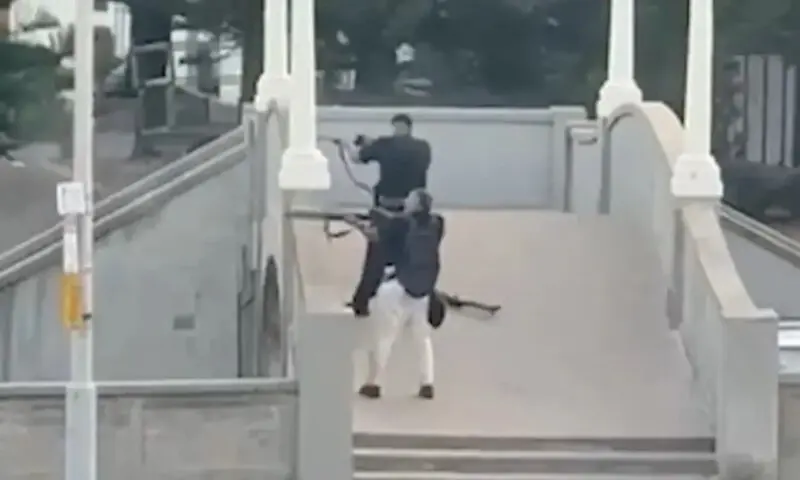
On December 14, a mass shooting took place at Bondi Beach in Sydney during the Hanukkah celebration, attended by members of the Jewish community. At least 16 people were killed and at least 39 injured, when two gunmen – a father-and-son duo, Sajid Akram (50), of Pakistani origin, and Naveed Akram (24), from the city’s south-west – deliberately targeted Jewish attendees.
Sajid Akram was killed by the Police, while Naveed Akram is in custody. Authorities also discovered and safely removed improvised explosive devices (IEDs) near the scene.
Australian Prime Minister Anthony Albanese condemned the attack as a terrorist act fueled by hate, describing it as an “act of evil anti-Semitism.”
The incident underscores the rise of anti-Jewish sentiments worldwide. Within Australia, on July 4, 2025, around 20 pro-Palestinian protesters stormed the Israeli-owned Miznon restaurant on Hardware Lane in Melbourne, chanting “Death to the IDF” (Israel Defence Forces).
On January 21, 2025, a childcare centre in Maroubra, Sydney – a non-religious facility located near a synagogue and Mount Sinai College Jewish school – was targeted in an arson attack. The building was set alight, causing extensive damage, and walls were sprayed with antisemitic graffiti, including phrases like “Fuck the Jews.”
The Executive Council of Australian Jewry reported 1,654 anti-Semitic incidents from October 2024 to September 2025.
On the other side of the globe, on October 2, a violent incident occurred in Manchester, United Kingdom (UK), targeting Jewish worshippers during Yom Kippur, the holiest day in the Jewish calendar.
As Second Sight noted, a terrorist attack took place outside the Heaton Park Hebrew Congregation Synagogue in Crumpsall, north Manchester, resulting in the deaths of two members of the Jewish community and injuries to another three.
The attacker, Jihad al-Shamie, 35, was a British citizen of Syrian origin. Several lesser anti-Semitic incidents were also reported across the UK in August and September. In the United States (U.S.), in early June at Boulder, Colorado, Mohamed Sabry Soliman targeted a pro-Israel solidarity gathering using Molotov cocktails and a makeshift flamethrower, injuring several people.
In May, two Israeli Embassy staff members, Yaron Lischinsky and Sarah Milgrim, were fatally shot outside Washington’s Capital Jewish Museum as they left a young diplomats’ event; the suspect, Elias Rodriguez, was arrested after reportedly shouting “Free Palestine.”
Earlier, on April 13, in Harrisburg, Pennsylvania, Cody Balmer threw Molotov cocktails into the residence of Governor Josh Shapiro, a Jewish public official, causing extensive damage, while the Governor and his family were inside during Passover; Balmer was arrested and later pleaded guilty.
In Germany, on January 2, a 19-year-old Syrian asylum seeker stabbed a 30-year-old Spanish tourist from behind at the Holocaust Memorial (Memorial to the Murdered Jews of Europe), seriously injuring him in an attack motivated by a desire to kill Jews. The suspect was arrested at the scene and later linked to radical Islamist and antisemitic views.
A rapid surge in antisemitic violence and hatred worldwide can be directly attributed to the Israel-Hamas war in Gaza, following the October 7, 2023, Hamas attack on Israel.
This conflict served as a powerful trigger, igniting unprecedented spikes in harassment, vandalism, assaults, mass protests and online hate against Jewish communities far beyond the Middle East.
The Anti-Defamation League, for instance, reported 8,873 incidents in the U.S. in 2023 (a 140 per cent increase over 2022) and 9,354 in 2024.
The Combat Antisemitism Movement documented a global total of 6,326 incidents in 2024 (107.7 per cent rise from 2023 and 3,883 from January to July 2025. UK’s Community Security Trust recorded 4,103 incidents in 2023 (a 147 percent increase) and 3,528 in 2024.
Australia’s Executive Council of Australian Jewry noted over 2,000 incidents in the year following October 2023. And Canada’s B’nai Brith reported a record 6,219 incidents in 2024.
Legitimate criticism of Israeli policies frequently blurred into outright anti-Semitism during global protests and online discourse, with anti-Israel rhetoric often incorporating classic tropes, conspiracy theories, or calls for indiscriminate violence against Jews.
This surge of antisemitism spans multiple ideological lines, from jihadist-inspired attacks to far-left activism and far-right opportunism, highlighting how geopolitical crises can quickly amplify age-old prejudices.
Historically, Jews have often been alternately portrayed as an inferior or threatening group – a narrative that remains a core component in the rhetoric of organisations such as Hamas, Hezbollah, and the Islamic State of Iraq and Syria (ISIS), which depict Jews as eternal religious enemies.
Extreme Right groups in the West portray Jews as secret manipulators of power; corrupt, avaricious and morally degenerate; and the architects of the ‘great replacement’, a purported conspiracy to demographically engineer the marginalization of White Christian communities by orchestrating mass immigration, among others.
These cross-ideological narratives fuel a pervasive ‘ambient’ hatred, turning Jewish communities into convenient scapegoats during times of crisis. These anti-Jewish narratives are deeply embedded in historical memory and ideological dogma, passed down from generation to generation, perpetuating harm not only to social cohesion and peace, but also threatening the security of current and future generations, and the stability of states.
(Ruchika Kakkar is Research Assistant at the Institute for Conflict Management).