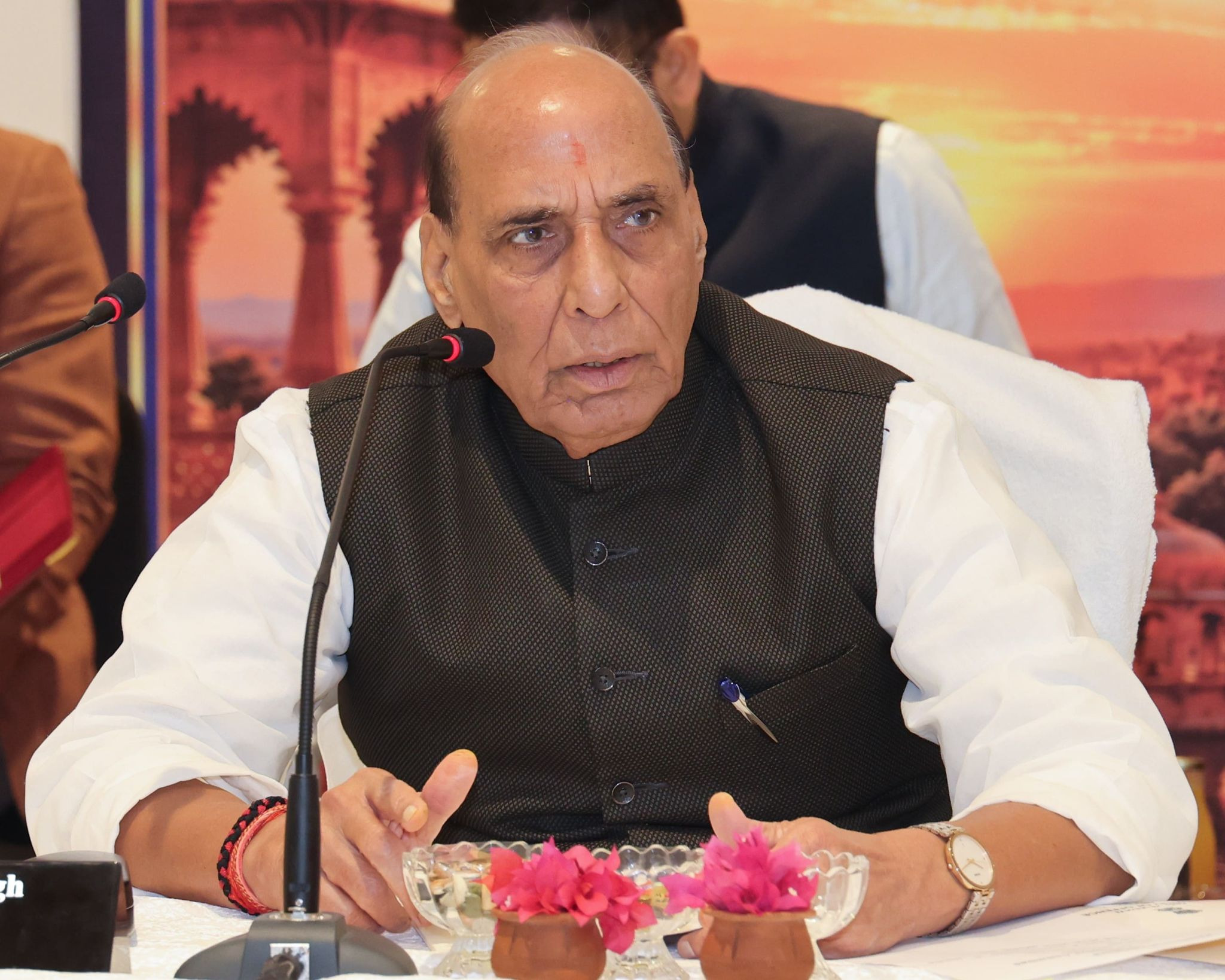
New Delhi, Nov 3 (NVI): Defence Minister Rajnath Singh today underlined the importance of jointness and integration among the three Defence Services, saying joint operational planning and coordinated application of capabilities across multiple domains were essential to meet emerging challenges.
He was chairing a meeting of the Consultative Committee of Ministry of Defence on modernisation of the Indian Defence Forces in Jaisalmer in Rajasthan which saw detailed deliberations on evolving security challenges, changing warfare paradigms, technological advancements and the need to develop a future-ready, operationally agile and technologically advanced military.
Singh highlighted the government’s sustained efforts towards modernisation of the armed forces, with a focus on budgetary support, capital acquisition, self-reliance, technology and human resources.
He said the defence budget for the financial year 2026-27 had been increased to a record Rs 7.85 lakh crore, including a capital outlay of Rs 2.19 lakh crore earmarked for modernisation and capital procurement.
The minister said the enhanced allocation reflected the government’s commitment to meeting the operational requirements of the armed forces while strengthening domestic defence industries and manufacturing capabilities.
Highlighting the progress in indigenous defence production, Singh said India’s defence production had increased from Rs 46,429 crore in 2014-15 to a record Rs 1.78 lakh crore in 2025-26.
He said defence exports, which were less than Rs 2,000 crore in 2014, had grown to around Rs 40,000 crore.
“We aim to achieve defence production worth Rs 3 lakh crore and defence exports worth Rs 50,000 crore by 2029,” Singh said.
The defence minister underlined the transformative role of technology in modern warfare, stressing the need to harness artificial intelligence, autonomous systems, unmanned platforms, cyber, space, electronic warfare and advanced communication technologies to strengthen military capabilities.
He said the Defence Research and Development Organisation (DRDO) had been undertaking initiatives to develop advanced weapons, missiles and systems, while the government was providing a level playing field to private industry to encourage greater participation in the defence sector.
Describing it as a “whole-of-the-nation” approach, Singh expressed satisfaction over the growing contribution of private industry, including micro, small and medium enterprises (MSMEs), start-ups and large corporations, towards strengthening the country’s defence capabilities.
Emphasising the role of human capital, Singh said the strength of the armed forces was determined not only by technology and financial resources but also by the capabilities, preparedness and operational efficiency of personnel.
He said the rapidly changing nature of warfare required the armed forces to continuously adapt their structures and formations to emerging operational requirements.
Singh cited the Indian Army’s new formations, including Asani, Bhairav and Shaktiban platoons, as examples of efforts to adapt to contemporary battlefield requirements.
He said modernisation was not merely about procurement of weapons and equipment but also about enhancing operational preparedness, developing indigenous technologies and building long-term capabilities.
The minister emphasised that self-reliance in defence was essential for safeguarding national security and reducing strategic dependence on foreign sources, adding that a robust domestic defence ecosystem was necessary to align technological development with military requirements.
He called for sustained investment in research and development, indigenous innovation and greater participation of domestic industry to strengthen India’s defence capabilities.
The meeting also discussed measures to accelerate capability development, streamline acquisition and development processes, optimise resources and establish measurable milestones for implementation of modernisation initiatives.
Members of Parliament from both the Lok Sabha and Rajya Sabha offered suggestions during the deliberations, which Singh said enriched the consultative process and helped shape a roadmap for future action.
The meeting emphasised a structured and phased approach to modernisation, with a focus on prioritising critical capabilities, strengthening coordination among stakeholders and periodically reviewing progress.
Raksha Rajya Mantri Sanjay Seth, Defence Secretary Rajesh Kumar Singh, Secretary (Defence Production) Sanjeev Kumar, Secretary (Ex-servicemen Welfare) Sukriti Likhi, Secretary (Defence Finance) Vishvajit Sahay and other senior civil and military officials attended the meeting.—(NVI)