
Fazil Mir
New Delhi, Nov 26 (NVI): Defence Minister Rajnath Singh on Thursday stressed the need for India to strengthen its preparedness against emerging security challenges while maintaining an effective response mechanism to deal with immediate threats amid evolving geopolitical dynamics.
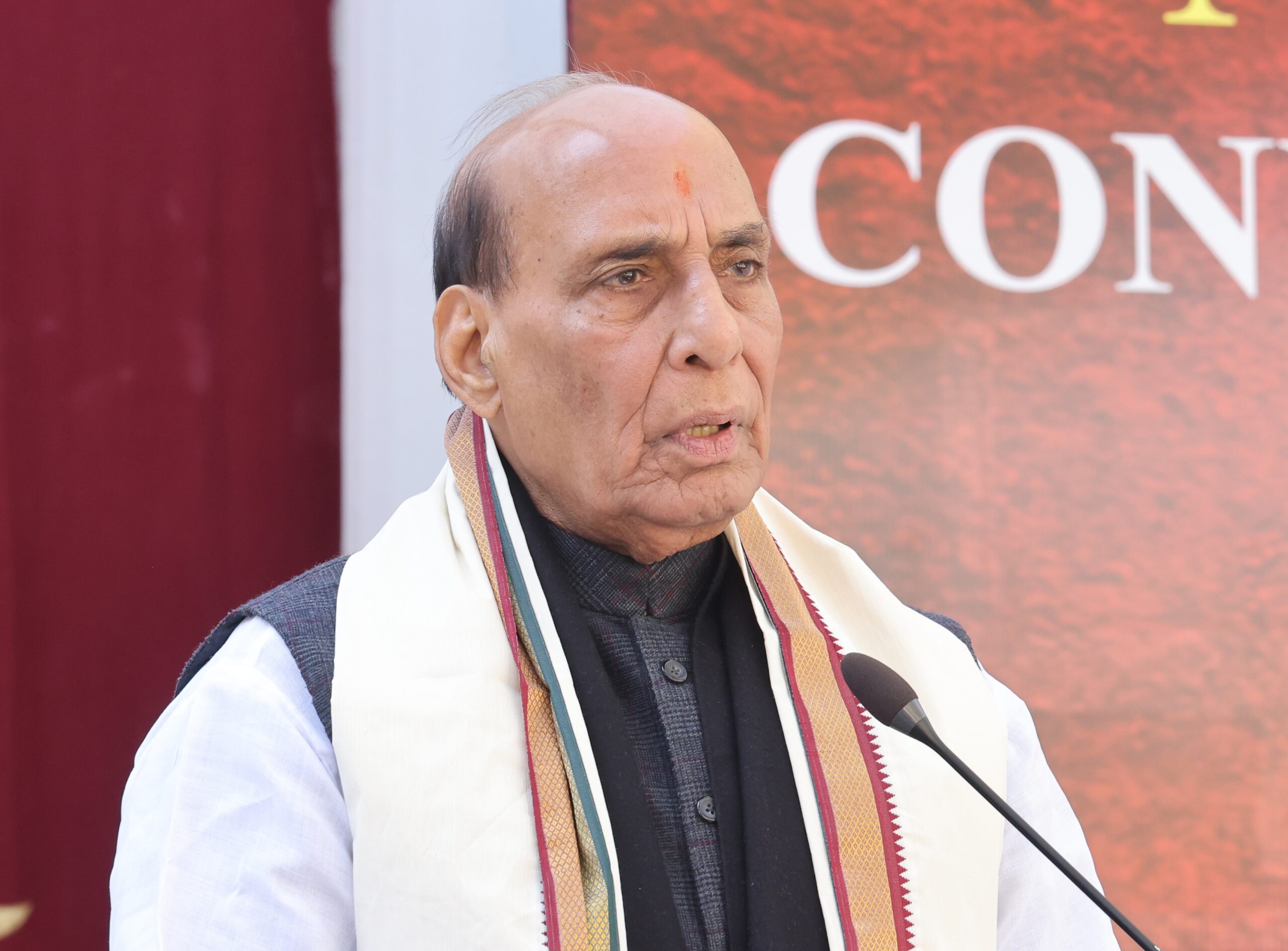
Addressing the convocation and valedictory ceremony of the 66th National Defence College (NDC) course in New Delhi, Singh said the changing global balance of power, emergence of new centres of strategic influence and shifting traditional alliances have made the security environment increasingly complex.
He said conventional military threats were increasingly co-existing with cyberattacks, disinformation, economic coercion, supply chain disruptions and other forms of hybrid warfare, blurring the distinction between internal and external security.
India’s geographical location, extensive land borders, maritime interests and growing international responsibilities require a forward-looking approach to national security, he said.
The Defence Minister emphasised the need to connect strategic learning with national security policymaking and called for greater utilisation of the intellectual capabilities and professional experience of senior officers from the armed forces, civil services and friendly foreign countries participating in NDC courses.
He suggested that the National Defence College, in consultation with the Defence Ministry, institutionalise a mechanism to identify key contemporary national security challenges for detailed examination during each course.
These challenges could include border management, maritime security, critical technologies, economic security, protection of critical infrastructure and emerging internal and external threats, he said.
Singh also called for involving serving senior military officers, civil servants and other officials in identifying actual operational, strategic and administrative challenges for examination by course participants.
Emphasising the importance of policy-oriented research, he said studies undertaken by participants should go beyond academic discussions and result in practical recommendations that could be submitted to the Defence Ministry and other concerned ministries for consideration.
“Every course at NDC should leave behind not merely a graduating batch of trained strategic leaders, but also a body of research, analysis and policy recommendations,” he said.
The Defence Minister also called for strengthening strategic gaming exercises at the institution through the incorporation of emerging technologies to create realistic scenarios and help participants assess the wider consequences of strategic decisions.
Appreciating the introduction of specialised sessions on artificial intelligence, machine learning, robotics, unmanned autonomous vehicles, aerospace technologies and semiconductors, Singh said such initiatives would familiarise future strategic leaders with emerging technological developments.
He also welcomed the introduction of a dedicated artificial intelligence capsule and the integration of closed-loop AI concepts into strategic gaming exercises.
Singh said the Executive MBA programme in Strategic Leadership and Public Policy, introduced under the aegis of IIT Madras, was an important step towards enhancing the academic standards and contemporary relevance of the NDC course.
Highlighting the college’s role in strengthening India’s international engagement, he said the participation of officers from friendly countries provided opportunities for professional interaction, mutual understanding and lasting relationships.
He also referred to the fourth edition of the International Strategic Engagement Programme (INSTEP), which brought together 25 participants from 22 countries of the Global South, along with Indian defence and civil services officers and representatives of defence companies.
India believes in a collaborative approach to addressing global challenges based on respect for sovereignty, mutual trust and shared responsibilities, Singh said, adding that professional relationships developed at NDC should continue beyond the completion of the course.
The ceremony was attended by NDC Commandant Air Marshal Manish Kumar Gupta, IIT Madras Dean (Faculty) Prof K Murali, senior Defence Ministry officials, faculty members and course participants.
About the 66th NDC Course
The 47-week National Defence College course, conducted annually from January to November, focuses on six major areas, including India’s strategic neighbourhood, economic security, science and technology, global issues, international security environment and national security strategies and structures.
A total of 122 officers attended the 66th course, including 40 foreign officers from 24 countries, drawn from defence forces, civil services, police services and other government organisations.—(NVI)