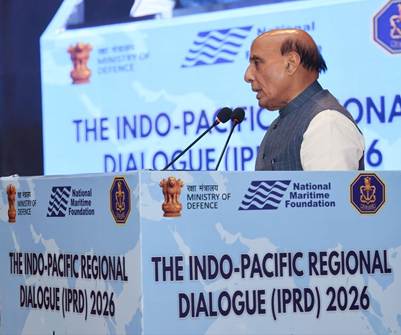
New Delhi, Nov 4 (NVI): Defence Minister Rajnath Singh on Wednesday called for diversifying supply chains, strengthening maritime infrastructure and enhancing regional cooperation to ensure greater resilience and secure inter-dependence amid growing global maritime security challenges.
Addressing the Indo-Pacific Regional Dialogue (IPRD) 2026, the Indian Navy’s annual apex-level international strategic conference, Singh said the answer to the vulnerabilities of an interconnected world lies in building resilience rather than abandoning globalisation.
He cautioned that certain countries and actors were seeking to exploit the strategic importance of oceans for narrow unilateral gains, citing deliberate trade disruptions, challenges to freedom of navigation and the weaponisation of critical maritime passages.
“The global maritime security environment is strained by deliberate trade disruptions. We see blatant challenges to the freedom of navigation and the weaponisation of narrow maritime passages. This growing instability in the maritime domain casts a long shadow over the broader international order,” he said.
Singh said oceans had historically served as bridges between nations and civilisations, facilitating trade, cultural exchanges and livelihoods, and stressed that maritime inter-dependence must be made more secure through cooperation, reliable infrastructure and improved maritime awareness.
Highlighting the evolving nature of maritime threats, he said security challenges were no longer limited to conventional military activities but also included piracy, trafficking, illegal fishing, cyberattacks and natural disasters.
He underlined the need to leverage emerging technologies, including artificial intelligence, autonomous systems, advanced sensors and data analytics, to strengthen maritime surveillance, security and economic activities.
However, the Defence Minister cautioned against allowing technological advancements to deepen inequalities among nations.
“Technology must not become another source of inequality among nations. If technological progress benefits only a limited number of countries, we will not achieve the collective resilience that our region requires,” he said.
Singh called for greater cooperation in research, education, innovation and capacity building, particularly to assist smaller maritime nations and developing countries in building sustainable technological capabilities.
He said the most useful technology was not necessarily the most expensive or sophisticated one, but technology capable of addressing real-world challenges.
The minister said the maritime sector would play a crucial role in India’s journey towards becoming a developed nation by 2047, highlighting the government’s efforts to build a comprehensive maritime ecosystem through investments in port infrastructure, connectivity, coastal economic activities and strengthening of the maritime industrial base.
He described the Maritime Amrit Kaal Vision 2047 as the country’s blueprint for maritime transformation, with a focus on technology, innovation, research, education and skill development.
Singh also stressed that economic development and environmental protection must go hand in hand, cautioning against treating oceans as an unlimited source of resources.
“Oceans cannot be treated as an unlimited source of resources. National prosperity and ecological responsibility are not competing objectives. They must reinforce each other,” he said.
Reaffirming India’s commitment to an open, inclusive and rule-based maritime order, he highlighted the vision of MAHASAGAR (Mutual and Holistic Advancement for Security and Growth Across Regions) and the Indo-Pacific Oceans Initiative, launched by Prime Minister Narendra Modi in 2019, as frameworks for strengthening regional maritime cooperation.
Singh urged participating nations to translate deliberations into tangible outcomes through joint research, scientific networks, university exchanges and affordable technological solutions to common maritime challenges.
“The future of the Indo-Pacific will not be shaped by technology alone. It will be shaped by the wisdom with which we use that technology, the partnerships we build and the confidence we create among nations,” he said.
Chief of the Naval Staff Admiral Krishna Swaminathan, in his address, emphasised the need to bridge disparities in scientific knowledge, research infrastructure and technological capabilities across the Indo-Pacific.
He said maritime cooperation must go beyond equipment acquisition and focus on developing sustainable capabilities that enable partner nations to operate, maintain, adapt and upgrade technologies.
Swaminathan called for greater collective investment in ocean science, enhanced sharing of scientific data, collaborative research initiatives and joint scientific expeditions. He also stressed the importance of strengthening regional institutions through trust, transparency and inclusive ocean governance.
The CNS said the IPRD-2026 provided an important platform to translate shared maritime interests into practical outcomes and develop forward-looking recommendations for strengthening scientific, technological and academic cooperation across the Indo-Pacific.
The three-day dialogue, being conducted by the Indian Navy in association with the National Maritime Foundation (NMF), commenced on November 3.
The second day of the conference focused on regional maritime resilience, shared understanding of activities at sea and strengthening scientific capabilities to anticipate and respond to environmental changes.
A ministerial session featured an address by Minister of State (Independent Charge) for Science and Technology and Earth Sciences Jitendra Singh, who also released an NMF publication titled “Alternative Hull Forms for the Future Indian Navy”.
Former Indian Navy chiefs Admiral R K Dhowan, Admiral Sunil Lanba, Admiral Karambir Singh and Admiral Dinesh K Tripathi, along with former Sri Lanka Navy chief Admiral Jayantha Perera, participated in an interactive session on maritime strategy, technological change and regional cooperation.
Another session on oceanographic science and climate resilience discussed cooperative maritime networks for preparedness in Indian Ocean island nations, including Mauritius and Seychelles, as well as sharing ocean data, research vessel capabilities and forecasting systems.
Chief of the Army Staff General Dhiraj Seth, Chief of the Air Staff Air Chief Marshal Ashutosh Dixit and other senior officials were also present at the event.—(NVI)