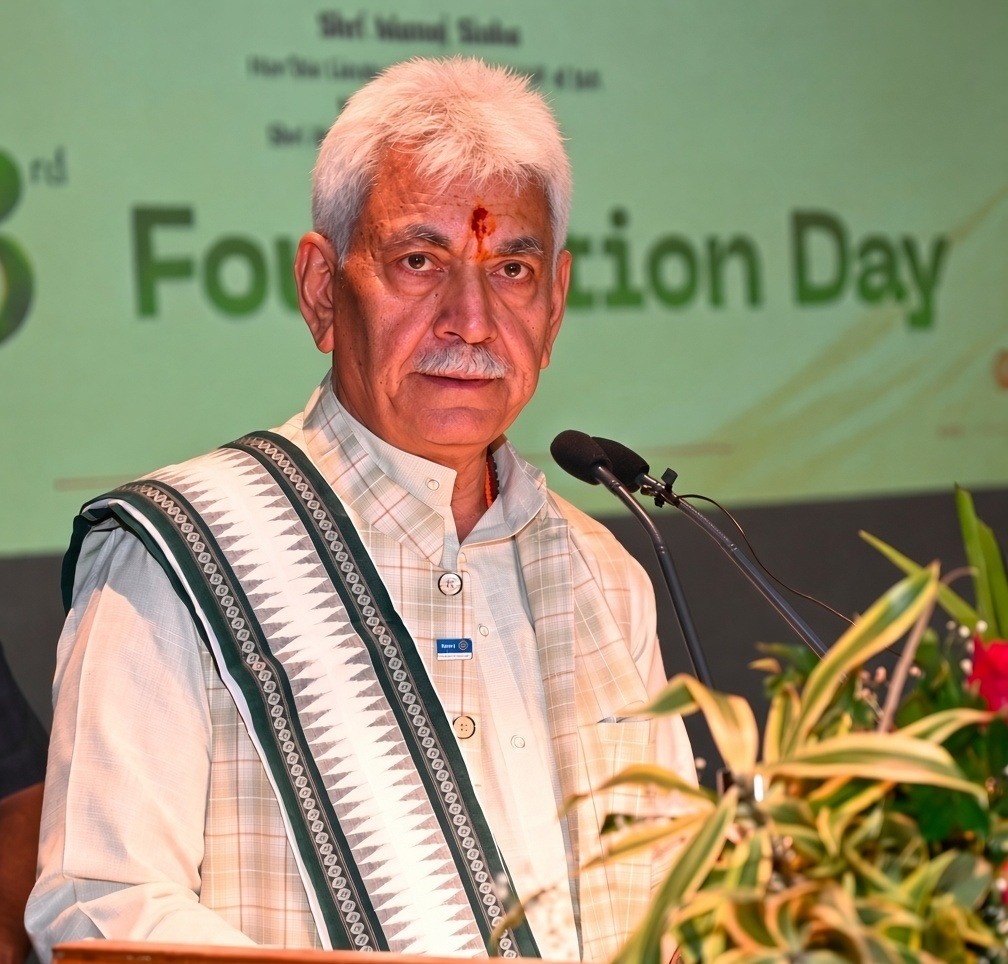
Jammu, Aug 19 (NVI) Lieutenant Governor Manoj Sinha on Wednesday called for transforming Shri Mata Vaishno Devi University into a global centre of knowledge and innovation, saying universities must focus on solving real-world problems rather than merely imparting conventional education.
Addressing the 23rd Foundation Day celebrations of the university at Katra, Sinha said SMVDU has emerged over the past 23 years as a centre of knowledge, innovation and values, nurturing students who are not only successful but also socially responsible.
“A university is not built by its buildings but by ideas, dreams, and possibilities,” the Lieutenant Governor said, underlining the role of visionary leadership, dedicated faculty and curious students in building institutions of excellence.
He lauded SMVDU’s achievements in research, innovation and entrepreneurship, noting that its faculty members have undertaken around 140 research projects, including international collaborations, while the university has established an AI and Deep Learning Lab, secured 14 patents and incubated 30 start-ups.
Sinha urged the university to strengthen industry-academia linkages and organise open-house meetings to facilitate the commercialisation of patents and innovations.
He said the true measure of a university’s success lies in its students and alumni, whose contributions to society and the nation carry forward the institution’s reputation.
Referring to the Rs 1 lakh crore research fund announced by Prime Minister Narendra Modi on August 15, Sinha urged the university to make maximum use of the initiative and ensure that a large number of faculty members and students submit applications.
“In the contemporary world, research and innovation becomes meaningful when it finds solutions to real problems, improves the quality of life in society and brings positive change to the lives of ordinary citizens,” he said.
The Lieutenant Governor identified limited research, faculty shortages, lack of accountability and weak industry linkages among the key challenges facing Indian universities.
He called for a change in the approach to education, saying institutions should move from asking “What should we teach?” to “What problems must we solve?”
India’s youthful population, creativity and risk-taking ability are its greatest strengths, Sinha said, urging universities to transform students into creators of opportunities rather than mere job seekers.
He also highlighted India’s ability to innovate at low cost, its cultural and linguistic diversity and its large global diaspora, and called upon SMVDU to leverage these strengths to develop solutions in areas such as healthcare, rural economy, urbanisation and digital innovation.
Sinha stressed the need for holistic education, saying sports, arts, literature, debates and cultural activities should receive due importance alongside science and technology.
He also encouraged the university to engage with rural communities, promote sustainable development and adopt global best practices in fieldwork, industry partnerships and vocational training.
Presenting a vision for SMVDU up to 2040, the Lieutenant Governor called for advanced research facilities in artificial intelligence, robotics, biotechnology and climate science, digital learning networks across rural Jammu and Kashmir, and international student-exchange programmes.
He said the ultimate purpose of education is not confined to economic development but also involves creating individuals who are creative, understand themselves, respect nature and recognise their responsibility towards humanity.
Sinha urged the university community to resolve to make SMVDU “a pilgrimage centre of knowledge, a laboratory of innovation, and a guiding light for society”.
He also invited suggestions from stakeholders for the proposed International Museum of Goddess at Katra.
On the occasion, the Lieutenant Governor inaugurated a bakery unit established by a Self-Help Group at SMVDU and felicitated achievers.
Vice-Chancellor Prof Pragati Kumar, members of the Shri Mata Vaishno Devi Shrine Board, senior civil and police officers, members of the university’s Executive Council, heads of educational institutions, faculty members, staff and students attended the celebrations.(NVI)