Srinagar, Oct 7 (NVI) : Jammu and Kashmir has achieved 55.24 per cent of its target under the PM Surya Ghar: Muft Bijli Yojana, with 46,133 residential rooftops solarised against the Union Territory’s target of 83,500 installations by March 2027, officials said on Wednesday.
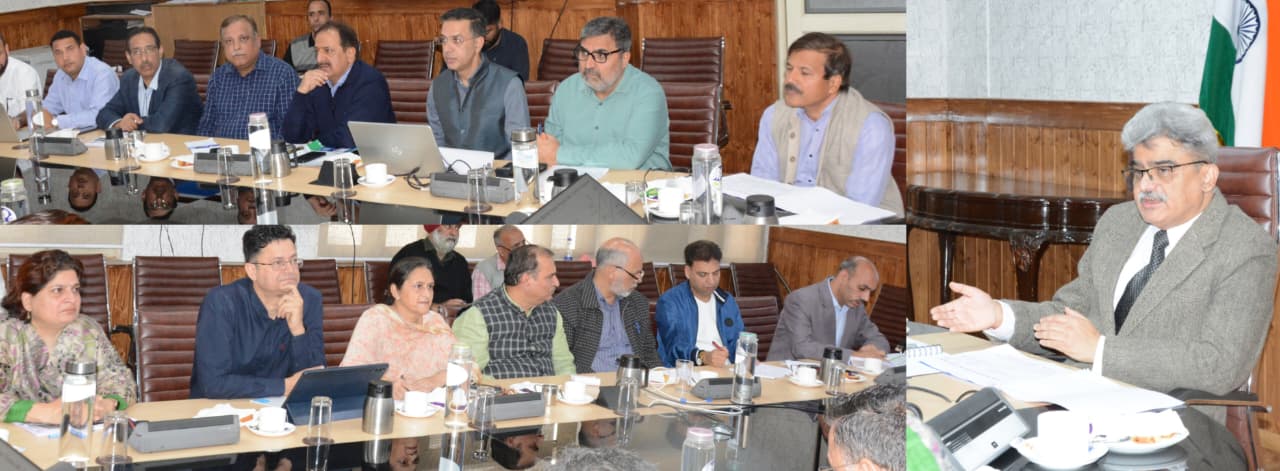
Chief Secretary Atal Dulloo reviewed the progress of rooftop solar installations for residential consumers and solarisation of government buildings under CAPEX and RESCO modes at a meeting here.
The achievement in J&K is higher than the national progress of 50.80 per cent, the meeting was informed.
Of the 46,133 residential rooftop solar installations, 17,809 have been completed in Jammu Power Distribution Corporation Limited (JPDCL) areas with a capacity of 62.69 MW, while 28,324 installations have been completed in Kashmir Power Distribution Corporation Limited (KPDCL) areas with a capacity of 102.55 MW, taking the total installed rooftop solar capacity in J&K to 165.24 MW.
The meeting was informed that Rs 344.14 crore in Central subsidy and Rs 13 crore in Union Territory subsidy have so far been credited to beneficiaries.
Against the target of 83,500 installations, 89,680 applications have been received, of which 82,591 applicants have selected vendors and 69,460 consumer agreements have been uploaded. A total of 42,686 rooftop systems have been commissioned, it said.
Dulloo directed the Power Development Department (PDD) and implementing agencies to address bottlenecks affecting the pace of installations, particularly bank financing, vendor availability, metering and execution of power purchase agreements (PPAs).
Taking note of the high rejection rate of bank loans, he directed the discoms to take up all rejected cases with the concerned banks, ascertain the reasons and resolve the issues so that eligible consumers are not denied the benefits of the rooftop solar programme.
Around 75 per cent of rooftop solar installations in KPDCL areas are dependent on bank financing. Of the 61,566 loan applications submitted, 17,416 have been rejected, including 14,232 in KPDCL areas, while 38,773 cases have been sanctioned and disbursed and 5,367 are under process.
The Chief Secretary also directed the discoms to proportionately distribute vendors across districts to ensure adequate availability of service providers and accelerate installations.
Reviewing solarisation of government buildings, the meeting was informed that against a CAPEX target of 12,994 buildings, 8,850 have already been solarised with a combined capacity of 95.64 MW.
Of these, 4,793 buildings with a capacity of 41.50 MW have been covered under PM Surya Ghar and hybrid projects, while 4,057 buildings with a capacity of 54.14 MW have been solarised under the ongoing programme.
Materials have been supplied to another 1,300 buildings, work is underway at 943 sites and surveys are being conducted for 1,901 buildings, officials said.
Under the RESCO mode, JAKEDA has proposed solarisation of 8,000 government buildings with a cumulative capacity of 152 MW, with work orders already placed for 5,185 buildings.
The National Hydroelectric Power Corporation (NHPC) has also proposed solarisation of 1,500 government buildings with a capacity of 23 MW under the arrangement.
Dulloo directed JAKEDA to coordinate with the discoms for installation of meters simultaneously with rooftop solar systems so that metering does not become a bottleneck after installation.
He also directed the PDD to ensure installation of smart meters at the earliest to facilitate commissioning of solar rooftop systems already installed on government buildings.
The Chief Secretary called for expeditious execution of PPAs and closer inter-agency coordination, stressing that administrative and procedural formalities should move in tandem with physical implementation.
He also asked JAKEDA to accord greater focus to the RESCO mode, observing that progress under the component was slow and needed to be accelerated through closer monitoring and timely resolution of implementation issues.
The meeting was attended by senior officers of the Power Development Department, Science and Technology Department, JPDCL, KPDCL and JAKEDA, while Deputy Commissioners participated through video conferencing.—(NVI)