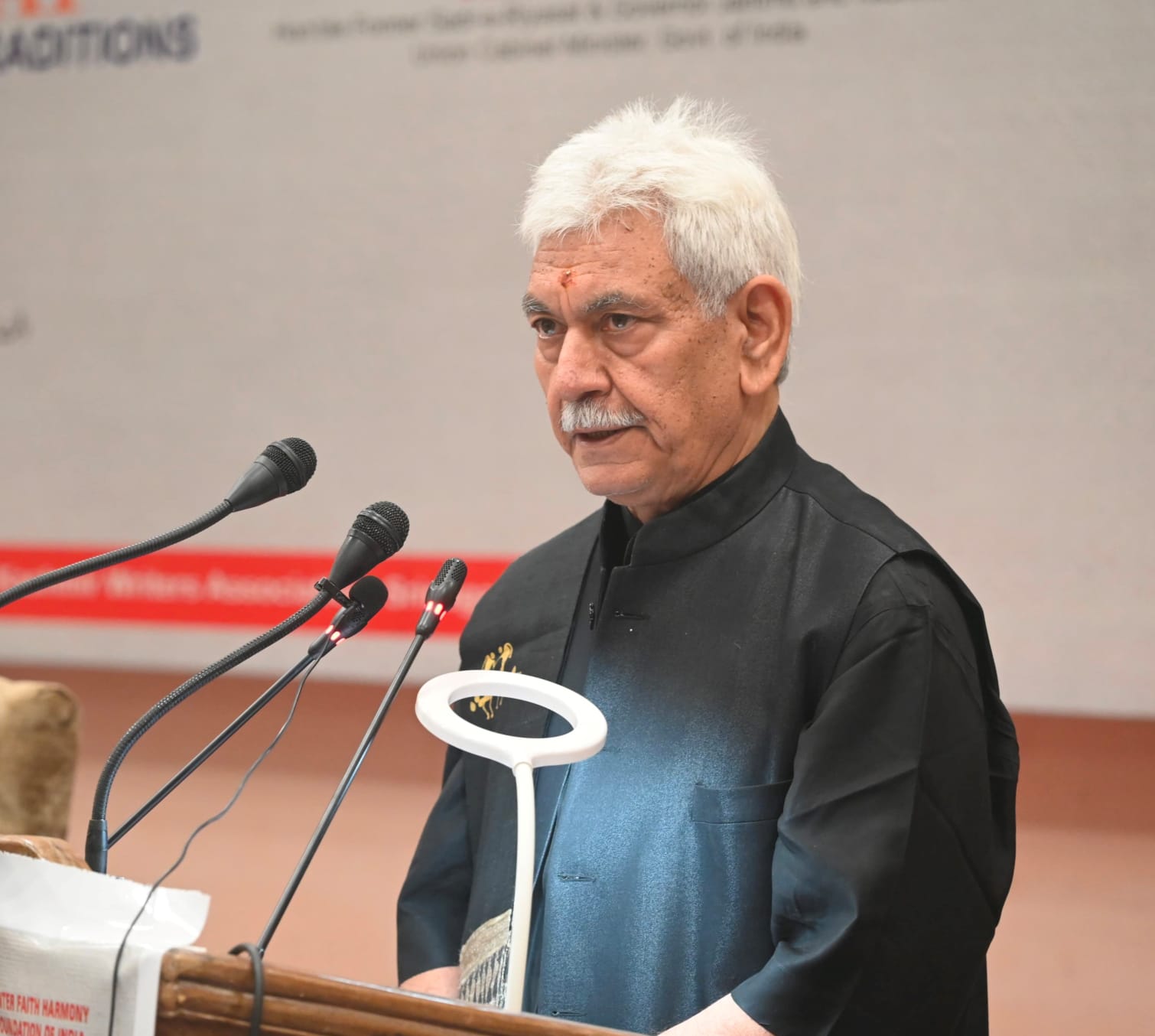
Srinagar, Jun 27 (NV): Lieutenant Governor Manoj Sinha on Saturday said India’s civilisational ethos is rooted in mutual respect and peaceful coexistence, asserting that the country’s ancient philosophy offers a guiding light to a world grappling with conflict and intolerance.
Addressing an Interfaith Dialogue organised by the National Council for Promotion of Urdu Language and the Inter-Faith Harmony Foundation of India here, Sinha said Hinduism, or Sanatana Dharma, never imposed itself on others but embraced diversity and coexistence.
“The world recognises that Hinduism, the world’s oldest living religion, never imposed itself. Instead, it embraced diversity and coexistence, giving Christianity, Islam, Judaism and Zoroastrianism the freedom to flourish in ancient India,” he said.
The Lieutenant Governor said the core spirit of Sanatana Dharma and Indian philosophy has the power to bridge divisions based on religion, language and race.
He described India as “a living idea” that teaches humanity to live together as one family and urged the younger generation to carry forward this vision of peace and mutual respect.
Sinha said the concept of “Bhartiyata” or Indianness embodies equal respect for all religions, unity in diversity and the ideal of Vasudhaiva Kutumbakam (the world is one family).
Referring to Jammu and Kashmir, he said the spirit of harmony and coexistence has been an integral part of the region’s culture for centuries, adding that “Kashmiriyat” draws inspiration from the broader philosophy of Bhartiyata.
The Lieutenant Governor also said Sufi saints who came to India found a culture rooted in love, compassion and spirituality, and were inspired by the teachings of the Vedas, Upanishads, Buddhism and Jainism.
He said India’s spiritual tradition has always encouraged people to practise their own faiths while living together in harmony.
Former Union minister Karan Singh, Kashmir University Vice Chancellor Nilofer Khan, senior government officials, academicians and literary personalities were among those present at the event.—(NVI)