
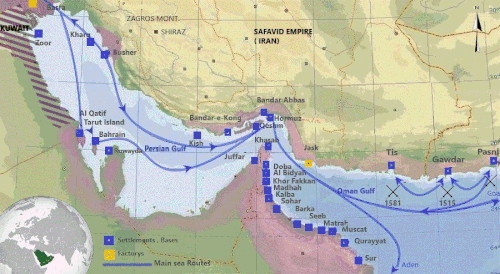
New Delhi, Mar 31: Asserting that its hold on the Strait of Hormuz will continue, Iran today said any passage through the crucial maritime area “must be conducted in compliance with the appropriate measures adopted” by it and “in coordination with the relevant authorities” of the country.
This means the flow of energy from West Asia will remain disrupted, affecting India and many other countries around the world and causing shortages of LPG, petrol and diesel.
Releasing a ‘Fact Sheet on the Legal and Proportionate Measures’, Iran said it was “compelled” to implement the “series of precautionary and restrictive measures regarding innocent passage through the Strait of Hormuz, aimed at protecting its supreme interests while ensuring maritime peace, stability, and security.”
It said the “measures have been implemented to repel aggression and neutralize the source of threats” and these “will continue, in accordance with legal standards, until these objectives are fully achieved and the source of threat and aggression is eliminated.”
The ‘Fact Sheet’ stated:
On February 28, 2026, the United States and the Zionist regime engaged in an act of illegal aggression against the territorial integrity and national sovereignty of the Islamic Republic of Iran, in flagrant violation of the established principles of international law. In response, and within the framework of the inherent right of self-defense pursuant to Article 51 of the United Nations Charter, the Government of the Islamic Republic of Iran has adopted a series of measures to counter this aggression.
As a result of this unlawful aggression, passage through the territorial waters of the Islamic Republic of Iran in the Persian Gulf, including the Strait of Hormuz, has become insecure, creating an emergency and extraordinary situation.
This state of affairs has had extensive implications for the national security and fundamental vital interests of the Islamic Republic of Iran, as well as for the safety and security of international maritime navigation in the Persian Gulf.
Given these emergency conditions, the possibility of innocent passage—as it exists under normal circumstances—has effectively ceased to exist. This situation is a natural and direct consequence of the illegal aggression by the U.S. and the Zionist regime against Iran’s territory and sovereignty, and the responsibility lies solely with these hostile parties.
The unique and unprecedented circumstances resulting from this war of aggression have compelled the Islamic Republic of Iran to implement a series of precautionary and restrictive measures regarding innocent passage through the Strait of Hormuz, aimed at protecting its supreme interests while ensuring maritime peace, stability, and security.
In exercising the inherent right of self-defense under Article 51 of the UN Charter, the primary objective of these measures is to prevent support for ongoing and future aggression against Iran and to guarantee free maritime navigation in the Persian Gulf and the Sea of Oman.
In this framework, the Islamic Republic of Iran—as the concerned coastal state responsible for the safety of navigation in the Persian Gulf and the Strait of Hormuz, and in accordance with the established rules of customary and treaty-based international law—shall prevent the transit of all vessels owned by or affiliated with the aggressor parties, their participants, or supporters of the aggression.
Furthermore, the innocent passage of third-party states through the Strait of Hormuz is considered legitimate only if it is not prejudicial to the national security and fundamental interests of the Islamic Republic of Iran or the peace and order of the Persian Gulf region, and provided it is free from any support for the threat or use of force against the sovereignty, territorial integrity, or political independence of the Iranian state.
It is understood that should the Iranian government determine there are reasonable grounds to believe that a vessel’s passage through the Strait of Hormuz poses a threat to national security, public order, or regional peace, it shall prevent such passage.
The aggressors, by abusing the right of passage through the Strait of Hormuz and establishing a presence in the Persian Gulf, initiated a war of aggression against the Islamic Republic of Iran and have continuously threatened the country’s national security.
In such a situation, characterized by the violation of a peremptory norm (the prohibition of aggression) and the breach of Iran’s sovereignty, the normalization of conditions and the expectation to refrain from exercising effective control over the Strait of Hormuz is impossible and lacks any legal or practical basis, given the realities of the state of war.
It is noteworthy that the right of states to take precautionary and restrictive measures within the context of armed conflict is recognized in international conventions and instruments.
The aggressive actions of the U.S. and the Zionist regime—which clearly violate the Law of the Sea, particularly regarding the threat or use of force against the sovereignty of a coastal state (prohibited under Article 14(4) of the 1958 Convention and Articles 19(2)(a) and 39(1)(a) of the 1982 Convention) —have disrupted the delicate balance between the rights and security of coastal states and the freedom of navigation.
Consequently, under these circumstances, the existing legal regime (innocent passage) is suspended, and passage is subject to the conditions declared by the competent authorities of the Islamic Republic of Iran.
Therefore, the exercise of effective and intelligent control by Iran over the transit of all vessels—especially those affiliated with the aggressors—based on the inherent right of self-defense and the principles of necessity and proportionality, is entirely legal and legitimate.
The Islamic Republic of Iran has always respected the principles of freedom of navigation and maritime safety;
however, the practical realization of these principles in the Strait of Hormuz is not possible except in light of respect for the sovereignty and sovereign rights of the Islamic Republic of Iran as the coastal state.
The Islamic Republic of Iran emphasizes that the responsibility for any disruption, insecurity, or increased risk in this vital waterway and its surrounding region rests directly with the United States and the Zionist regime.
By initiating an illegal and criminal war against Iran, they have placed regional stability and international shipping safety under an unprecedented threat and in blatant violation of the fundamental principles of the UN Charter.
In view of the foregoing, the legal and legitimate actions of the Islamic Republic of Iran have been taken within the framework of established principles of international law, based on the dual principles of necessity and proportionality. (NVI)