
By Ajay K. Kaul
New Delhi, Mar 11: The US, which trumpets the claim about possessing the most powerful military in the world, does not dare to provide escort facilities to the oil ships through the Strait of Hormuz amidst Iran’s threat to target any vessel associated with America, Israel or their friendly countries.
Despite having a massive armada, including two aircraft carriers, deployed in the maritime area around Iran, the US Navy has turned down requests from oil and shipping industries for defence escorts through the 166-kilometre long passage.
The refusal has been made in view of the threats posed by Iran, which has publicly stated that it will not allow “even a litre of oil” to pass through the Strait of Hormuz if the cargo is linked to the US, Israel or their friends.
The American refusal comes even as President Donald Trump has been claiming that the US military is having a strong control over the situation in the Middle East and is dominating the skies in the region.
Iran has already been targeting ships in the Strait of Hormuz and some of them have been hit, forcing a de facto closure of the maritime transit corridor which is extremely critical for movement of petroleum products for distribution globally.
The Persian nation has been defiant despite Trump warning that the US would carry out attacks “200 times more” than the present if any ship in the Strait of Hormuz is attacked.
Two days back, Trump told CBS News that escorts would begin “as soon as possible” and “when reasonable.”
Yesterday, US Energy Secretary, in a social media post, said the US has started providing escorts but he deleted it soon after.
The claim was mocked by Iran’s Parliament Speaker, who said the US Energy Secretary may be talking about actions on a ‘PlayStation’ (video games).
Subsequently, White House spokesperson, when asked about it at a press conference last night, stated that the US has not provided any escorts.
IMPACT OF CLOSURE:
Before the start of the war on February 28, around 140 tankers would transit the Strait of Hormuz each day. But with the effective closure of the Strait, more than 700 tankers of various countries are said to be held up.
The stoppage of movement of oil-ferrying vessels and tankers has severely impacted the flow of energy globally, resulting in shortages of fuel and continuing spike in prices.
India, which is hugely dependent on supplies of crude oil and gas from the countries in the Middle East, is among the many countries hit by the choking of supplies.
If the same situation continues, there will be fuel crisis in many countries around the globe.
STRAIT OF HORMUZ:
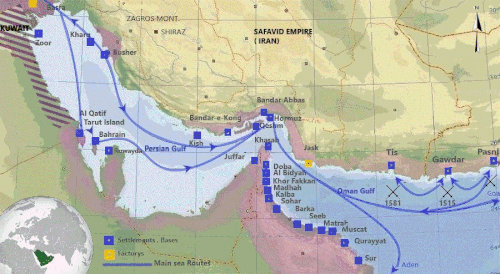
It is nearly 166 kms long maritime corridor between the Persian Gulf and the Gulf of Oman. Iran is located on its north side, while UAE and Oman fall on the southern side of the Strait.
Providing the only sea passage from the Persian Gulf to the open ocean, the Strait of Hormuz is one of the world’s most strategically critical maritime corridor for movement of goods by ships, since centuries.
The territorial waters of Iran constitute a major part of the corridor, particularly in a hump area where the Strait has the narrowest width of around 30 kms.
Accordingly, the ships have to pass through the territorial waters of Iran as also Oman under the ‘Transit Passage’ provisions of the United Nations Convention on the Law of the Sea (UNCLAWS).
This Convention has been accepted by most countries, including the US.
US DEPLOYMENT IN THE REGION:
Iran has been showing defiance even when the US has two aircraft carriers — USS Abraham Lincoln and USS Gerald R. Ford — deployed close to Iran.
One more aircraft carrier — USS George H.W. Bush — is also said to be moving towards the region for deployment.
These are nuclear-powered carriers, each equipped with 75 most-advanced fighter planes, and escorted by cruisers and guided-missiled destroyers.
DEPLOYMENT BY US ALLIES:
In addition to the armada of the US, its allies also have deployed substantial assets in the region.
France has Charles de Gaulle aircraft carrier, the country’s biggest nuclear-powered ship, deployed close to Iran.
Britain has also deployed fighter planes, warships and other military assets in the region around Iran.
DEPLOYMENT OF MINES:
To demonstrate it really means that it won’t allow “even a litre of oil” to pass through the Strait of Hormuz, Iran is said to be deploying thousands of small mines in the waters there.
While the US today claimed to have destroyed three mine-laying vessels in the Strait, the threat is clearly felt by it seriously. Obviously, Trump is wary of more American soldiers getting killed or injured and its additional military assets being destroyed.
Such an eventuality would hurt him politically at home, besides causing international humiliation.
That is the reason for its refusal to provide escorts to any oil ship in the Strait of Hormuz.