
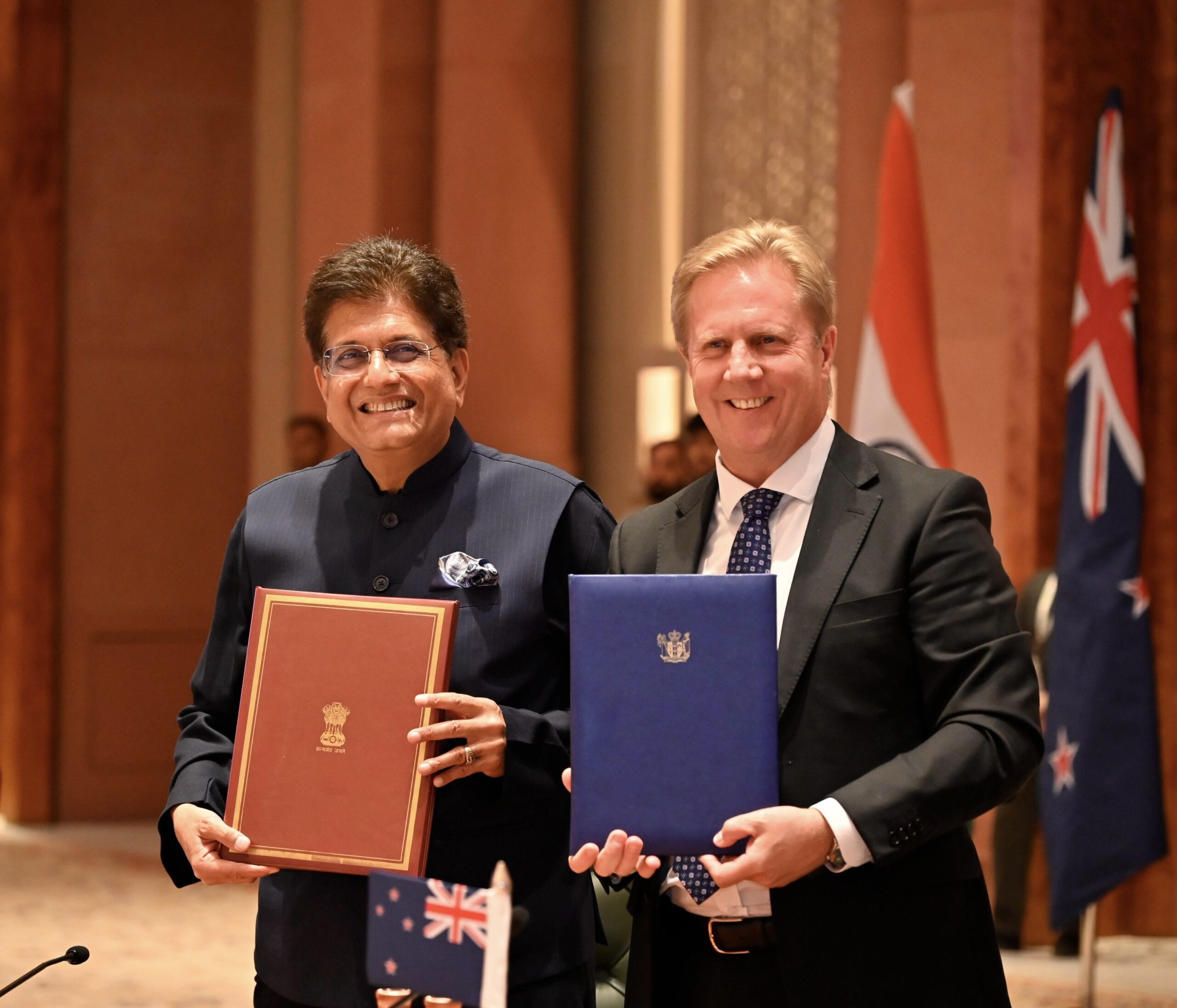
New Delhi, Apr 27: India and New Zealand opened a new chapter in their relation today as they signed a long-pending free trade agreement (FTA) which is expected to open a range of fresh opportunities for business and commerce between the two countries.
The agreement was signed by Commerce Minister Piyush Goyal and his New Zealand counterpart Todd McClay here, capping a negotiation process spanning over 25 years.
“This landmark agreement reflects deep mutual trust, shared ambition, and a common commitment to prosperity,” Goyal said.
The agreement grants 100% duty-free access for Indian exports to New Zealand, opening significant opportunities for MSMEs, farmers, women, youth, professionals and job-creating sectors, while safeguarding India’s sensitive interests through a balanced and calibrated framework, he said.
“This forward-looking agreement will also facilitate $20 billion of investment into India, deepening our cooperation in trade, services, investment, innovation, mobility, agriculture productivity and education, and creating pathways for skilled talent and students,” Goyal said.
The negotiations began in 2010 but were paused in 2015 after nine rounds. These were revived in March 2025 and concluded in December last year.
The deal effectively removes tariffs across thousands of product categories, making Indian goods significantly more competitive.
Sectors expected to benefit the most include textiles, leather, engineering goods, pharmaceuticals, and processed foods — many of which are labour-intensive and export-driven.
New Zealand Prime Minister Christopher Luxon described it as a “once-in-a-generation” deal that unlocks fresh opportunities across goods, services, investment, and labour mobility.
The agreement builds on steadily improving trade ties between the two countries.
Bilateral merchandise trade has already climbed to about $1.3 billion in 2024-25, while services trade — particularly in IT and travel — continues to grow.
Investment opportunities:
One of the most significant aspects of the agreement is New Zealand’s commitment to invest $20 billion in India over the next 15 years.
This long-term capital flow is expected to support infrastructure, agriculture, and technology partnerships, while also strengthening supply chains.
For India’s domestic economy, the biggest gains are expected in employment-heavy sectors. Zero-duty access for industries such as textiles, footwear, and gems and jewellery could translate into higher export volumes and job creation, especially for MSMEs.