
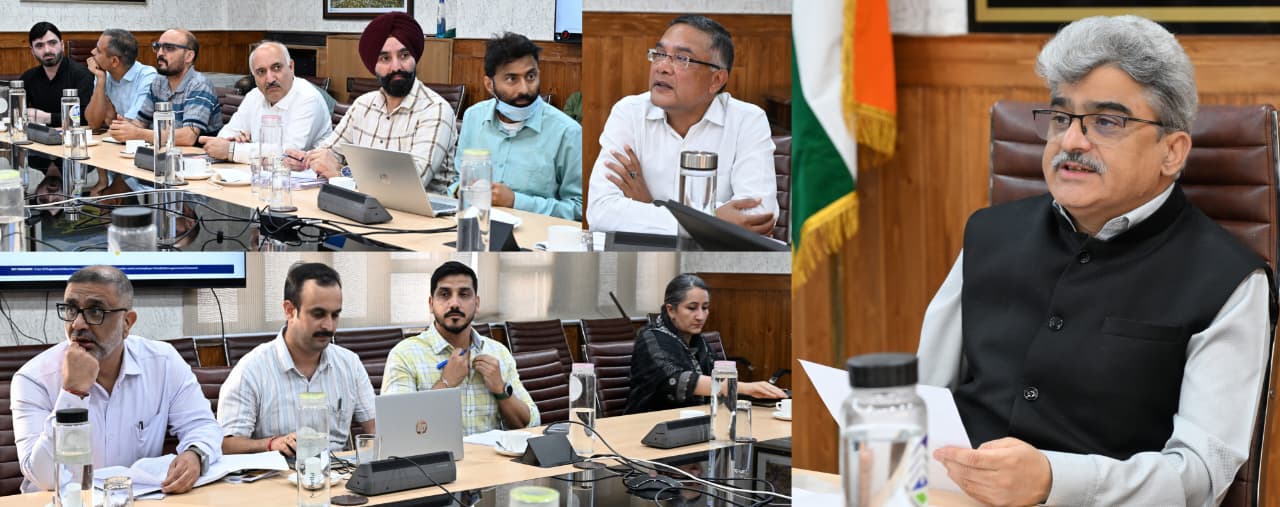
Srinagar, Aug 13 (NVI): Jammu and Kashmir Chief Secretary Atal Dulloo on Thursday reviewed the financial and social security benefits emerging from the implementation of the four new labour codes for private sector workers in the Union Territory, stressing the need to ensure that the reforms translate into greater financial security and statutory protection for employees.
Chairing a meeting attended by senior officials of the Finance, Law, Labour and Employment departments, Dulloo said the new framework should not be viewed merely as a compliance exercise but as a step towards creating a more equitable, transparent and financially secure employment ecosystem.
The four codes — Code on Wages, 2019; Industrial Relations Code, 2020; Code on Social Security, 2020; and Occupational Safety, Health and Working Conditions Code, 2020 — consolidate 29 existing labour laws into a unified framework.
The Chief Secretary directed the Labour and Employment Department and other concerned departments to ensure that workers and employers are made aware of the financial and social security benefits available under the new framework.
He also emphasised that the implementation mechanism should take into account the changing nature of employment and ensure that workers engaged outside traditional permanent arrangements are not excluded from social security benefits.
The meeting was informed that the new framework provides for universal wage protection, with minimum wage provisions extended across employments, replacing the earlier scheduled-employment approach.
It also provides for a National Floor Wage, below which minimum wages fixed by states and Union Territories cannot fall, subject to the applicable framework.
According to the presentation made by the Labour and Employment Department, employers’ EPF contribution is 12 per cent of wages, subject to the applicable statutory wage ceiling. The ESI framework provides for an employer contribution of 3.25 per cent of gross wages for eligible employees within the prescribed wage ceiling, in addition to the employee contribution mandated under law.
A key reform relates to fixed-term employment. Under the new framework, fixed-term employees are recognised as a formal category and are entitled to statutory benefits at par with permanent employees for the period of their employment.
Fixed-term employees would also be eligible for pro-rata gratuity after one year of continuous service, calculated at the applicable rate of 15 days’ wages for every completed year of service, subject to statutory provisions and the prescribed ceiling.
The reforms are expected to provide greater financial certainty and formalisation of employment arrangements in the private sector while giving workers clearer statutory rights and benefits.
The new framework also introduces dedicated provisions for the social security of gig and platform workers, besides strengthening the institutional architecture for unorganised workers and building workers.
The four labour codes envisage a simplified and technology-driven compliance mechanism, including single registration, a single licence and unified annual returns. Mandatory appointment letters for employees are also part of the framework.
The meeting was informed that the reforms would have implications across various employment arrangements, including contractual and fixed-term employment, unorganised workers and emerging categories such as gig and platform workers.
Dulloo stressed that effective implementation of the reforms would be crucial to strengthening the social security net, improving wage protection and enhancing financial security and formalisation of employment for workers in Jammu and Kashmir.
The meeting concluded with an emphasis on ensuring a transparent and simplified compliance environment for employers while safeguarding the statutory rights and benefits of workers.(NVI)