Thursday, July 23, 2026
Home Blog Page 11

J&K preparing Public-Private Partnership Policy to attract investment

J&K Chief Secretary Atal Dulloo

Srinagar, July 17 (NVI) The Jammu and Kashmir government is preparing a Public-Private Partnership (PPP) Policy with the objective of creating an enabling ecosystem for attracting private investment and accelerating infrastructure and public service development across the Union Territory.

Chief Secretary Atal Dulloo today chaired a meeting to deliberate upon the broad contours of the proposed Policy.

Addressing the meeting, the Chief Secretary underscored the importance of building institutional capacity for successful implementation of the proposed policy.

He stressed the need for systematic capacity building of officers and officials at different levels so that they are adequately equipped to operationalise the policy in an effective and time-bound manner.

Emphasising the need for delivering tangible outcomes on the ground, Dulloo observed that the Government must lead by example in implementing the policy to instil confidence among investors as well as the general public.

He directed the Industries Department to take lead in formulation of the policy by suitably refined it and incorporating the suggestions received during the meeting so that a comprehensive and well-structured policy document is finalised within the next month.

Referring to global best practices, the Chief Secretary cited the World Bank’s well-established STEP model, describing it as a dynamic and self-evolving framework that enables efficient project execution with minimal procedural hurdles.

He called for developing a similar institutional model tailored to the unique requirements, administrative structure and developmental priorities of Jammu and Kashmir.

The Chief Secretary further directed CITaG to proactively identify a pipeline of viable PPP projects across sectors and simultaneously establish a robust institutional mechanism and implementation framework to facilitate their timely execution once the policy is notified.

Speaking during the meeting, Additional Chief Secretary, Finance, Shailendra Kumar, observed that the overarching objective of the proposed policy is to leverage private investment for creating public assets and delivering quality public services for the welfare of the people.

He emphasised that while drawing from national and international best practices, the policy should remain rooted in the local context, addressing Jammu and Kashmir’s unique developmental priorities, challenges and opportunities.

Earlier the Chief Executive Officer, CITaG, gave a detailed presentation on the proposed policy framework, highlighting the prevailing PPP landscape across the country and the existing scenario in Jammu and Kashmir.

The presentation outlined the need for a comprehensive, transparent and investor-friendly policy to position the Union Territory as a preferred destination for private investment in key sectors.

The presentation proposed a streamlined regulatory framework aimed at reducing procedural bottlenecks by facilitating timely statutory approvals, including No Objection Certificates (NOCs), environmental clearances and other mandatory permissions, thereby making the investment process more efficient, predictable and less cumbersome for prospective investors.

It further envisaged a multi-sectoral institutional mechanism with clearly defined roles and responsibilities to facilitate appraisal, approval, monitoring and implementation of PPP projects through a coordinated government setup, ensuring time-bound decision-making and seamless project execution.

The proposed policy identified several high-potential sectors for PPP interventions in Jammu and Kashmir, including urban infrastructure, solid waste management, agriculture, food processing, energy, power, tourism, hospitality and healthcare, where private participation can significantly enhance service delivery, infrastructure creation and economic growth.

The presentation also elaborated upon the proposed framework for identification and prioritisation of projects, transaction structuring, operational modalities, legal architecture, governance safeguards, grievance redressal mechanism and a well-defined institutional hierarchy with clearly delineated powers and responsibilities to ensure transparency, accountability and effective implementation.

During the deliberations, the Administrative Secretaries and Heads of Departments offered valuable suggestions and sector-specific feedback for further strengthening the proposed policy framework, with emphasis on making it practical, implementation-oriented and aligned with the developmental aspirations of Jammu and Kashmir. (NVI)

Punjab: Sacrilege Charges And Justice System

A Gurudwara (for representation only)

Column 

By Nijeesh N

On the intervening night of July 13–14, 2026, Mewa Singh, an accused in a 2020 sacrilege (be adbi) case, was hacked to death by unidentified assailants inside his residence in Turan village, Fatehgarh Sahib district, Punjab.

The killing once again underscored the enduring volatility surrounding sacrilege-related incidents in the State.

Singh had been arrested in October 2020 for allegedly desecrating the Guru Granth Sahib at the village gurdwara by waving traditional weapons (shastars).

After spending nearly a year in prison, he was granted bail, re-arrested in 2025 after the court revoked his bail for repeated non-appearance, and released again in December 2025.

Although social media widely claimed that Singh had been beheaded, Punjab Police clarified that he had sustained multiple fatal sword injuries, but had not been decapitated.

Investigators are examining several possible motives, including revenge linked to the 2020 sacrilege case, personal enmity, and financial disputes, though no arrests have been made.
Irrespective of the immediate motive, the symbolism of the murder is unmistakable.

In Punjab, be adbi is no longer merely a criminal offence; it has evolved into one of the State’s most politically charged and emotionally sensitive issues.

Each new incident revives unresolved grievances rooted in the 2015 Bargari sacrilege case in Faridkot, where the desecration of the Guru Granth Sahib was followed by Police firing on protesters at Behbal Kalan, killing two persons and profoundly reshaping Sikh political
discourse.

The episode triggered a series of sacrilege cases across Punjab, many of which remain
pending before courts in Punjab and Chandigarh.

Since 2015, four of the more than two dozen accused in the Bargari sacrilege cases have been killed in targeted attacks allegedly carried out by pro-Khalistani extremists or gangsters linked to them.

Official data indicates that 597 sacrilege cases were registered in Punjab between 2015 and 2025, including 65 in 2015, 54 in 2016, 47 in 2017, 40 in 2018, 31 in 2019, 59 in 2020, 80 each in 2021 and 2022, 54 in 2023, 65 in 2024, and 22 in 2025. A further nine cases were reported up to February 28, 2026.

Of the 597 cases, 480 involved Sikh religious scriptures or places of worship, 92 involved Hindu religious sites, 14 involved Muslim shrines or scriptures, and 11 involved Christian places of worship.

Although 544 of the 791 identified accused were arrested, the criminal justice outcomes have been limited.

Of the 597 First Information Reports (FIRs), only 44 have resulted in convictions, while 99
ended in acquittals, 83 were cancelled during investigation, 37 were quashed by courts, and 102 remain untraced.

Meanwhile, 131 cases are pending trial and another 101 remain under investigation.
As beadbi has evolved into a legal, political, and religious battleground, the timing of the killing is equally significant.

As Punjab heads towards the Assembly elections, beadbi has once again become a major political issue.

In April 2026, the AAP government enacted the Jaagat Jot Sri Guru Granth Sahib Satkar (Amendment) Act, 2026, introducing stringent penalties, including life imprisonment, for sacrilege.

Although presented as fulfilling a long-standing demand for stronger legal protection of the
Guru Granth Sahib, the legislation has also triggered fresh political and institutional controversy.

The Akal Takht opposed several provisions, arguing that the government had legislated without adequate Panthic (relating to Sikh institutions and traditions) consultation and had encroached upon matters of Sikh religious authority.

In an unprecedented move on June 29, 2026, Acting Jathedar Giani Kuldeep Singh Gargaj summoned all Sikh Members of the Legislative Assembly (MLAs) from across party lines and issued a one-month ultimatum to amend the Act’s “controversial” provisions.

Chief Minister Bhagwant Mann was excluded from the meeting after the Akal Takht had earlier declared him Guru Dokhi (enemy of the Guru) and Khalsa Panth Virodhi (opposed to the Khalsa Panth) over a controversial video.

The Punjab Government has since indicated its willingness to revisit the disputed provisions.

The implications extend beyond electoral politics. Sacrilege has long been a potent mobilising issue for radical Sikh groups.

While Punjab is far removed from the insurgency of the 1980s, extremist and overseas separatist networks continue to exploit high-profile sacrilege incidents to portray the State
as incapable of protecting Sikh religious sanctity.

Equally concerning is the rise of religious vigilantism. Certain Nihang factions and self-styled religious enforcers have repeatedly targeted individuals accused of sacrilege, fostering a culture of instant retribution over due process.

The June 2025 killing of a social media influencer Kanchan Kumari aka Kamal Kaur Bhabhi accused of “obscenity” which was defended by senior Akal Takht functionaries, highlighted the growing acceptance of vigilante justice in matters of perceived religious offence.

Such incidents undermine state authority and normalise parallel systems of punishment.

For Punjab’s security establishment, therefore, the challenge is considerably larger than solving a single murder.

The State must simultaneously ensure credible investigations into sacrilege incidents,
expedite long-pending prosecutions, prevent retaliatory violence, and insulate religious grievances from electoral competition.

Failure on any of these fronts risks further legitimising vigilantism, deepening communal polarisation, and providing fresh opportunities for extremist mobilisation.

Mewa Singh’s killing is not just another homicide; it is a reminder that unresolved questions surrounding beadbi continue to occupy one of the most sensitive intersections of religion, politics and security in Punjab.

(Disclaimer: Nijeesh N is a Research Associate with Institute for Conflict Management. The views expressed in the column are solely of the author).

Key of Rajasthan Nuclear Plant to be constructed, tender floated

Mahi Banswara Nuclear Power Plant in Rajasthan.

New Delhi, July 17 (NVI) A tender has been floated by Anushakti Vidhyut Nigam Ltd (ASHVINI), the joint venture of state-owned NTPC and Nuclear Power Corporation of India Ltd (NPCIL), regarding construction of a key section of the proposed 2,800 MW Mahi Banswara Nuclear Power Plant in Rajasthan.

The tender covers the Nuclear Island Mega Engineering, Procurement and Construction (EPC) Package, which includes the reactor building, nuclear structures, heavy water upgrading plant, water systems and waste management facilities.

The nuclear island is the core of a nuclear power plant where the reactor and other critical systems are located.

The estimated value of the EPC contract is over ₹28,000 crore.

According to the tender document, the selected contractor will be responsible for engineering, design, supply, civil construction, installation, testing, commissioning, and operation and maintenance of the package.

The project will have four indigenous Pressurised Heavy Water Reactors (PHWRs) of 700 MW each, taking the total capacity to 2.8 GW.

The project is significant as it will be the first nuclear power plant in India that will not be fully owned by NPCIL.

So far, the country’s entire installed nuclear power capacity of 8.8 GW is owned by NPCIL.

NPCIL said this is the largest Nuclear Island EPC package floated under India’s indigenous PHWR programme.

The package covers all major works required for the four reactors. The Centre is expanding nuclear power generation to strengthen energy security and reduce carbon emissions.

It has set a target of 100 GW of nuclear power capacity by 2047. In 2024-25, nuclear plants generated 56,681 million units of electricity, accounting for 3.1% of India’s total power generation. (NVI)

Tanks, armoured vehicles of Indian Army likely to be upgraded

Russia-made T-72 tank (file pic)

New Delhi, July 17 (NVI) Russia-made tanks and armored vehicles are expected to be upgraded by the Indian Army to update these assets with the advanced features.

The project, estimated to cost $7.85 billion dollars, will include life-cycle enhancement of the T-72 and T-90 tanks, Infantry Combat Vehicles (BMPs), and Armored Recovery Vehicles (ARVs).

Around 790 T-72 tanks, 200 T-90 tanks, and 230 armored recovery vehicles will reportedly  undergo restoration over a period of five years.

The program aims to bring the platforms to a constant operational readiness capability and extend their lifespan.

The upgrade project is likely to be undertaken by State-owned Armoured Vehicles Nigam Ltd (AVNL), which has reportedly completed restoration of two T-72 tanks as a pilot project earlier this year.

The move follows inputs regarding operational experiences, particularly from the  mountainous terrain of Ladakh.

The decision comes in the wake of state-backed defense undertakings repeatedly pushing for long-term orders as a prerequisite for investing in capacity, technology, and supply chains.

The upgraded platforms are likely to retain only their basic structure while incorporating new-generation equipment.

The program also envisages the integration of drones into the armored fleet.

India is in the process of a massive drive to modernize its defence sector.

Earlier this month, the government approved a tranche of arms purchases worth US$5.5 billion as part of the effort.

In March, the governmet approved the purchase of defense equipment worth US$25 billion, including Russian-made S‑400 air defense missile systems, various types of aircraft, and artillery systems.

The Indian Defense Ministry said the March approvals included additional Russian S‑400 Triumf systems, transport aircraft to replace the country’s ageing fleet of Soviet‑era An‑32 and Il‑76 planes, and various artillery systems.

The procurements also cover armor‑piercing tank ammunition, gun systems, and aerial surveillance systems for the army; life‑extension upgrades for Su‑30 fighter jets operated by the air force; and hovercraft for the coast guard. (NVI)

Man Killed in bid to snatch rifle of policeman in J&K, cop injured

J&K Encounter
Security forces in Kashmir (File Pic)

Shivam Bakshi

Bhaderwah (J&K), July 17 (NVI): A man was killed during his attempt to snatch a rifle from a security person in Doda district of Jammu and Kashmir last night, police said today but ruled out any terror angle.

A J&K Policeman was also injured in the incident that took place in Gandoh area of the district, officials said.

“Last night, on detecting suspicious movement in general area of Jai Valley, Baderwah , police team challenged those persons.

“It led to scuffle, in which there was an attempt to snatch weapon.

“A single round fire got discharged leading to injury to the assailant. He was extricated to hospital, but succumbed,” police said in a statement today.

The deceased was identified as Arif from Bhaderwah, police said, adding the place of incident is about 25 km from his residence.

A policeman has also suffered serious head injuries.

“No terror angle is there. Preliminary investigation suggests that the deceased was into bovine smuggling,” the police said.

Meanwhile, police have detained a religious preacher for questioning in connection with the incident.

Further investigation into the incident has been taken up. (NVI)

Balochistan: Major attack by BLA on Pakistani forces, 45 killed, dozens injured

Baloch Liberation Army (BLA) fighters at some undisclosed location. File Pic.

Quetta (Balochistan), July 16 (NVI) Baloch Liberation Army (BLA) has carried out massive coordinated attacks on Pakistani forces in Balochistan which is going on and has so far resulted in the killing of at least 45 soldiers and injuries to dozens, the outfit said.

The attacks were carried out in the Khadkocha area of Mastung, targeting a convoy of buses transporting personnel of the occupying Pakistani army, their security details, and the military reinforcements that subsequently arrived at the scene, BLA spokesman Jeeyand Baloch said in a brief statement.

“As of writing this statement, intense clashes with the enemy forces are still ongoing,” he said in a statement to NVI.

“According to the reports received so far, more than 45 personnel of the occupying army have been eliminated and dozens of others injured in this operation,” he said.

“In view of the latest situation on the battlefield, a further extraordinary increase in the number of casualties is highly likely,” he added.

This attack was executed by the BLA’s vanguard unit, the ‘Fatah Squad’, the spokesman said.

He said a a detailed statement containing the final operational details of this major battle and the enemy’s personnel and material losses will be released to the media soon. (NVI)

J&K mulls new minor mining policy

Srinagar, Jul 16 (NVI): The Jammu and Kashmir government on Thursday deliberated on the proposed Comprehensive Minor Mining Policy-2026 aimed at plugging regulatory gaps, strengthening enforcement and introducing a transparent, technology-driven framework for scientific management of minor mineral resources.

The proposed policy was discussed at a high-level meeting chaired by Chief Secretary Atal Dulloo, attended by senior officers from the Geology and Mining Department, divisional administration, the Pollution Control Committee and other stakeholder departments.

During the meeting, officials reviewed the broad contours of the draft policy and discussed measures to make the mining sector legally robust, environmentally sustainable and technology-driven.

Dulloo said the proposed policy should be fully aligned with the provisions of the Central legislation governing minor minerals and capable of withstanding legal scrutiny. He also called for adopting best practices from other states, particularly Odisha, while tailoring them to Jammu and Kashmir’s requirements.

The chief secretary stressed the need to safeguard the livelihoods of traditional mining communities through a transparent digital ecosystem while ensuring mining rights remain non-transferable and are not misused.

Expressing concern over illegal mining, Dulloo directed the departments concerned to explore stronger legal deterrents against habitual offenders and called for wider inter-departmental consultations before finalising the policy.

Officials also discussed introducing an integrated digital system featuring e-challan generation, geo-fencing and real-time monitoring of mineral transportation to improve transparency and enforcement.

The meeting identified several gaps in the existing framework, including the absence of priority allocation of minor minerals for government infrastructure projects, delays in statutory approvals and the need for a single-window clearance mechanism.

Among the proposals discussed were a legally compliant “mine-to-market” tracking system, periodic revision of penalties, third-party audits of extraction from private lands, scientific replenishment assessments, and stronger enforcement against illegal mining.

The meeting also decided that the Centre for Innovation, Technology Assessment and Good Governance (CITaG) would incorporate suggestions from stakeholder departments into the draft policy for further consideration.

The proposed policy aims to establish an accountable and technology-enabled mining ecosystem balancing environmental sustainability, ease of doing business and public interest, officials said.(NVI)

47 Amarnath pilgrims escape unhurt after bus catches fire in J&K Ramban

Oplus_16908288

Shivam Bakshi

Ramban, July 16 (NVI): Forty-seven Amarnath Yatra pilgrims escaped unhurt after the bus they were travelling in caught fire on the Jammu-Srinagar National Highway near Karool in Ramban district on Thursday, officials said.

The bus, carrying pilgrims from Rajasthan, was on its way from Srinagar to Jammu when it suddenly caught fire near Karool.

Soon after the incident, teams of Police, CRPF, Army, SDRF and Fire and Emergency Services, along with local volunteers, rushed to the spot and launched a rescue and firefighting operation.

All 47 occupants, including the driver and conductor, were safely evacuated before the flames engulfed the vehicle, officials said.

No loss of life or injuries were reported in the incident. Traffic on the strategic highway remained disrupted for some time during the firefighting operation and was later restored after the blaze was brought under control.

Meanwhile, officials said the cause of the fire is being investigated. (NVI)

ACB Cracks Down on Corruption, Patwari Arrested in Kathua J&K

Jammu, Jul 16 (NVI): The Anti-Corruption Bureau (ACB) on Thursday arrested a patwari in Jammu and Kashmir’s Kathua district for allegedly accepting a bribe of Rs 10,000 from a complainant in connection with mutation-related documents, officials said.

The accused, identified as Khajan Chand, was posted at Patwar Halqa Mahanpur in Kathua district.

According to the ACB, the patwari had allegedly demanded Rs 20,000 from the complainant for providing documents after the mutation was attested in favour of the complainant’s sister. The complainant had already paid Rs 9,000, while the remaining amount was later negotiated and settled at Rs 10,000.

Unwilling to pay the bribe, the complainant approached the ACB, following which a verification was conducted and a case was registered under the Prevention of Corruption Act.

A trap was subsequently laid, during which the accused was caught red-handed while allegedly accepting the bribe in the presence of independent witnesses, the officials said.

The accused was arrested on the spot and the bribe money was recovered from his possession.

Searches were also conducted at his residence as part of the investigation, which is underway, the ACB said.(NVI)

J&K DGP, IGP review anti-terror operations in Rajouri, Poonch

Shivam Bakshi

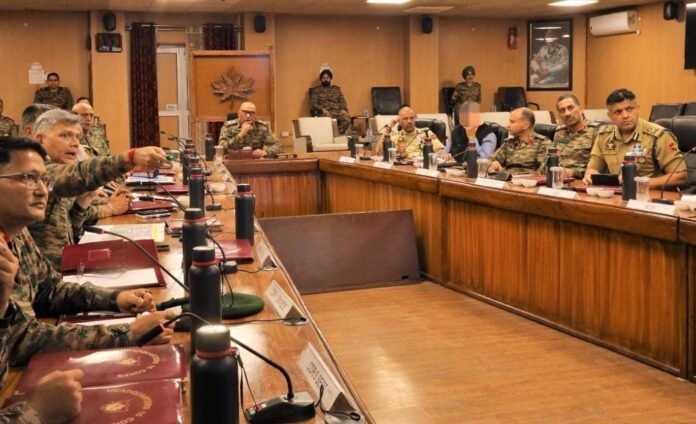
JAMMU, July 16 (NVI): Director General of Police (DGP) Nalin Prabhat on Thursday reviewed the ongoing anti-terror operations in the twin border districts of Rajouri and Poonch with senior officers of the Army, CRPF and Jammu and Kashmir Police.

The review meeting was attended by Inspector General of Police (Jammu Zone) B.S. Tuti, senior officers of the Army’s 25 Division and Romeo Force, the Central Reserve Police Force (CRPF), and the Jammu and Kashmir Police.

The officers assessed the operational situation and reviewed the ongoing counter-terror operations in the region, with emphasis on inter-agency coordination and maintaining a strong security grid in the twin border districts.—(NVI)

MUST READ