Saturday, April 25, 2026
Home Blog Page 1196

J&K: Top Hizbul commander among 3 terrorists killed in Shopian encounter

2 LeT militants surrender after gunfight in J&K's Kulgam
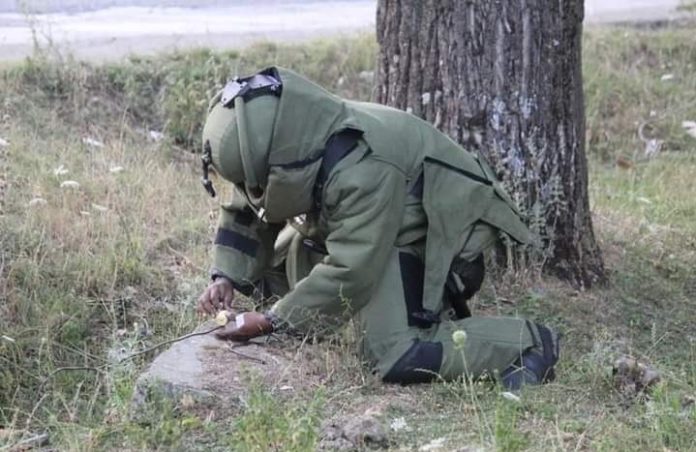
(Representational/file image)

Abid Bashir

Srinagar (NVI): Three terrorists of Hizbul Mujahideen including a top commander of the terror outfit were killed in an encounter with security forces at Turkwangan village of south Kashmir’s Shopian district, defence officials said today.

They said that acting on a specific tip-off about the presence of terrorists in Turkwangan, joint teams of police, Army and CRPF laid a siege early this morning. “When the forces zeroed in on a suspected spot where terrorists were hiding, heavy volume of fire came under, triggering an encounter,” the officials said.

Three of them were killed after an hour-long exchange of fire between the two sides.

Defence spokesman in Srinagar, Colonel Rajesh Kalia, said that the three terrorists were killed in an operation at village Turkwangan, Shopian. “Two Ak-47-riffles and one INSAS riffle has been recovered from the encounter spot. Operation is still going on in the area,” he said.

A police official said that one of the terrorists was a top commander of Hizbul Mujahideen and has been identified as Zubair-ul-Islam. Today’s encounter is the fifth such encounter in the past ten days in South Kashmir in which 19 terrorists have been killed.

This year so far, 92 terrorists including top commanders of Hizbul Mujahideen, Jaish-e-Mohammed and Lashkar-e-Toiba were killed which includes Reyaz Naikoo, the chief operational commander of Hizb, Bashir Koka of Lashkar and Abdur Rehman alias Fouji Bhai of Pakistan, who was an IED expert of Jaish.

Figures suggest that 60 terrorists were killed alone since the outbreak of COVID-19 in Kashmir on March 20.

India’s COVID tally crosses 3.43 lakh; death toll 9,900

New Delhi (NVI): The total number of coronavirus cases in India now stands at 3,43,091, with 9,900 deaths due to the pandemic, Union Health Ministry said.

At least 10,667 new cases of coronavirus and 380 deaths have been reported in India in the last 24 hours.

So far, 180,013 patients have recovered all over the country.

In the worst-hit Maharashtra, the COVID-19 cases climbed to 1,10,744, followed by Tamil Nadu with 46,504 cases, and Delhi with 42,829 cases.

Maharashtra has also reported the highest number of fatalities at 4,128, followed by 1,505 in Gujarat and 485 in West Bengal.

The death toll in the national capital rose to 1,400, while 16,427 patients in Delhi have recovered so far, the healthy ministry data shows.

Other states with high virus cases are Gujarat (24,055), Uttar Pradesh (13,615) Rajasthan (12,981) and Madhya Pradesh (10,935).

Meanwhile, Prime Minister Narendra Modi to interact with chief minister’s of various states on ways to combat rising cases of coronavirus in the country, in the two-day meet.

India launches its first gas exchange

New Delhi (NVI): India today got its first gas exchange- the Indian Gas Exchange (IGX) – that will enable market participants to trade in standardised gas contracts.  The exchange is also expected to facilitate transparent price discovery in natural gas.

The first nationwide online delivery-based gas trading platform was launched by Minister of Petroleum and Natural Gas & Steel Dharmendra Pradhan in an e-ceremony.

IGX will be a delivery-based trading platform for delivery of natural gas, the Ministry of Petroleum and Natural Gas said in a statement today. “Incorporated as a wholly owned subsidiary of the IEX – India’s energy market platform, IGX will enable market participants to trade in standardised gas contracts. The platform is fully automated with web-based interface to provide seamless trading experience to the customers,” the Ministry said in a release.

On the occasion, Dharmendra Pradhan said that the launch of the new electronic trading platform for natural gas today has opened a new chapter in the energy history of India and help the nation move towards free market pricing of natural gas. He said that with this landmark, India is joining the club of progressive economies. “As there will be a market driven pricing mechanism, India Gas Exchange (IGX) will play a bigger role towards realizing a free market for gas,” he added.

The minister also said that Petroleum and Natural Gas Regulatory Board (PNGRB) is working on rationalization of tariff to make natural gas affordable in every part of the country.

He also said that through IGX, India’s vision on mega investments on Liquefied Natural Gas (LNG) terminals, gas pipelines, CGD infrastructure and permission for market driven price mechanism will be materialized.

Referring to the various initiatives taken to make India a gas-based economy, the Minister said that Indian gas market has multiple price bands for assets including pre-NELP, NELP, High Temperature and High pressure (HTHP) and Deepwater and Ultra Deep Water blocks. He said that the country will soon have 50 MMT LNG terminal capacity. He said that the country has long-term gas contracts with many countries like Qatar, Australia, Russia and the US, and has made investments abroad in strategic assets in Mozamibque, Russia and other countries.

He also mentioned about various ongoing projects to strengthen the gas infrastructure in the country like Urja Ganga, Eastern India grid, Indradhanush project in the North-east, Dhamra-Dahej pipeline, coal gasification and CBM policy. He said that country will have more than 30,000km of pipeline in next few years.

Pradhan further said that the new electronic trading platform for natural gas is the biggest indicator of the Centre’s progressive policy as it completes the entire energy value chain from gas production from multiple sources and imports of LNG from different parts of globe to having a transparent price mechanism.

J&K: 27 travelers among 57 more tested positive for Covid, tally at 5,098

Over 3,200 cops COVID positive in J&K and 15 succumbed to virus
File photo

Abid Bashir

Srinagar (NVI): Jammu and Kashmir today witnessed 57 fresh Covid-19 cases taking the total number of confirmed cases in the Union Territory to 5,098.

Officials said that among the 57 new cases, 14 were tested positive at CD hospital, 6 at Army’s Command Hospital, Udhampur and rest at other hospitals.

Among 57 new cases, 29 belong to Kashmir division while 28 are from Jammu division, officials said, adding that the total number of positive cases in Kashmir has reached to 3,907 including 2,176 recoveries and 53 deaths while the total number of positive cases in Jammu has reached to 1,191 including 428 recoveries and 7 deaths.

The officials said that the total number of active cases in J&K is 2,432 including 1,676 from Kashmir and 756 from Jammu division.

Meanwhile, the recovery rate which was just 33 percent a few days before has now reached over 51 percent. Out of 5,098 positive cases in the UT, 2,604 cases have recovered which is 51.03 percent.

In Kashmir, out of 3,907 positive cases, 2,176 have recovered, which is 55.69 percent of the total cases.

In Jammu, out of 1,191 cases, 428 have recovered which is 35.93 percent of total cases.

Cases tested positive in J&K include 2 each from Kulgam, Kupwara and Budgam, 14 from Srinagar, 8 from Pulwama and 1 from Ganderbal in Kashmir while 28 from Jammu include 6 each from Jammu and Samba districts, 7 from Udhampur, 3 from Reasi and  1 each from Kathua and Kishtwar.

As per officials figures, 633 positive cases including 8 deaths and 398 recoveries are from Kulgam, 515 including 11 deaths and 223 recoveries are from Baramulla, 538 including 14 deaths and 158 recoveries are from Srinagar, 490 including 385 recoveries and 5 deaths are from Anantnag, 538 including 304 recoveries and 5 deaths are from Shopian, 399 including 288 recoveries and 5 deaths are from Kupwara, 239 including 194 recoveries and 1 death are from Bandipora, 241 including 112 recoveries and 4 deaths are from Budgam, 252 including 60 recoveries and 2 deaths are from Pulwama and 62 including 54 recoveries are from Ganderbal.

In Jammu division, 279 including 139 recoveries and 4 deaths are from Jammu district, 199 including 57 recoveries are from Ramban, 165 including 39 recoveries and 1 death is from Udhampur, 160 including 76 recoveries are from Kathua, 104 including 33 recoveries from Poonch, 105 including 39 recoveries are from Samba, 66 including one death and 12 recoveries are from Rajouri, 63 including 24 recoveries and 1 death are from Doda, 27 including 11 recoveries are from Reasi and 23, including 7 recoveries are from Kishtwar.

As per the daily information bulletin, 2,37,765 persons in Jammu and Kashmir are under observation while 40,891 persons have been kept under home quarantine. Apart from that, 2,432 persons are in hospital isolation while 32 persons are under hospital quarantine.

According to the bulletin, 1,45,245 persons have completed the surveillance period and 49,103 persons are under home surveillance.

So far, results of 2,71,294 samples are available out of which 266,196 are negative while 5,098 have been tested positive. Among positive cases, 2,432 are active, 2,604 persons have recovered while 62 have died.

CBIC launches e-Office in over 500 CGST and custom offices

New Delhi (NVI): The Central Board of Indirect Taxes and Customs (CBIC) today launched e-Office application in over 500 CGST and custom offices all over India to automate internal file handling.

The e-Office application has been launched to help improve governance by automating the internal processes of handling files.

The application was launched remotely in the presence of over 800 senior officers of CBIC.

Over 50,000 officers and staff will use this application making CBIC one of the largest Government departments to automate its internal office procedures, an official release said.

The launch of e-Office marks a fundamental change in internal office procedures which is so far based on manual handling of files and paper movement, the Ministry of Finance said in a statement. The CBIC expects e-Office would complement its many other IT led reforms which are directly aimed at enhancing the ease of doing business for the trade and industry, it said.

The e-Office is a Mission Mode Project (MMP) under the National e-Governance of India.

This launch is one more measure taken by the CBIC in leveraging technology for providing a ‘Faceless, Contactless and Paperless’ indirect Tax administration.

The e-Office application is developed by the NIC and is supported by the Department of Administrative Reforms and Public Grievances (DARPG). E-Office aims to improve governance by automating the internal processes of handling files and taking decisions within Government.

The use of e-Office by the rank and file of the CGST and Customs officers in their day to day work would lead to speedier decision making, transparency, accountability, and positive impact on the environment by cutting down the use of paper and printing.

Of particular relevance in the present-day challenging situation arising due to COVID-19 is that e-Office would help avoid contact with physical files thereby preventing possible transmission of any virus, the Finance Ministry said.

Also, e-Office ensures enhanced security as no file or document can be altered or destroyed or backdated. An in-built monitoring mechanism would identify where the files are held up enabling quick disposal and faster decision making, it added.

Ethiopia has inspired more and more countries to plant billions of trees

Representational Image

New Delhi (NVI): Around 18 million hectares of forest are lost worldwide each year – an area roughly the size of Panama, according to a report.

Destruction of tropical rainforest, which stores 210 gigatons of carbon, is the second biggest global contributor to climate change, says the report published by Global Center on Adaptation and World Economic Forum.

At the current rate, up to 28,000 species will go extinct in the next 25 years thanks to deforestation.

In the past 50 years, Ethiopia has lost 98% of its forested areas. To mediate this, it planted an estimated 350 million trees in just a single day in 2019, according to the report. The country has set an example and its success has inspired other countries, like Pakistan, India and China to do the same.

Developing countries from Ethiopia to Senegal to Pakistan are busy demonstrating how humanity can turn over a new leaf, says the report.

Pakistan’s Billion-Tree Tsunami project added 350,000 hectares of trees to the country’s landscape in just three years, while India and China – at one time Asia’s chief deforestation culprits – are leading the way in re-greening efforts, with the former planting 66m trees in 12 hours in 2017 and the latter deploying its army to plant an Ireland-sized area of forest in 2018, the report said.

The west African nation, Senegal, is home to some 1,85,000 hectares of mangrove swamps, but around 45,000 have been lost since the 1970s due to drought and deforestation. To combat this, a public- and private-funded effort run by the environment agency Océanium has seen 1,00,000 people from 350 villages perform a mass-planting scheme which has replaced a total of 79 million trees.

However, besides eye-catching headlines and interesting numbers, the forest and green cover actually plays a great role in the fight against climate change. Besides sequestering carbon, boosting biodiversity and pollinators, promoting rainfall and providing firewood, fodder, jobs and shelter, forests are increasingly being recognised for the crucial infrastructure tasks they perform.

Forests protect priceless arable land from extreme weather events, prevent soil erosion, bind soil together to prevent flash floods, provide natural water filtration systems and even, in snowy areas far from east Africa, shield human settlements from avalanches.

Increasingly, this ‘green infrastructure’ is expected to play a vital role in climate change adaptation and as humanity works to meet the UN’s Sustainable Development Goals, according to the report.

Natural infrastructure responses to climate change – known as ecosystem-based adaptation (EbA) – are increasingly finding favour as an alternative to human-engineered ‘grey’ infrastructure, which relies on concrete and steel, two of the most environmentally destructive materials on the planet, says the report.

J&K border residents mulling moving to safer places due to ceasefire violations by Pak

Smoke billowing from a house under fire due to intense shelling by Pakistan in Chowkibal area of Kupwara on April 12. (Photo via arrangement)

Abid Bashir

Srinagar (NVI): With this year’s first quarter witnessing a record number of ceasefire violations along LoC in Kashmir, many people living in the villages close to India Pakistan border in north Kashmir’s twin districts of Kupwara and Baramulla are considering going to safer places.

According to the villagers living in these border areas, the frequent ceasefire violations by Pakistani troops have taken a serious toll on their livestock and property.

Given the intensity of exchange of firing and heavy shelling with weapon systems including artillery by the armies of both the countries, people living close to the LoC in Uri, Keran and Tangdhar are considering moving to safer places for the safety of themselves and their livestock. The majority of people who spoke to NVI over the phone from the villages close to LoC are sensing trouble in the days ahead given the nature of aggression on both sides of the fence.

“I have not seen such an aggression between the two sides ever before. The armies of India and Pakistan are using massive artillery as if there is a war already between them. The only thing on my lips is sacred verses (kalimah), when I see mortar shells raining on trees and pastures,” said Abdur Aziz Khatana (75) a resident of Nambla village of Uri.

Khatana said that he feels that things can go from bad to worse in the coming days given the nature of heavy firing and shelling from both sides. “Don’t know when this would end. It may go worse in the days ahead. This is my gut feeling,” he said, adding that he and his relatives have decided to migrate to town in case the situation turns ugly. “If things remain the same, we will go and camp in Srinagar along with our livestock. If we stay here, we will die along with our cattle.”

Shahzada Bano, a widow in Charunda village of Uri said that since the past one week, LoC is very hot as there is a heavy exchange of fire. “It is hard to judge who violates the ceasefire. We don’t get time to judge who resorts to firing first. But the fact is that intense shelling from both sides and their deafening sound breaks the morning silence and triggers a wave of fear among us all,” she said.

A mother of three children, including two daughters, she said that the first thing she does when there is an exchange of fire is taking all her three children in a “self-made underground bunker for safety.”

“I tell my kids not to come out. My second priority is my livestock which is our source of living. I have two buffaloes and three cows beside a dozen sheep. I lock them in the shed and pray for the safety of my children and my livestock when shelling intensifies,” she said.

She said if things remain the same in the coming days, she will travel along with her children and livestock to the Chenab valley in Jammu where her relatives live.

Many residents of Uri villages close to LoC are seriously planning to migrate if things deteriorate in the days and weeks ahead. “Things seem to be turning worse. We are considering options where to migrate—Srinagar or Jammu,” one such resident told NVI.

As per official records, since January this year, 1,630 ceasefire violations have taken place in J&K, majority of them in  Poonch, Rajouri, RS Pura, Keran and Uri sectors. An army official said that it is the Pakistan army that violates the 2003 CF pact every time. “We are always giving them a befitting response. There have been casualties on both sides,” he said, adding that “this year so far, there is a surge in CFV from across the LoC.”

Covid-19 cases in Afghanistan cross 25,500 as 761 more test positive

New Delhi (NVI): At least 761 new coronavirus positive cases have been reported in Afghanistan in the past 24 hours, taking the total to 25,527 across the country, according to Afghan media reports.

According to country’s Ministry of Public Health, seven people lost their lives over the past 24 hours and 365 more recovered.

Among the new COVID-19 reported in last 24 hour cases, Kabul once again was on top of the list with 237 cases followed by Logar with 103 cases.

In addition, 113 cases were reported in Kunduz , 93 in Takhar, 25 in Kandahar, 22 in Nangarhar, 15 in Paktia, 14 in Baghlan, 15 in Bamiyan, 37 in Parwan, 30 in Wardak, 8 in Kunar, 16 in Panjshir, 11 in Badakhshan, 10 in Daikund, 4 in Nuristan and 12 in Uruzgan.

At least, 57,532 people have been tested for coronavirus in the country, the ministry said.

So far, 5,090 patients have been cured or discharged, while 478 died from the pandemic.

Virtual camp for free distribution of aids & devices for divyangjans in Punjab

New Delhi (NVI): Amid the ongoing Covid-19 pandemic, first ever distribution of assistive aids and devices to divyangjan (Persons with Disabilities) through virtual platform under ADIP Scheme was organised in Firozpur district of Punjab today.

“Special measures have been taken by Government of India so that the benefit of welfare scheme for Persons with Disabilities (Divyangjan) continue uninterrupted,” the Ministry of Social Justice and Empowerment said in a statement.

A virtual ADIP Camp for free distribution of assistive aids and devices at Block level for Divyangjans under the ADIP ( Assistance to Disabled Persons for Purschase/Fitting of Aids/Appliances) scheme of Government of India was organized at Talwandi Bhai Block of Firozpur District in Punjab today, it said.

This is the first camp being organized by the ALIMCO under DEPwD, M/o Social Justice and Empowerment under the ADIP Scheme of the Government of India after opening of lockdown with the Standard Operating Procedure (SOP) as per the GOI directives, the ministry said.

Union Minister for Social Justice and Empowerment Thaawarchand Gehlot took part as the Chief Guest through online video streaming.

On the occasion, Gehlot said that the ministry under the able guidance of the Prime Minister Narendra Modi is fully committed to the welfare of Divyangjan in the country through various measures and schemes.

In view the COVID-19 pandemic, the Ministry of Social Justice and Empowerment has decided that now Virtual ADIP Camps will be organized nationwide for distribution of aids and assistive devices to divyangjan, Gehlot said.

He also said that several schemes have been initiated by his ministry to provide financial assistance and scholarships to Divyangjan students to pursue their education to become self-reliant and dwelt upon many important schemes and programs of his ministry to facilitate and help Divyangjan.

Gehlot called upon the persons with disabilities and their family members to get enrolled for Unique ID Cards for Divyangjan which are valid all over India. 31 lakh Unique ID Cards have been delivered to Divyangjan so far in the country, he added.

Satnam Kaur, MLA, Firozpur in her address thanked the Ministry in arranging the Virtual camp for Divyangjan in her Constituency during the pandemic.

She suggested that the eligibility of Divyangjan for Motorized Tricycle should be relaxed further to facilitate more such people.

Total 95 beneficiaries of Block Talwandi were provided with 166 different categories of assistive appliances valuing over Rs.12 Lakh. 11 Motorized Tricycle were also distributed among the beneficiaries in the camp. However, in all, 962 beneficiaries of Firozpur District are being provided with 1667 assistive appliances valuing over Rs.1 Crore 50 Lakh. Distribution is being done in 6 Blocks of Firozpur starting from 15th to 20th June, 2020, the Ministry said.

COVID-19 tally exceeds 90,000 mark in Bangladesh; nearly 1,200 dead

Bangladesh lockdown

New Delhi (NVI): Bangladesh today saw another surge in coronavirus cases and deaths. A whopping 3,099 new cases were reported, taking the total number of confirmed cases to 90,619.

The country also recorded a total of 38 deaths due to the novel coronavirus during this period, raising the death tally to 1,209, according to United News of Bangladesh.

So far, a total of 34,027 people have recovered from the deadly contagion, after 15,297 more patients made recovery.

The detection rate of new patients in the country has been recorded at 20.61 per cent.

Meanwhile, former Sylhet City Corporation (SCC) Mayor Badar Uddin Ahmed Kamran died from coronavirus infection at a hospital today early morning.

MUST READ