Monday, April 6, 2026
Home Blog Page 1300

Directive for felling female Russian poplar trees in Kashmir

Srinagar (NVI): Amid the coronavirus pandemic, authorities in Kashmir have been directed to axe female Russian poplar trees and enforce a complete ban on their plantation and growing in view of concerns regarding pollen-related infections.

The directive has been given by Divisional Commissioner, Kashmir, Pandurang K Pole, to all Deputy Commissioners and other authorities concerned in compliance with an order of the Jammu and Kashmir High Court.

However, Social Forestry Corporation has been asked to increase the capacities so far as male popular trees are concerned, so that saplings and cuttings of such trees are available to the farmers on reasonable rates.

In the directive, Pole has asked the officials concerned to discuss the pollen-related infections in wake of already spread of COVID-19 and enforce a complete ban on plantation and growing of female Russian poplar trees in private Nurseries, an official spokesman said.

He further directed that pruning, lopping of female poplar trees on property land within 500 meters of habitation should be conducted within 10 days and warned of strict action for non-compliance.

The Divisional Commissioner also said that the Social Forestry Corporation should axe all female Russian poplar trees on their lands or at any other locations.

Any species of this variety on State land or Kahcharie land within 500 meters from village (habitation), Basti, should also be felled down, the directive said.

He directed the Deputy Commissioners to constitute teams for cutting the trees on state and Khacharie land.

16 mn lost jobs in US in 3 weeks due to Covid-19: Report

New Delhi (NVI): The coronavirus outbreak has thrown more than 16 million Americans out of work in just three weeks as the pandemic continues to spread across the country, according to US media reports.

The US Department of Labor in its report has said that more than 6.6 million people filed jobless claims in the week ending April 4.

More than 16 million people have made unemployment claims over the past three weeks, as restrictions on activities led most businesses to close. The restrictions to contain the virus have also put about 95 per cent of Americans on some form of lockdown.

As per reports in US media, the country has lost 10 per cent of the workforce in three weeks.

With over 16,000 deaths due to COVID-19 and the total number of cases surging past 4,50,000 in the United States, the pandemic situation has led to a large number of people filing first-time unemployment claims.

ICAI, ICSI and ICMAI donate Rs 28.80 Crore to PM CARES Fund

New Delhi (NVI): In view of the spread of coronavirus, the Institute of Chartered Accountants of India (ICAI), Institute of Company Secretaries of India (ICSI) and Institute of Cost Accountants, under the Ministry of Corporate Affairs (ICMAI), have come forward to donate an amount of Rs 28.80 crore towards PM-CARES Fund for providing assistance to those in need.

The Prime Minister’s Citizen Assistance and Relief in Emergency Situations Fund (PM CARES Fund) was created on March 28 in respect to the COVID-19 pandemic in the country.

It has been set up with the primary objective of dealing with any kind of emergency or distress situation as posed by the COVID-19 pandemic, and to provide relief to the affected people.

However, the minimum amount one can donate towards PM Cares Fund is Rs.10 and the donations will be exempted from tax and fall under Corporate Social Responsibility.

So far, total number of COVID-19 cases in India stand up to 6,412 and 199 people have died from the pandemic across the country.

195 million workers may lose jobs worldwide due to COVID-19: ILO report

Representational image

New Delhi (NVI): The coronavirus pandemic is expected to wipe out 6.7 per cent of working hours globally in the second quarter of 2020, according to a report by International Labor Organization (ILO).

The United Nations’ labor agency said this would be the equivalent of 195 million full-time workers.

Large reductions are foreseen in the Arab States (8.1 per cent, equivalent to 5 million full-time workers), Europe (7.8 per cent, or 12 million full-time workers) and Asia and the Pacific (7.2 per cent, 125 million full-time workers).

The UN agency said the eventual increase in global unemployment in 2020 depended on how quickly the economy could recover in the second half of the year and how effective policy measures were in boosting labor demand.

Since the ILO published its preliminary assessment, it said cases of COVID-19 infection had risen six times.

Huge losses are expected across different income groups but especially in upper-middle income countries (7.0 per cent, 100 million full-time workers).

The agency has also said that this far exceeds the effects of the 2008-9 financial crisis.

The sectors most at risk include accommodation and food services, manufacturing, retail, and business and administrative activities.

There is a high risk that the end-of-year figure will be significantly higher than the initial ILO projection, of 25 million.

More than four out of five people (81 per cent) in the global workforce of 3.3 billion are currently affected by full or partial workplace closures.

“Workers and businesses are facing catastrophe, in both developed and developing economies,” said ILO Director-General Guy Ryder. “We have to move fast, decisively, and together. The right, urgent, measures, could make the difference between survival and collapse.”
The ILO described the coronavirus as the “worst crisis since World War II.”

According to the new study, 1.25 billion workers are employed in the sectors identified as being at high risk of “drastic and devastating” increases in layoffs and reductions in wages and working hours.

Many are in low-paid, low-skilled jobs, where a sudden loss of income is devastating.

Looked at regionally, the proportion of workers in these “at risk” sectors varies from 43 per cent in the US to 26 per cent in Africa. Some regions, particularly Africa, have higher levels of informality, which combined with a lack of social protection, high population density and weak capacity, pose severe health and economic challenges for governments, the report cautions.

Worldwide, 2 billion people work in the informal sector (mostly in emerging and developing economies) and are particularly at risk.

The UN agency reiterated the need for large-scale, integrated policy measures to help combat the economic threat of the virus, but added that there was a need for immediate support for those working in the most affected sectors.

“This is the greatest test for international cooperation in more than 75 years,” said Ryder. “If one country fails, then we all fail. We must find solutions that help all segments of our global society, particularly those that are most vulnerable or least able to help themselves.”

“The choices we make today will directly affect the way this crisis unfolds and so the lives of billions of people,” he added. “With the right measures we can limit its impact and the scars it leaves. We must aim to build back better so that our new systems are safer, fairer and more sustainable than those that allowed this crisis to happen.”

J&K: Admin enforces strict lockdown in Kashmir amid Covid outbreak

(File Photo)

Abid Bashir

Srinagar (NVI): Jammu and Kashmir administration today enforced strict lockdown in Srinagar and other parts of Kashmir amid heavy deployment of security forces to prevent further spread of deadly Covid-19 pandemic.

The total number of positive cases in J&K has already swelled up to 184. Four people including a woman have also died so far due to Covid-19.

Even as the Srinagar administration had imposed restrictions on March 19, but the lockdown was enforced on Prime Minister Narendra Modi’s call on March 22 across the country. However, senior security officials in Srinagar stated that people continued to defy the lockdown especially after the deployment was thinned down during evening hours without bothering they may catch the deadly virus.

Yesterday, Deputy Commissioner Srinagar Shahid Iqbal Chaudhary and Senior Superintendent of Police for Srinagar, Haseeb Mughal stated that from Friday, there would be strict lockdown across Srinagar and all the passes issued by the district administration would be invalid. The administration’s decision to enforce strict lockdown comes close on the heels of spurt in the Covid-19 positive cases in J&K.

“Despite the fact that we are fighting an invisible enemy, people are not cooperating with us. Even on the eve of Shab-e-Baraat on Thursday night, we were forced to register four FIRs as some people insisted to hold night-long prayers in mosques,” the SSP said. “People must understand that it’s not a militancy issue or a law and order problem. We are fighting an invisible enemy in form of Covid-19.”

In Thursday’s presser, Deputy Commissioner Srinagar said that 800 people didn’t reveal their travel history on time. He said had those people cooperated with the administration on time, perhaps the situation would have been different so far. The DC Srinagar also stated that the next four days were crucial to decide which way the situation is heading.

People in Srinagar, where almost 20 million live, woke up to a surprising morning—deployment of security forces, even in lanes and by lanes.

Those living in Srinagar outskirts also said that there was a deployment of security personnel in the interior parts of the city which till yesterday were “free to roam around”. “In Soura, strict lockdown was enforced and only medical shops selling medicine were open,” Aijaz Ahmed, a resident of Soura told NVI. “A policeman handed over me helpline numbers saying stay indoors and call on these numbers for medicine or other essentials.”

The Srinagar administration and police have set up helpline counters across the district to help people in need of essentials and medicines.

The administration has divided the district into 25 zones and each zone is headed by a nodal officer who would ensure that essentials including medicine etc are delivered at the doorsteps of people.

A policeman deployed at Pantha Chowk area of Srinagar said that they have strict directions not to allow two-wheelers or four-wheelers to ply on roads. “We are following the directions in spirit. This is for the safety of people. We don’t want to see Kashmir becoming Italy or United States,” said the cop, wearing a mask and gloves. Meanwhile, today is the third Friday in a row when no congregational prayers would be held in masjids and shrines across the Valley.

“In times of pandemic, our religion allows us to pray at home. So first priority is to save lives. I reiterate my appeal to all Kashmiri people to stay home and pray at their homes. God will listen to their prayers in homes too as he is present everywhere,” Kashmir’s Grand Mufti Nasir-ul-Islam told NVI.

“People should not behave like illiterates. Godforbid, if we won’t follow directions from the administration or health experts, we should remain ready to face the worst. I hope better sense would prevail,” he added.

Women and girls worst affected due to COVID-19 outbreak: UN chief

UN chief
UN Secretary-General, Antonio Guterres

New Delhi (NVI): Coronavirus pandemic is deepening already existing inequalities and “is having devastating social and economic consequences for women and girls” that could reverse limited progress toward gender equality, UN Secretary-General Antonio Guterres said.

Although, the early data shows that the mortality rates from COVID-19 may be higher for men. But the pandemic is having devastating social and economic consequences for women and girls.

The UN chief, in a video message, urged governments to put women and girls at the centre of their efforts to recover from COVID-19.

“Nearly 60 per cent of women around the world work in the informal economy, earning less, saving less, and at greater risk of falling into poverty. As markets fall and businesses close, millions of women’s jobs have disappeared,” he added.

According to a latest report released, to accompany UN chief’s statements, by the United Nations recommends ways to put women’s leadership and contributions at the heart of resilience and recovery.

“Teenage girls out of school may never return,” Guterres continued. “Progress lost takes years to regain.”

In addition to this, the unpaid work has “increased exponentially” as a result of school closures and children being at home, and the increased needs of older people, Guterres said.

He furhter added, “These currents are combining as never before to defeat women’s rights and deny women’s opportunities,”

Antonio stated that all the measures taken to protect and stimulate the economy, from cash transfers to credits and loans, must be targeted at women.

The pandemic has also led to a horrifying increase in violence against women.

“Nearly one in five women worldwide has experienced violence in the past year. Many of these women are now trapped at home with their abusers, struggling to access services that are suffering from cuts and restrictions,” the Secretary-General informed.

COVID-19 is not only challenging global health systems, but testing our common humanity. Gender equality and women’s rights are essential to getting through this pandemic together, to recovering faster, and to building a better future for everyone, Guterres concluded at last.

Coronavirus cases top 1.6mn globally; deaths cross 95,000

Coronavirus cases

New Delhi (NVI): The total number of coronavirus cases across the world has reached at least 1,601,984 with the global death toll passing 95,000, according to Johns Hopkins University data.

The total number of cases in US has now reached 4,40,000, which is the highest number of cases worldwide, with the death toll surpassing 16,500.

In addition to this, more than 6.6 million Americans lost their jobs last week, taking the total of job losses to 16 million in the last three weeks as the coronavirus pandemic brings the US economy to a standstill, according to media reports.

In UK, 65,077 have tested positive and the number of people admitted to hospital with symptoms stands at 16,784, with a total of 7,978 deaths.

The number of people killed by the coronavirus in Spain has also passed 15,000. To date, Spain has a total of 1,52,336 confirmed cases of the virus.

Meanwhile, Italy has registered 1,43,626 confirmed cases of the virus, including 18,279 deaths and 28,470 survivors.

The head of the United Nations has called the coronavirus pandemic the “fight of a generation” and a threat to world peace and security.

COVID-19 deaths in India rise to 199; total cases at 6,412

New Delhi (NVI): The total number of coronavirus cases in India has increased to 6,412 and 199 people have died from the pandemic across the country, Union Health Ministry confirmed today.

In last 12 hours, there has been an increase of 547 new COVID-19 cases and 30 deaths.

Additionally, the confirmed cases of coronavirus include 6,341 Indians and 71 foreign nationals.

15 states and Union Territories account for more than 95 per cent of India’s total coronavirus cases.

While Maharashtra has reported over 200 new cases and 25 deaths, taking the state’s tally to 1,364, the highest in the country, according to Health Ministry.

At present, the number of active COVID-19 cases stands at 5,709, while 503 people were either cured or discharged and 1 had migrated to Singapore.

JK: Cyber police registers FIR against circulation of fake SC proceedings in Kashmir

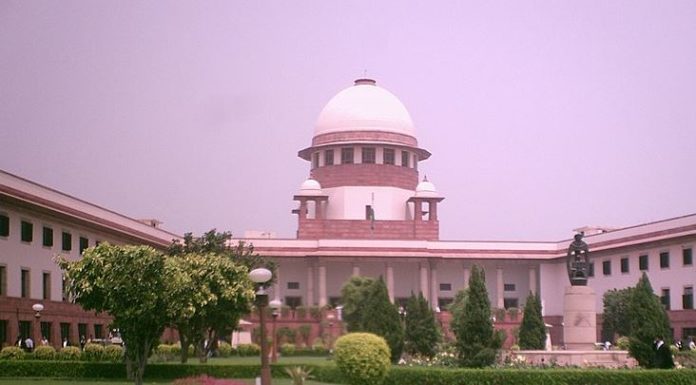
Srinagar (NVI): Cyber police station in Kashmir today registered an FIR against “some miscreants” for circulating fake and fabricated proceedings of the Supreme Court of India.

A statement issued by the Cyber police reads that it received information through reliable sources that some miscreants with criminal intention have fabricated and circulated a document purporting it to be a record of proceedings of the Supreme Court of India on April 09.

“The document was fabricated in the case titled foundation of Media Professionals Vs Union Territory of Jammu & Kashmir and ANR, in which it has been falsely reflected that J&K Union Territory administration has been ordered to take a quick review within 24 hours and restore full internet communication in the region,” the statement by Cyber police said.

It said that the document is fake and forged from its appearance. “This fraudulent and dishonest action has been undertaken by unknown miscreants in order to mislead public in general and public authorities in particular,” the statement said.

It said that a case FIR No. 06/2020 under relevant sections of law stands registered in Cyber Police Station, Kashmir Zone, Srinagar and investigations have been set into motion.

“General Public is advised not to circulate unauthentic, fabricated or fake information through social media platforms. Any person found indulging in such activities will be dealt strictly under Law,” the statement further said.

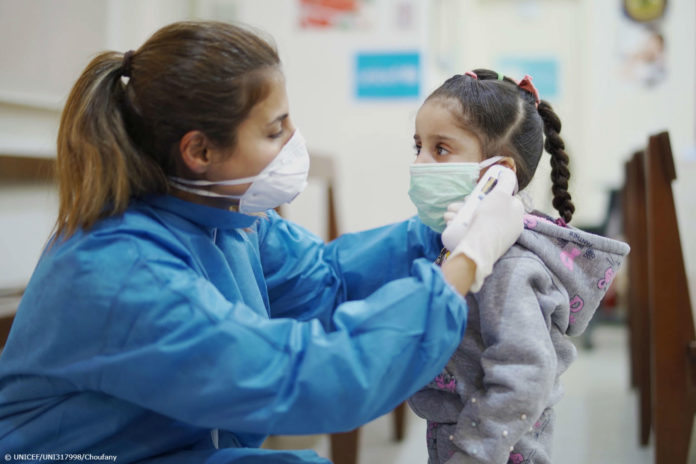
Concerned over child rights amid COVID-19, UNICEF to launch ‘agenda for action’

(Pic courtesy: UNICEF)

New Delhi (NVI): As coronavirus pandemic is claiming lives across the world, UNICEF has called upon governments to come into action and protect the most vulnerable children from the impact of the disease.

The international body has said that global coordination is urgently needed to prevent this health crisis from becoming a child-rights crisis.

“Not only are children and young people contracting COVID-19, they are also among its most severely impacted victims. Unless we act now to address the pandemic’s impacts on children, the echoes of COVID-19 will permanently damage our shared future,” said UNICEF Executive Director Henrietta Fore in a statement today.

She said that according to an analysis by UNICEF, 99 per cent of children and young people under 18 worldwide (2.34 billion) live in one of the 186 countries with some form of movement restrictions in place due to COVID-19.

“Sixty per cent of all children live in one of the 82 countries with a full (7%) or partial (53%) lockdown – accounting for 1.4 billion young lives,” she added.

The Executive Director further stated that this week, UNICEF is launching its global ‘agenda for action’ to protect the most vulnerable children from harm.

The agenda has six pillars:

1) Keep children healthy

2) Reach vulnerable children with water, sanitation and hygiene

3) Keep children learning

4) Support families to cover their needs and care for their children

5) Protect children from violence, exploitation and abuse

6) Protect refugee and migrant children, and those affected by conflict.

Talking about health, UNICEF head said  that COVID-19 has the potential to overwhelm fragile health systems in low- and middle-income countries and undermine many of the gains made in child survival, health, nutrition and development over the last several decades.

To overcome this challenge, she said that there is an urgent need to preserve and strengthen health and food systems in every country around the world.

She said that in a similar way, many nutrition programmes are disrupted or suspended, as are community programmes for the early detection and treatment of undernourished children. “We need to act now to preserve and strengthen health and food systems in every country around the world,” she said.

On hygiene aspect, she said protecting ourselves and others through proper handwashing and hygiene practices has never been more important. “Globally, 40 per cent of the population, 3 billion people, still lack a basic handwashing facility with soap and water available at home – and this is as high as nearly three quarters of the population of the least developed countries,”

She called upon the governments to ensure that every household, school, and health care facility has the means to a hygienic and healthy environment.

Coming to education, Henrietta said that an entire generation of children have seen their education interrupted due to the pandemic situation. “Nationwide school closures have disrupted the education of more than 1.57 billion students – 91 per cent – worldwide. We know from previous shutdowns that schoolchildren, and especially girls, who are out of school for extended periods of time are much less likely to return when classrooms reopen,” she said.

She warned that an entire generation of students could suffer damage to their learning and potential. “Redoubling our commitments to education, and our investments in it, has never been more urgent,”’ she added.

On socio-economic impact of COVID-19, she said that it will be felt hardest by the world’s most vulnerable children. “Many already live in poverty, and the consequences of COVID-19 response measures risk plunging them further into hardship,” she said.

To address this concern, she said governments must scale up social protection measures – providing social safety nets and cash transfers, protecting jobs, working with employers to support working parents, and prioritizing policies that connect families to life-saving health care, nutrition and education.

In her statement, the UNICEF Director also mentioned that children are at heightened risk of exploitationviolence and abuse when schools are closed, social services are interrupted, and movement is restricted.

She said that a social movement to stamp out violence and abuse of children, mirroring the movement to stamp out the violence experienced by women, is essential.

Touching upon another vital issue, Henrietta said that children already living through humanitarian crises must also not be forgotten during the COVID-19 response. “2020 was already set to be a year with more people than ever before in need of humanitarian assistance, and the vulnerabilities of children in crisis-affected countries will persist and likely be further compounded by the consequences of this pandemic, exposing them to a double jeopardy,” she said.

Finally, the UNICEF Executive Director stated that defending children in the midst of this crisis means ensuring the availability and accessibility of life-saving supplies such as medicines, vaccines, sanitation and education supplies.

MUST READ