Saturday, March 21, 2026
Home Blog Page 1355

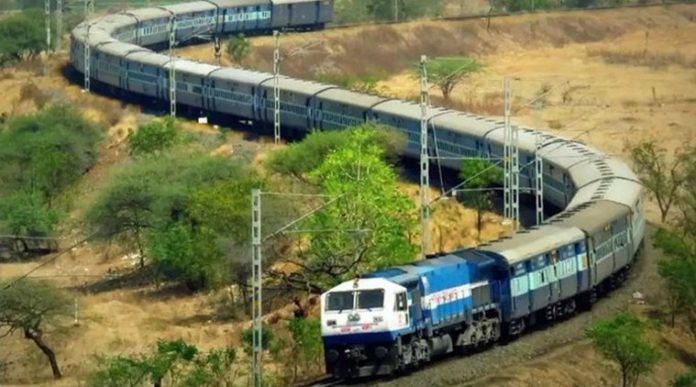
Safest year for Indian Railways; no passenger deaths in 2019-20

Representational Image (PIB)

New Delhi (NVI): Indian Railways has claimed zero passenger deaths in rail accidents in the year 2019-20, making it the national transporter’s safest year in its history, according to official data.

The remarkable feat has been achieved for the first time in this year since the introduction of the Railway System in India 166 years ago in the year 1853.

While railways witnessed staff deaths during the last year, there were no passenger deaths in the last 11 months, the data revealed.

In 2018-19, railways recorded 16 death, 28 deaths in 2017-2018 and 195 deaths during 2016-2017.

While between 1990-1995, an average of more than 500 accidents took place every year, with around 2,400 deaths and 4,300 injured in those five years, a decade later between 2013-2018, an average of around 110 accidents took place every year which killed around 990 people and injured about 1,500 people.

Railway train accidents (consequential) includes collision, derailment, fire, level crossing accidents and other miscellaneous accidents. While calculating the casualty due to a train accident, the number of persons killed are taken into account.

Railways does not count run over deaths as deaths in railway accidents.

Safety being the topmost priority of the Indian Railways, the measures undertaken for safety improvement included massive renewal of railway tracks, effective track maintenance, stringent monitoring of safety aspects, improved training of railway staff and so on.

Also total elimination of Unmanned Level Crossings Gates on broad gauge has resulted in elimination of accidents on this score thus giving huge impetus to safety of train operations.

This unprecedented feat could become possible with inputs in the system in the form of Rashtriya Rail Sanraksha Kosh (RRSK) introduced in the year 2017-18 with a corpus of Rs 1 lakh crore to be spent in the next five years, having annual outlay of Rs 20,000 crore. With this fund, it has been possible to undertake very critical safety works of urgent nature and results are evident.

Centre to create portal for data sharing in public domain: Amitabh Kant

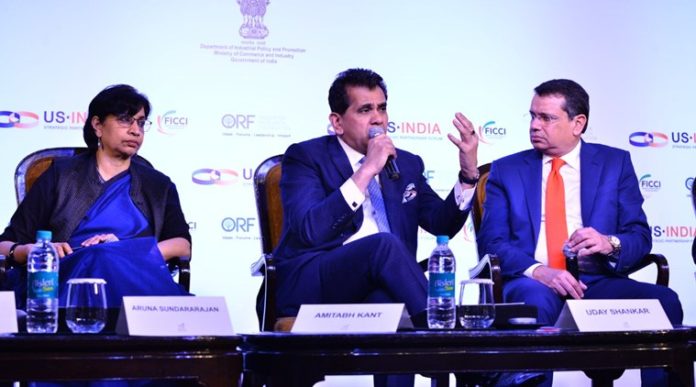
New Delhi (NVI): The Central government is in the process of creating a portal to share data on public platform for public use, NITI Aayog CEO Amitabh Kant said today.

Kant was speaking at the session on ‘Shaping the New Economy: Transitions & Trends in Technology’ during ‘US-India Forum: Partners for Growth’ organized by FICCI here, jointly with USISPF and ORF.

“India has a vast amount of data. NITI Aayog is working on a portal to put this data in an anonymous manner in public domain so that the people across the sectors can utilize it,” he said.

The NITI Aayog CEO further stated that India has over 2,000 startups working in AI and machine learning and we can’t starve the startups of data. However, he outlined that critical human personal data should be kept within the country.

Kant further added that there is a need to create an economic framework for data pooling as a business resource in a responsible manner.

“It is not possible for India to grow rapidly at high rates without a technological leapfrogging in many areas of growth. India has to get into sunrise areas of the industry, and I believe India can radically change the landscape of electric mobility,” Kant said.

He said that India offers the size and scale to do innovations across health and education among other sectors. India has a scale of data that no other country can offer. “Indians are going to use data to a greater size and scale as we are the only country in the world which has a varied bank of biometrics,” Kant added.

Highlighting the potential of Artificial Intelligence, Kant urged companies and banks to leverage on the power of machine learning and AI. “Companies or banks which do not use Artificial Intelligence or machine learning will just go bust. Companies which use the power of technology will leapfrog,” he said.

Ms Aruna Sundararajan, Former Secretary of Telecom, Government of India said, “We must open up and enlarge the regulatory sandboxes in every area and have a full play for innovations.”

FICCI Senior Vice President Uday Shankar moderated the session.

Film producer Firoz Nadiadwala meets J&K LG Murmu

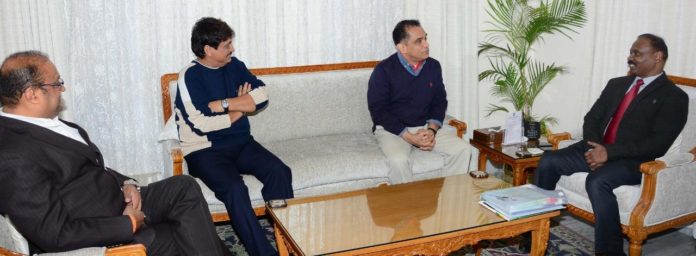
Jammu (NVI): Renowned film producer Firoz Nadiadwala today met Jammu and Kashmir Lieutenant Governor Girish Chandra Murmu and discussed various aspects and feasibility of developing the Union Territory as one of the prime choices of film shooting destination for filmmakers.

During the meeting, the Lt Governor observed that the Jammu and Kashmir administration is making the best possible efforts towards achieving the creation of a vibrant film ecosystem in the UT and creating a suitable environment and promotion of film production in J&K.

“Film production is one of the priority sectors identified for Global Investors’ Summit coming up in the month of May,” he said, adding that the breathtaking locales of J&K, a large number of religious and heritage sites, dense forests, waterfalls and a long and cherished tradition of film shooting make the UT an attractive site for film shooting and its development.

Dr Sunil Shukla, Director General, Entrepreneurship Development Institute of India (EDII), also called on the Lieutenant Governor at Raj Bhavan here. Shukla briefed the Lt Governor about efforts being made by the EDII, an autonomous and not-for-profit institute, for taking entrepreneurship to a large number of schools, colleges, science and technology institutions and management schools in several states by including entrepreneurship inputs in their curricula.

Kashmiri youngster reviving rabab, Valley’s own sound

Mubashir Bukhari

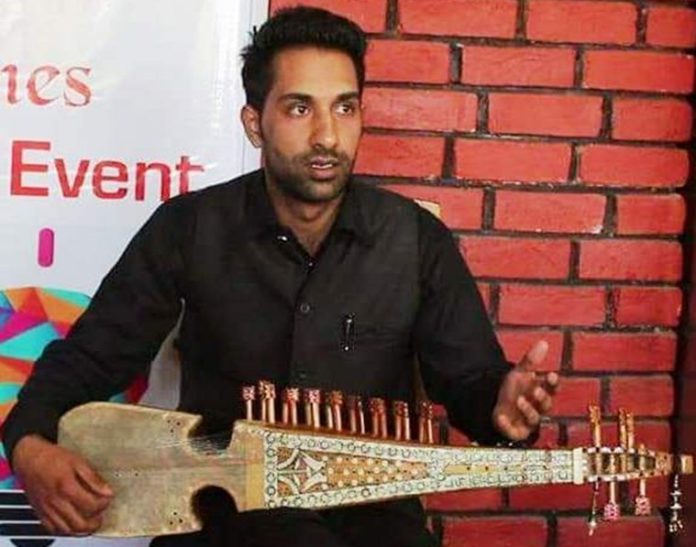
Srinagar (NVI): 25-year-year old Yawar Nazir Bhat sits cross-legged cradling a rabab in his newly built room, peculiarly without any windowpanes or doors.

As he strikes the strings of the instrument with the plectrum, the room resonates with music that is at the heart of Kashmir.

Rabab or Rubab basically originated in Afghanistan (their national instrument). Also known as the Kabuli Rabab, it made its way into India and was adopted by the people of Kashmir.

When it comes to traditional Kashmiri music, it seems incomplete without Rabab. The instrument was once popular in the 16th century in classical music circles in middle Asian countries until sarod and sitar stole its thunder.

So time to go back to Yawar Nazir Bhat’s room now, who is one of the youngest members of the Bhat family from the Kreeri hamlet of Baramulla district in Kashmir. The youngster developed a love for music from a very tender age.

Belonging to a family of musicians, Yawar says that it was only a matter of time before he picked up the instrument. “At the age of 8, I wanted to learn Rabab because it was in my blood. I had got to know about my grandfather- who was one of the famous players of this instrument in the entire J&K, and my thirst for learning this instrument increased,” says Yawar.

Three years back, Rabab was just a simple musical instrument for Yawar which was played by his grandfather. But now he connects to it and even wants to keep alive the music strumming from the instruments in the minds of people.

At 25, he has already made his name and has performed in various stage shows and concerts across India. Besides, he is also part of a music school where young boys and girls are trained to learn Rabab. “My inspiration was my grandfather but I didn’t get support from my family. But then my uncle Ghulam Nabi Bhat who was himself a famous Rabab player supported me and gifted me one,” Yawar says.

In Pune this year, Yawar received Bhai Mardana award for spreading communal harmony from a cultural organization ‘Sarhad’.

Bhai Mardana was a longtime companion of Guru Nanak Dev (Sikh Guru) and was born in a Muslim family in Rai Bhoi di Talwandi, now Nankana Sahib of Pakistan. He used to play Rabab (r-aa-bab) or rebeck as Guru Nanak sang songs of God. Later, Bhai Mardana spent his life singing and spreading teachings of Nanak, while preaching communal harmony.

Yawar wants to take forward the art of his grandfather to the next generation.

Yawar’s grandfather, Ustaad Sonullah Bhat was among the first rabab players from Jammu and Kashmir. He played Rabab for almost 30 years and represented Kashmir at national and international forums. Sonullah Bhat himself learned Rabab from his father but it was during Radio Kashmir years from 1932 to 1962, that his work got noticed. He went on to play Rabab in countries like the US, Russia, Pakistan, and Afghanistan.

Sonullah’s son, Nazir Ahmad Bhat couldn’t carry forward his father’s legacy due his own professional commitments but his brother, brother’s son and his own son have taken up the job of keeping alive the music.

Yawar shuttles between college and recording studio where he learns the technicalities of Rabab from his cousin-brother, Abdul Hamid Bhat. Though very young into this field, he gets offers from a lot of music bands of the valley to perform with them. “New generation is more towards modern instruments. But I feel we should not forget our history and our culture. It is easy to learn Guitar or Piano than to learn Rabab. Why I choose this? Because it’s what my grandfather has left behind,” said Yawar.

Yawar’s cousin, Abdul Hamid Bhat (42) another grandson of Sonullah Bhat and the instructor of Yawar, from the age of 10, has learned this instrument from his father and has been into this field from the last 30 years. After Sonullah, he is the only one from the family who has kept this dying art alive and is still performing at various forums like his grandfather used to and is associated with Radio Kashmir.

Abdul Hamid has been part of various state-sponsored programmes and has played Rabab at Radio Kashmir, Doordarshan, Hyderabad, Karnataka, Jaipur, Indore, and Bombay. He was part of the artistes’ group who visited Lima, Capital of Peru and performed there. He has also performed in Senegal in West Africa.

Besides, that he is running ‘Sonullah Bhat Folk Music School’ in Kreeri along with Yawar. “We started this school with the help of the Ministry of Culture so that the dying art of rabab will be revived. And secondly, we won’t let it disappear as it is our Miras,” says Hamid.

He said that though they have few students in the school who come to learn, the number is growing day by day. Hamid believes that Kashmiri culture is incomplete without Rabab. “Some people think Rabab is played in “Chakker” (Kashmiri folk music) only but that is wrong. It’s a very important component in ghazals, Sufi classic, Indian classic,” he says.

Class 10 student prevented from joining militancy: J&K Police

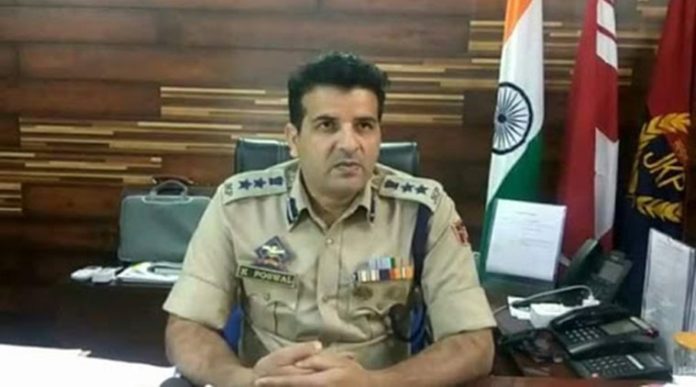
Senior Superintendent of Police Ganderbal, Khalil Ahmad Poswal

Mubashir Bukhari

Srinagar (NVI): Jammu and Kashmir police today claimed that it detained a Class X student and prevented him from joining militancy in Central Kashmir’s Ganderbal district.

Senior Superintendent of Police Ganderbal, Khalil Ahmad Poswal said that the boy had joined many groups on WhatsApp, “who were spreading rumours, radicalising youth and propagating hatred against India.”

“All the socials sites were accessed by the accused through misuse of internet by using 15 different VPNs. He was ready to join militancy as the Pakistani handler, had got established his contacts with militant groups in Shopian. Timely intervention of Police saved the youth from joining militancy,” he said.

According to the police, an FIR was registered against the student. “It has been found that the accused is highly radicalised, has uploaded objectionable contents on Facebook which includes propagation of ISIS ideology,” police said.

Considering the tender age of the student, Police said that they will try to provide proper counselling to the boy and talk to his family.

Police also said that they have started a drive against all those who are misusing the VPNs for their involvement in heinous and unlawful activities.

“General public is informed through media not to use VPNs for accessing the social sites. Legal action will be taken against all those who violate the Government directions and the provisions,” police said.

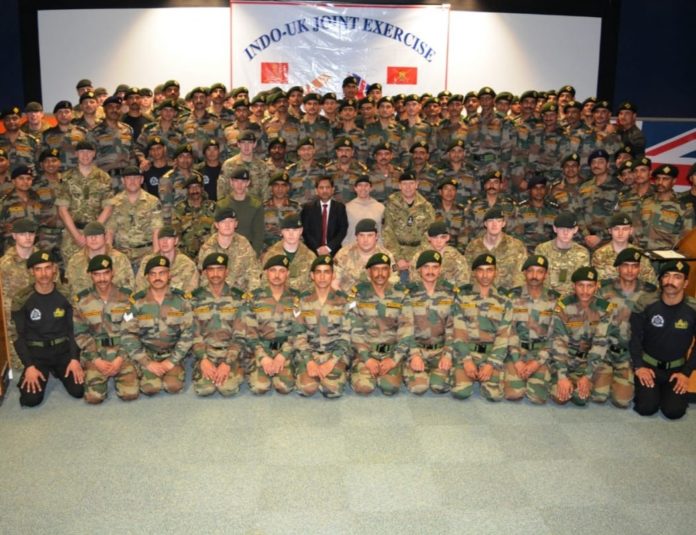
India-UK joint military exercise ‘Ajeya Warrior’ concludes

New Delhi (NVI): The fifth edition of joint military exercise between India and United Kingdom — Ajeya Warrior 2020 — concluded at Salisbury Plains in the UK.

The closing ceremony was attended by Brigadier Tom Bewick, Commander of UK 7 Infantry Brigade and Brigadier Gavin, Defence Attache of the UK in India, the Ministry of Defence said in a statement here today.

The exercise started on February 13. The fifth edition of the exercise included joint training in urban and semi-urban areas.

As part of the exercise, important lectures, demonstrations and drills related to counter-insurgency and counter-terrorist operations were rehearsed and executed jointly, the MoD said.

The bonhomie and camaraderie displayed by the troops, thereby ensuring integration and achievement of interoperability at all levels, was among the highlights of the exercise.

Besides promoting understanding and interoperability between the two armies, it further helped in cementing ties between both the nations, an official statement said.

In the series of military training exercises undertaken by India with various countries, exercise Ajeya Warrior with the United Kingdom is an important exercise in terms of the security challenges faced by both the nations in the realm of changing facets of global terrorism.

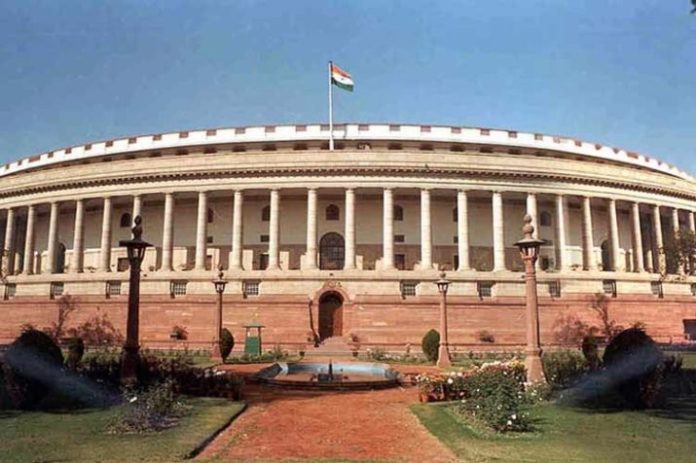
Polls to 55 Rajya Sabha seats on Mar 26

New Delhi (NVI): Polls in 55 Rajya Sabha seats which are falling vacant in April will be held on March 26, the Election Commission said today.

“The term of office of 55 members of the Rajya Sabha elected from 17 States is due to expire on their retirement in April 2020,” the EC said in a statement.

These seats from 17 states are falling vacant on different dates in April due to the retirement of members.

While notification for the biennial elections will be issued on March 6, March 13 is the last date of filing nominations.

The votes will be counted at 5 pm on the same day of voting, an hour after the polling will end.

Maharashtra has the highest number of retiring MPs at seven. Prominent among them is NCP leader Sharad Pawar, followed by Tamil Nadu with six, West Bengal and Bihar with five seats each, Gujarat, Odisha, and Andhra Pradesh with four each.

Assam, Rajasthan, and Madhya Pradesh each will have three seats vacant by April 12, Jharkhand, Haryana, Telangana, Chhattisgarh will have two seats and Meghalaya, Manipur, Himachal Pradesh will have one vacant seat each.

10 lakh smart meters installed across India: Power Minister

New Delhi (NVI): Around ten lakh smart meters have been successfully installed across India under the Central government’s Smart Meter National Programme (SMNP), Power Minister RK Singh said today.

Operational in Uttar Pradesh, Delhi, Haryana and Bihar, these smart meters aim to bring efficiency in the distribution system leading to better service delivery, the Ministy of Power said in a statement here.

The programme is being implemented through Energy Efficiency Services Limited (EESL), it added.

(EESL) is a joint venture of PSUs under the Ministry of Power which was set up by the government to facilitate energy efficiency projects and to work as Energy Service Company.

At an event here to mark 10 years of EESL, the Power Minister also announced the commissioning of 100 Mega Watt cumulative capacity decentralised solar power plants connected to agriculture feeders.

The capacity of these solar power plants, in each substation, ranges from 0.5 MW to 10 MW.

The decentralised solar plants cater to the requirements of farmers connected to the respective agriculture feeder daily, by means of reliable day time electricity.

The minister also launched the dashboards of Smart Meter National Programme (SMNP), National Electric Mobility Programme and solar initiatives to transparently monitor the real time progress of the programmes and its impact.

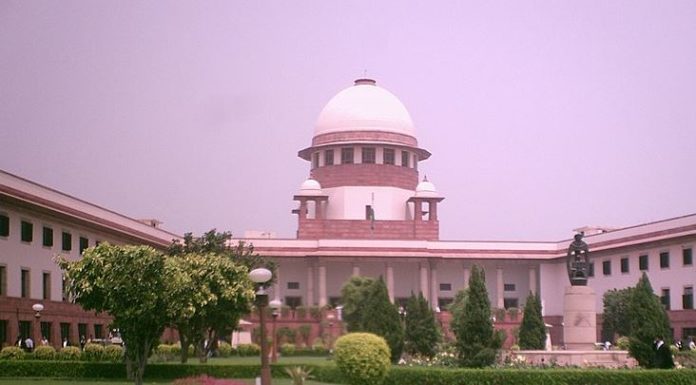
Five SC judges down with Swine Flu: Health Min

New Delhi (NVI): Five judges of Supreme Court are suffering from Swine Flu, the Ministry of Health said today while releasing a statement regarding preventive measures taken at SC premises to curb the situation.

“Five judges of Hon. Supreme Court of India have been affected from Swine Flu which is caused by H1N1 virus,” the ministry said in a statement.

“All the judges were provided treatment as per the protocol. Prophylactic Treatment was also given to all who have come in contact with them including their family members,” the ministry added.

The judges infected by the H1N1 virus were not able to attend court today, reports in the media said.

Meanwhile, the Health Ministry said that all five judges were kept in home isolation.

“Of these, three Judges have already resumed their duty and two continue to be under home isolation/observation and are recovering,” it said.

Apart from this, First Aid Post (FAP) of CGHS was strengthened at the Supreme Court premises as a preventive measure.

The court rooms and residences are being sanitised and awareness regarding preventive measures was disseminated to all concerned, an official statement read.

A H1N1 sensitization workshop for lawyers and other staff members will also be conducted by Ministry of Health & Family Welfare at Bar Council of India office tomorrow, it added.

H1N1 is a seasonal infection which usually occurs every year with two peaks (One in January to March and other between July to September).

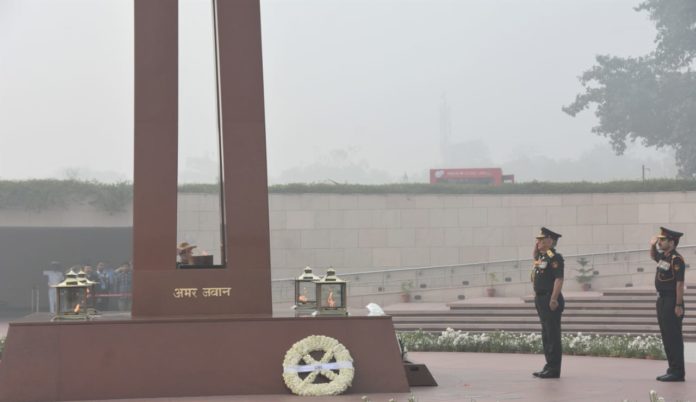
1st anniv of National War Memorial

General Bipin Rawat laid wreath at the National War Memorial (Source: @adgpi)

New Delhi (NVI): The first anniversary of the National War Memorial was marked here today as Chief of Defence Staff General (Retd) Bipin Rawat paid tributes to martyrs in a solemn wreath-laying ceremony.

National War Memorial is a tribute by the grateful nation to its fallen heroes in the line of duty during various external wars and Internal security challenges that the Armed Forces of the country have faced since 1947.

Gen. Rawat, along with veterans from the three armed services paid homage to the fallen heroes, the Ministry of Defence said in a statement.

The memorial was dedicated to the nation by Prime Minister Narendra Modi a year ago on this day.

Since its inauguration last year, around 21 lakh people have visited the memorial with over 5,000-7,000 people foot-fall at the monument every day.

MUST READ