Friday, March 6, 2026
Home Blog Page 1415

China, Pak, Bangladesh, Afghan climbers need permission to climb Indian peaks: MHA

File photo.

New Delhi (NVI): Mountaineers from China, Pakistan, Bangladesh and Afghanistan will now have to take prior permission for climbing peaks which are opened in India, according to a government order.

According to a Home Ministry gazette notification dated December 19, these mountaineers will have to follow the routes prescribed by the Indian Mountaineering Foundation.

Amending the Foreigners Order, 1948, the Home Ministry said, “Prior permission of the Central Government shall be required by nationals of China, Pakistan, Bangladesh, Afghanistan or persons having their origin in the said countries even for climbing peaks which are so opened under specific orders issued by the Central Government”.

The Home Ministry order further said, “The Indian Mountaineering Foundation shall specify routes, attach liaison officer and impose such restrictions as it may deem necessary in respect of peaks which are so opened under specific orders issued by the Central Government”.

The order also said that no foreigner or group of foreigners shall climb or attempt to climb any mountain peak in India, except those peaks which are opened for mountaineering or trekking expeditions under specific orders issued by the Central Government from time to time with routes.

India, China military drill concludes

India-China Joint Training Exercise “Hand-in- Hand” concluded on December 20.

Shillong (NVI): The joint military exercise, aimed at building and promoting positive relations between the armies of India and China culminated today at the Joint Training Node, Umroi Military Station in Meghalaya.

The eight edition of India-China Joint Training Exercise “Hand-in- Hand” commenced on December 7.

The drill was aimed at practicing the participating infantry companies of India and Chinese armies in joint drills of counter-terrorism operations in semi-urban terrain under the United Nation mandate, an official statement said.

The exercise entailed firing from each others weapons, conduct of tactical lectures and demonstration by both the countries on various aspects of counter-terrorism operations. It included physical training activities ranging from endurance runs, battle obstacle courses and games.

The high joint training standards achieved by both contingents were on display during a 72 hours field training exercise which encompassed various drills requiring seamless integration of action of the part of troops involved in the facets of counter-terrorism operations in conjunction with gruelling methods to execute the assigned tasks.

The exercise culminated with a glittery closing ceremony where the participating troops displayed high standards of military drill.

The closing ceremony was reviewed by Major General JS Sandhu in the presence of other senior officers of both the participating countries. The Chinese side was represented by Major General Li Shizong.

The bonhomie achieved between the troops was at display during the campfire. The two armies have gained from each others expertise and experience in conduct of counter-terrorism and company level operations.

Tremors in north India as 6.3 magnitude quake rocks Afghanistan

New Delhi(NVI): Strong tremors were felt in several parts of north India including Delhi-NCR at around 1715 hours.

According to National Center for Seismology, an earthquake measuring 6.3 on the Richter Scale jolted Afghanistan at around 1709 hours today.

The epicentre of the quake was 244 km north northeast of Kabul in Afghanistan.

Tremors were also felt in Pakistan.

CAA stir: DMRC shuts several metro gates

New Delhi(NVI): The Delhi metro shut the entry and exits gates of several metro stations of various lines due to Citizenship Amendment Act (CAA) protest in the some parts of the National capital.

According to DMRC, Metro Stations–Rajiv Chowk, Central Secretariat, Mandi House, Janpath, Pragati Maidan, Khan Market, Johri Enclave, Shiv Vihar, Dilshad Garden, Chawri Bazar, Lal Quila, Jama Masjid, Delhi Gate, Jaffrabad, Maujpur-Babarpur and Jamia Millia Islamia  have been closed but interchange facility is available.

Hundreds of protesters gathered at Delhi’s Jama Masjid located in the old city, to join a protest against the CAA.

Holy city Varanasi most sought after destination: Jitendra Singh

Minister of State in PMO Dr Jitendra Singh at the ceremonial launch of GoAir flight from Delhi to the Holy city of Varanasi.

New Delhi (NVI): The holy city of Varanasi is one of the most sought after destinations, not only for religious tourism but also for exploring tourists, Minister of State in PMO Dr Jitendra Singh said here today.

“Varanasi is the face of India’s ancient civilization and culture,” the Minister said while launching the inaugural flight of GoAir from Delhi to Varanasi, here today.

“Religious domestic tourists, of course, do come to Varanasi, but hordes of foreigners also throng to this holy city to experience and study India’s ancient civilization and culture. The visit creates a natural bonding between visitor and India’s rich heritage and culture,” Dr Singh said.

He said that in the last five years, Varanasi had been bestowed the pride of place which it was worthy of he said. Adding that “Varanasi district has undergone so much development and beautification that it is difficult to believe without seeing and experiencing it”.

Complimented the airlines for launching another flight to Varanasi from Ahmedabad, the Minister remarked, “What a lovely coincidence that the Prime Minister’s constituency and his home state are being connected today by a direct flight”.

On the occasion, Dr Singh also asked the airlines management to consider launching a late evening flight from Jammu to Delhi, the statement added.

COP25 outcome balanced with exception of climate finance issues: Javadekar

Environment Minister Prakash Javadekar addressing press conference in New Delhi on December 20.

New Delhi (NVI): With the exception of climate finance issues, India considers the outcome of COP25 a balanced one, which addresses concerns of all parties, especially developing countries and provides necessary building blocks for successful implementation of the UNFCCC and its Paris Agreement, Environment Minister Prakash Javadekar said.

“India engaged constructively in negotiations while protecting India’s key interests including consideration of principles of equity and Common but Differentiated Responsibilities and Respective Capabilities (CBDR-RC), need for enhanced means of implementation including climate finance, technology transfer at affordable costs and capacity-building support, from developed to developing countries in accordance with their obligations under the UNFCCC and Paris Agreement”, Javadekar said while addressing a press conference here today.

The crucial COP25 meeting was held in Madrid, Spain under the Presidency of Chile from December 2 to 15. The conference, which was expected to conclude on December 13, was extended till 15th, to arrive at a consensus on a range of issues, particularly Article 6 of Paris Agreement, Warsaw International Mechanism for Loss and Damage associated with climate change impacts and climate finance.

He said, “Prime Minister Narendra Modi has increased the target for renewables from 175 Giga Watts to 450 Giga Watts at the recent UN Climate Action Summit. India is simultaneously progressing on solar, biomass and wind energy”.

The COP25 decision, titled Chile Madrid Time for Action, emphasises the continued challenges that developing countries face in accessing financial, technology and capacity-building support, and recognises the urgent need to enhance the provision of support to developing country parties for strengthening their national adaptation and mitigation efforts, an official statement said.

The decision also recalls the commitment made by developed country parties to a goal of mobilising jointly USD 100 billion per year by 2020 to address the needs of developing countries.

On the issue of global ambition for combating climate change, the decision adopted provides for a balanced and integrated view of ambition that includes not only efforts for climate change mitigation, but also for adaptation and means of implementation support from developed countries to developing countries.

India’s five trillion dollar economy goal is achievable: Modi

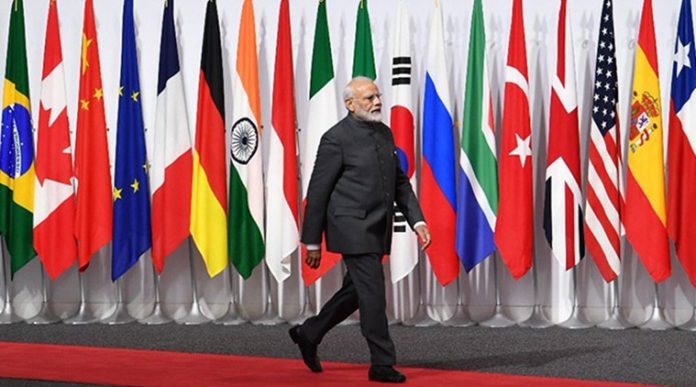
Prime Minister Narendra Modi

New Delhi (NVI): Stating that five trillion dollar economy is “achievable”, Prime Minister Narendra Modi today said that to achieve this target the government will invest Rs 100 lakh crore in the infrastructural sector and another Rs 25 lakh crore in the rural sector.

Inaugurating the ‘Hundred Years of ASSOCHAM’ here, the Prime Minister said, “The idea of making India a five trillion dollar worth economy is not a sudden one, our country has strengthened itself so much in the last five years that we can aim to achieve such goals”.

“Five years before, the economy was heading for . Our government has brought in fundamental changes in India’s economy so that it can run with set rules in a disciplined manner,” Modi said.

He said, “We have met with the decades old demands of the Industrial Sector and we have built a strong foundation for a five trillion dollar economy ”.

He said that the government was building the Indian economy on two strong pillars of “formalisation and modernisation”.

“We are trying to bring in more and more sectors into the horizon of formal economy. Along with this we are linking our economy with latest technology so that we can speed up the process of modernisation,” he added.

He said that through automation a new company gets registered in just few hours. Adding that “Automation is helping quick trading across”.

The Prime Minister said that the country could make a significant jump in the rankings of Ease of doing business due to a sustained effort.

“Ease of doing business may sound just like four words, but in order to improve its rankings there is a lot of effort that goes into it including changing the policies and rules at the ground level, ” he said.

“Today we have a government that listens to the industry, understands its needs and which is sensitive to its suggestions.

He also emphasised the efforts being made towards a faceless tax administration in the country in order to reduce human interface between the tax payer and authorities.

“In order to bring about transparency, efficiency and accountability in the tax system, we are moving towards a faceless tax administration”, he added.

He said that the government had decriminalised several laws in the corporate sector to reduce the burden and allow the industry to function in a fearless ecosystem.

Prime Minister said that the Corporate Tax at this time in the country is the lowest ever and this would propel a boost in the economic growth.

“The Corporate Tax is the lowest at the moment, meaning if there is any government that is taking the lowest Corporate Tax from the industry, then it is ours, ” he added.

He also spoke about the efforts being made towards bringing about labour reforms, besides sweeping reforms in the Banking Sector to make it more transparent and profitable.

“Owing to the steps taken by the government, today 13 banks are on the path of profit out of which six banks are out of PCA. We have also hastened the process of unification of banks. Today banks are expanding their countrywide networks and are in the direction of achieving global recognition” he added.

India sends first shipment of vegetables to Dubai from Varanasi

APEDA

New Delhi (NVI): In its endeavor to promote exports from agriculture produce rich regions of the country, Agricultural and Processed Food Products Export Development Authority (APEDA) today flagged off the first shipment of vegetables by sea route from Varanasi to Dubai.

APEDA in association with Uttar Pradesh government has organised sending trial shipment of one container of fresh vegetables by sea route to Dubai.

The container will have 14 Mts of fresh vegetables exported by an export house from Mumbai supported by Vegetables and Fruits Exporters Association (VAFA) and sourced from three FPOs of Ghazipur and Varanasi, an official statement said.

Considering the potential of production of fruits and vegetables in Varanasi region comprising of five districts — Ghazipur, Jaunpur, Chandauli, Mirzapur and Sant Ravidas Nagar — APEDA is in the process of setting up Agri export hubs in these districts.

Notably, VAFA, Mumbai has signed MoU with four FPOs for sourcing of fresh vegetables and fruits for export to international markets.

FPOs have been engaged to ensure supply of quality produce from the region. The initiative of setting up the Agri Export hub in Varanasi is now yielding results with the sending of the first trial shipment of vegetables sourced from FPOs in Varanasi region to Dubai by sea route for the first time today, the statement said.

APEDA is an organisation under the Commerce and Industry Ministry and is responsible for promoting exports of agriculture and processed food products from India.

Goyal asks gem and jewellery sector to create jewellery parks

New Delhi (NVI): The government has asked members of Indian gem and jewellery sector to explore the possibility of creating jewellery parks on lines of the gold souk in Dubai to attract buyers from domestic market and overseas.

Speaking on the occasion of the 46th India Gem and Jewellery awards 2019 held on Wednesday, Piyush Goyal said, “Members of this sector may also explore the possibility of creating jewellery parks on the lines of the gold souk in Dubai to attract buyers from the domestic market and also overseas”.

He said that India has a huge potential to grow in the trade and creating more jobs and assured that the government will extend all help to the sector to achieve its target of USD 75 billion.

“Indian gem and jewellery sector is the global hub of jewellery and contributes to around seven per cent of the country’s GDP and 15 per cent to India’s total merchandise exports,” he said.

He also urged entrepreneurs in the sector, to make full use of the soon to be launched NIRVIK Scheme of ECGC that will ease the lending process and enhance loan availability for exporters.

“It will also make foreign exchange loans available at much cheaper rates not only for large export houses but also small exporters,” Goyal said.

The Minister said the gem and jewellery sector must also address the issue of unnecessary import of gold.

He urged those associated with the sector to device a scheme that will help the Government to unlock this asset that is lying locked up in personal vaults of the citizens which will help reduce the burden on India’s FOREX reserves.

The Minister also appreciated the work being done by this sector in the fields of education especially children in tribal areas through the ‘Ekal Vidyalayas’ and urged the sector to establish awards in categories like units giving highest worker’s benefits like health insurance and education of children and spend more CSR funds on the five million employees, and their families, engaged in this sector.

He also gave away awards in recognition of business excellence in the sector that is helping to strengthen Brand India.

Vasant Mehta received the lifetime achievement award, for his role in transforming the Indian diamond manufacturing industry into a global jewellery manufacturing hub that boasts of quality and design oriented jewellery.

ADB, India sign $ 490 mn loan for upgradation of MP roads

Representative picture.

New Delhi (NVI): The Asian Development Bank (ADB) and the Union government today signed a $490 million loan for public-private partnership (PPP) project to upgrade about 1,600 km of state highways and major district roads (MDRs) in Madhya Pradesh.

Besides, another $286 million investment will be mobilised through private sector participation under the PPP modality.

The project will upgrade 750 km of state highways and 850 km of MDRs to two-lane and all-weather standards with road safety features, an official statement said.

It will also develop an e-maintenance system, which can record defects or required maintenance, along with a training programme to develop capacity on contract implementation and project finance in Madhya Pradesh Road Development Corporation.

Since 2002, ADB has provided the state government with five loans to develop its road network, improving about 7,300 km of roads or about 11 per cent of the total network.

Speaking on the occasion, Additional Secretary (Fund Bank and ADB) Sameer Kumar Khare said that the state highways and major district roads provide a crucial link between rural roads and national highways.

The upgradation of these roads under the project will improve rural and peri-urban connectivity in the state and improve access to markets and better services, he added.

Country Director of ADB’s India Resident Mission, Kenichi Yokoyama said that the project continues ADB’s engagement with the state’s road sector since 2002. This will open a new partnership by introducing PPP through the hybrid-annuity model, thereby leveraging government financing and improving the sustainability of capital investments.

Notably, under the hybrid-annuity model, the government will release 60 per cent of the total project cost during construction, to be paid to the concessionaire in tranches linked to completion milestones. The remaining 40 per cent is arranged by the concessionaire in the form of equity and commercial debt. Once the project is completed, the government will repay the concessionaire’s financial investment over 10 years.

MUST READ