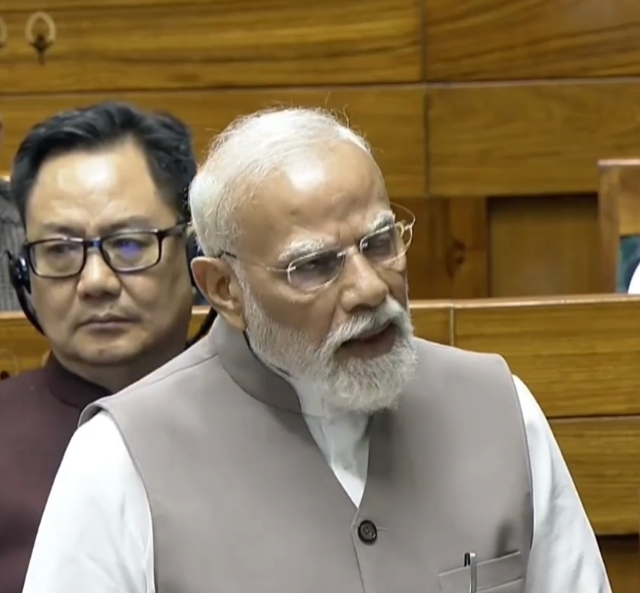
New Delhi, Mar 23: As the West Asia war continues to rage into the 4th week, Prime Minister Narendra Modi today spoke on the issue in Parliament, highlighting how it is posing “unprecedented challenges” to India and asserting that closure of the Strait of Hormuz and attacks on infrastructure in oil and gas rich region was not acceptable.
Modi underlined that the crisis in West Asia is not limited to that region but is affecting the entire world.
The war in West Asia started on February 28 when the US and Israel launched air strikes on Iran and assassinated its Supreme Leader Ayatollah Ali Khamenei and some other top leaders.
Iran retaliated by carrying out attacks on Israel and American military and economic assets in the Gulf countries, including Saudi Arabia, Qatar, UAE, Bahran, Oman and Kuwait.
Impact on India:
“The war has created new challenges for India as well…. West Asia war has created unprecedented challenges for India too,” Modi said while making a statement in the Lok Sabha.
“India is facing economic and security challenges due to the war in West Asia,” he said.
Regarding Indians in the Middle East:
The Prime Minister said his government is actively working to ensure safety of Indians living in Gulf countries.
Around 1 crore Indians live in the Gulf, Modi pointed out and said the Government of India is providing all help to Indians living in the Gulf.
He said he has been in touch with leaders in the region. “I have spoken to leaders of the Gulf countries and they have given assurances regarding safety of the Indians there,” he said.
“Our missions in the affected countries are continuously engaged in helping Indians. Whether it’s Indians working there or tourists who have gone there, everyone is being provided with all possible assistance.
“Our missions are regularly issuing advisories. 24/7 outreach rooms and emergency helplines have been established in India and other affected countries.
“Through these, all affected people are being provided with the latest information,” he said.
Evacuation of Indians
Giving an overview regarding the evacuation efforts, PM Modi said, “Since the war began, more than 3,75,000 Indians have returned safely to India.
“From Iran, nearly 1,000 Indians have returned safely so far, of which over 700 are medical students.
“In view of the situation, CBSE has cancelled Class 10 and 12 exams in the schools in Gulf countries and is taking necessary steps to ensure students’ education continues without disruption,” he said.
Strait of Hormuz:
PM Modi highlighted that a large quantity of crude oil, gas, fertilisers and many essential items comes to India through the Strait of Hormuz route.
“Since the war began, the movement of ships through the Strait of Hormuz has become very challenging. Despite this, our government has made efforts to ensure that the supply of petrol, diesel, and gas is not severely impacted.
He added that, “Attacks on commercial ships and disruptions in international waterways like the Hormuz Strait are unacceptable. Through diplomacy, India is continuously making efforts for the safe passage of Indian ships, even in this atmosphere of war.”
Efforts to tackle domestic impact:
“As we all know, the country imports 60% of its LPG requirement. Due to uncertainty in supply, the government has prioritised domestic LPG consumers,” PM Modi said.
“At the same time, domestic production of LPG is also being increased. Continuous efforts have also been made to ensure that the supply of petrol and diesel across the country remains smooth…,” he said.
The Prime Minister also spoke about steps being taken within the country to manage the impact of the crisis. “Domestic LPG production is being increased,” he said.
He added that “ethanol blending in petrol has reached 20 per cent.”
Attacks on infrastructure in West Asia:
PM Modi also said that attacks on infrastructure in the West Asia region was unacceptable and should be avoided.
He was referring to the attacks on oil and gas installations in the countries in the region during the ongoing war. (NVI)