Srinagar, April 30: A proposed amendment to Jammu and Kashmir’s Revenue Service recruitment rules has ignited a wider political and cultural debate, turning what began as a procedural update into a flashpoint over language, identity, and administrative access.
The draft proposal, currently open for public feedback, has drawn strong criticism from the Peoples Democratic Party (PDP), which alleges that the move could dilute the role of Urdu in government services. However, the National Conference-led administration has rejected these claims as premature, maintaining that no final decision has been made.
Protests and Political Reactions
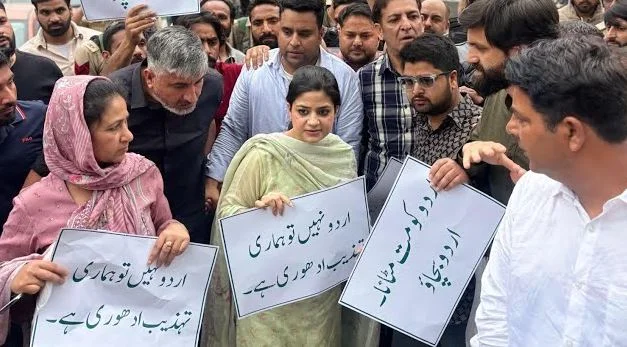
The issue spilled onto the streets of Srinagar, where PDP leader Iltija Mufti led protests, framing the proposal as a threat to the region’s linguistic heritage. She argued that Urdu has historically served as a unifying language across communities and remains deeply embedded in governance and daily life.
In response, government representatives clarified that the notification was only meant to invite public opinion. Advisor Nasir Aslam Wani stated that Urdu continues to hold importance in revenue administration and will not be removed from recruitment processes.
Why Urdu Matters in Administration
Urdu has long been central to governance in Jammu and Kashmir, particularly in land and revenue records. For decades, it was mandatory for key administrative roles such as Patwari and Naib Tehsildar because official documents were maintained in the language. Officials argue that removing this requirement without adequate transition measures could create practical challenges in handling existing records.
Historical Context
Urdu became the official court language in 1889 under Maharaja Pratap Singh, replacing Persian. It remained the sole official language of the region for over a century, serving as a link language among diverse linguistic groups including Kashmiri, Dogri, and Punjabi speakers.
Following the abrogation of Article 370 and the reorganisation of Jammu and Kashmir into a Union Territory, the government expanded the list of official languages to include Kashmiri, Dogri, Hindi, and English alongside Urdu. This ended Urdu’s exclusive status.
The Core Debate
At the heart of the controversy lies a larger question: should recruitment policies prioritise administrative practicality or reflect evolving linguistic diversity?
Supporters of the proposed changes, including voices aligned with the Bharatiya Janata Party, argue that removing mandatory Urdu requirements promotes inclusivity and opens opportunities for candidates from different linguistic backgrounds.
Opponents, however, warn that reducing Urdu’s role risks weakening a language deeply tied to the region’s history and governance. They also highlight the continued reliance on Urdu in official records, suggesting that abrupt changes could disrupt administrative efficiency.
What Lies Ahead
With the proposal still under review, the government has emphasised that public consultation is part of a democratic process. The final decision is expected to balance concerns around inclusivity, administrative needs, and cultural preservation.
For now, the debate continues to reflect a broader tension between modern policy reforms and the preservation of linguistic identity in Jammu and Kashmir.