
By Ajay Kaul
New Delhi: It is October 22 today, one of the darkest dates in the history of Jammu and Kashmir.
It was on this day in 1947 that the geography of Jammu and Kashmir was changed by a barbaric and bloody invasion by Pakistan Army and its affiliated militia driven by an inhuman lust for the heavenly territory.
Through this brazen aggression, Pakistan caused massive levels of miseries to the people of Jammu and Kashmir and left wounds which continue to fester even 79 years after.
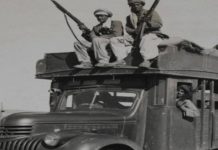
On this day in 1947, Pakistan sent lakhs of heavily-armed personnel, including regular army soldiers and tribesmen, with the objective of forcibly annexing Jammu and Kashmir, which was till then a Princely State ruled by Dogra King Maharaja Hari Singh.
Actually, when reorganization of India was taking place under the Partition process, the rulers of all Princely States of the undivided India had to choose between the Indian Dominion and the Pakistani Dominion.
Hari Singh wanted time to take a decision, even as the most popular leader of Kashmir at that time, Sheikh Mohammad Abdullah, was in favour of joining India.
While seeking time, Hari Singh officially proposed on August 12, 1947, a Standstill Agreement with both India and Pakistan till the time he made a decision about the fate of Jammu and Kashmir.
Under the proposal, the Maharaja would maintain his authority on administrative aspects like trade, communications and postal services of Jammu and Kashmir while the political future was to be decided at a later stage.
Pakistan quickly accepted the proposal on August 15, 1947.
India, on the other hand, suggested negotiations to decide on the terms of the proposed agreement and Hari Singh agreed to it.
While this process was underway, Pakistan launched an invasion on October 22, 1947, under a criminal operation, codenamed ‘Operation Gulmarg’.
It was led by Pakistan Army’s Major General Akbar Khan. But to cause deception, the troops were sent in civilian clothes to appear as tribesmen.
Pakistan thought its objective could be achieved within days as Hari Singh had under his command a small and ill-equipped military force.
After storming into Jammu and Kashmir, the Pakistani invaders unleashed brutalities on local people, particularly targeting minority Hindu Pandits, Sikhs and Christians. They indulged in mass killings, rapes, arson and looting as they moved towards Srinagar.
Several women and girls of Kashmiri Pandits, Sikhs and Christians were gang-raped and several of them were kidnapped and taken to Pakistan by the invaders.
As Maharaja’s forces were no match for the large number of better-trained and brutal Pakistani invaders, Sheikh Abdullah marshalled thousands of volunteers, including Kashmiri Muslims, Pandits and Sikhs, to counter the advancing raiders.
With a few weapons, many of the volunteers armed themselves with sticks, sickles and other farming tools.
But their motivation to defend their pious land of Jammu and Kashmir from the Pakistani invaders was massively high. They fought as much they could, to stop the advance by the Pakistani forces.
Realizing the unfolding catastrophe where even he could have been captured, Maharaja Hari Singh fled from Srinagar to Jammu and sought urgent help from India.
However, the Indian government, led by Prime Minister Jawahar Lal Nehru, pointed out to the Maharaja that he had still not given his consent for accession and hence, it would be not be possible to provide military support.
It is then that the Maharaja, using his powers as the Ruler of Princely State of Jammu and Kashmir, signed the Treaty of Accession on October 26, 1947.
The very next day, Indian troops arrived in Srinagar where they got a rousing reception from hundreds of Kashmiris, mostly Muslims, at the Airport. Immediately, they launched an operation to flush out the Pakistani invaders from Jammu and Kashmir.
In fact, when the Indian troops landed, the Pakistani invaders had reached the outskirts of Srinagar city. Fierce fighting ensued and the Indian troops started pushing back the Pakistani invaders who suffered huge casualties and retreated.
Pakistan sent in more regular troops but they were no match to the Indian forces.
In the subsequent months, Pakistani invaders were pushed back beyond Baramulla, Kupwara, Tangdhar etc.
However, they were still occupying several parts of the state, including the major towns of Muzaffarabad, Rawalakot, Kotli, Gilgit and Baltistan and the Indian forces were engaged in throwing them out.
But then a Ceasefire was imposed by the UN Security Council (UNSC) in January 1948, under which, troops of both India and Pakistan had to stay put at the places they were at that point of time.
The UNSC, through a Special Resolution No. 47, also mandated certain steps to be taken by both India and Pakistan with respect to Jammu and Kashmir.
The first step mandated that Pakistan should withdraw “tribesmen and Pakistani nationals not normally resident therein who have entered the State for the purpose of fighting, and to prevent any intrusion into the State of such elements and any furnishing of material aid to those fighting in the State.”
The second step prescribed that India should have its forces “to the minimum level required for law and order” after withdrawal of the Pakistani intruders.
The UNSC also said that Pakistan should “provide full freedom to all subjects of the State, regardless of creed, caste, or party, to express their views and to vote on the question of the accession of the State, and that therefore they should co-operate in the maintenance of peace and order.”
Pakistan never fulfilled the steps mandated by the UNSC Resolution, thus making a mockery of the world body’s decision.
As a result, Pakistan continues to illegally occupy about 78,000 square kms of Jammu and Kashmir, which was thus divided into two parts and continues to be in that condition.
Pakistan did not even return thousands of Kashmiri women and men, mostly Pandits, who were abducted by the invaders. Such is the evil character of Pakistan.
The people of Jammu and Kashmir in the illegally-occupied parts have been suffering for all these decades because of the Pakistani oppression and brutalities.
But finally, they have risen and since the last four-and-a-half months, a revolt against Pakistan is underway in Pakistan-occupied Jammu and Kashmir (POJK), misleadingly called ‘Azad Kashmir’ by Pakistan. (NVI)