
Tuesday, June 23, 2026
Home Blog Page 1238

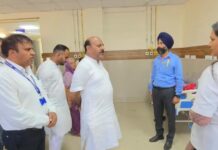
Odisha: Pvt hsptl in Bhubaneswar sealed after 27 Covid cases found, including staff

Subrat Kumar Sarangi

Bhubaneswar (NVI): A private hospital in the city has been sealed by Bhubaneswar Municipal Corporation after 27 fresh Covid-19 positive cases were found, a maximum of them being the staff members.

According to sources, Blue wheel Hospital in Mancheswar Industrial Estate has been sealed after fresh cases were found.

The municipal corporation has issued a show-cause notice to the hospital for violation of COVID-19 guidelines by the government.


After detection of the positive cases, all direct contacts of the cases have been quarantined and premises of the hospital have been sanitised to avoid the further possibility of spread of infection.

The total number of coronavirus cases in Odisha touched 5,752 today after 290 fresh cases were reported in the last 24 hours, according to Odisha State Information and Public Relations Department data.

-ARK

Bangladesh COVID-19 tally tops 1.22 lakh; 1,582 dead

Bangladesh lockdown

New Delhi (NVI): As Bangladesh is witnessing a spurt in the number of coronavirus cases and deaths, 37 new fatalities were reported in the last 24 hours taking the total death toll to 1,582.

In addition to this, 3,462 new cases were also detected during this period, taking the total number of Covid-19 patients in the country to 1,22,660, according to United News of Bangladesh.

So far, 49,666 people have recovered in the country after 2,031 more patients were recovered during this period.

The detection rate of new patients was recorded at 21.07 percent today in the country, according to media reports.

Against the total number of detected cases, the recovery rate is 40.49 percent while the mortality rate is 1.29 percent.

-CHK

Coronavirus cases exceed 1.88 lakh in Pakistan

New Delhi (NVI): Pakistan has been witnessing a daily surge in the number of coronavirus cases as the tally crossed 1,88,926 today with more than 3,892 deaths.

Looking at the breakdown of cases, Sindh province has reported 72,656 coronavirus cases, highest among all the provinces, while Punjab has 69,536 positive cases.

On the other hand, Khyber-Pakhtunkhwa has recorded 23,388 cases, Balochistan is at 9,634, Gilgit-Baltistan at 1,337, Islamabad at 11,483 and Pakistan-occupied Kashmir is at 892 cases so far, according to media reports.

So far, nearly 77,754 people have recovered from the deadly contagion in the country.

In addition to this, as many as 3,337 patients are in critical condition across the country, the Health Ministry said.

-CHK

Afghanistan COVID-19 cases climb to 29,715 with 639 deaths

New Delhi (NVI): Afghanistan today witnessed a rise in coronavirus cases with 234 new infections, taking the overall tally to 29,715 across the country, according to Afghan media reports.

The death toll due to the virus rose to 639 with 21 new fatalities being reported in the last 24 hours.

Among the fresh cases reported, Kabul once again was on top of the list with 124 cases followed by Herat with 34 positive cases.

Other provinces which reported cases are Nangarhar (10), Bamiyan (24), Badghis (8), Logar (3), Parwan (2), Badakhshan (6), Laghman (2), Kunar (7), Panjshir (3), Kapisa (7) and Daikundi (4), as per the reports.

In terms of fatalities, 11 Covid-19 deaths were reported in Herat, 5 in Baghlan, 4 in Kabul and 1 in Balkh, in the past 24 hours.

The Afghan Ministry of Public Health (MoPH) said 9,869 people have recovered from the respiratory disease across the country.

So far, 67,451 people have been tested for coronavirus in the government’s testing centres in Afghanistan.

Meanwhile, the MoPH announced yesterday that they had spent USD 36.7 million so far in their COVID-19 response.

-RJV

Nepal Covid-19 tally crosses 10,700; death toll 24

New Delhi (NVI): 629 new positive coronavirus cases have been reported from Nepal, taking the toll in the Himalayan nation to 10,728, according to local media reports.

The country’s Ministry of Health and Population said, Of the newly infected, 519 are males and 110 females.

At present, the virus has been confirmed in 76 districts while Rasuwa in Bagmati Province is the only district without a single case so far.

Rautahat has a total of 1,203 cases, the highest for a district, followed by Dailekh with 752 infections while Kapilvastu has 706 COVID-19 patients.

The ministry also said that, 457,920 samples have been tested for coronavirus in Nepal till now. Of these, 193,194 samples were tested through the PCR and 2,83,696 through the RDT.

Apart from this, 114 persons have been cured or discharged from the hospitals in last 24 hours. With this total recovery cases stands at 2,338, of which 2,141 are males while 197 females.

So far, 24 people died from the pandemic in Nepal as no coronavirus related death was reported today in the country.

-RJV

Cabinet approves private sector participation in space activities

Union Minister Jitendra Singh (file pic)

New Delhi (NVI): The Union Cabinet, headed by Prime Minister Narendra Modi, today approved far reaching reforms in the Space sector aimed at boosting private sector participation in the entire range of space activities.

Private sectors will participate in the entire range of space activities, including planetary exploration missions, Union Minister Jitendra Singh said.

India is among a handful of countries with advanced capabilities in the space sector. With these reforms, the sector will receive new energy and dynamism, to help the country leapfrog to the next stages of space activities.

PM Narendra Modi also tweeted in this regard and stated, “The reform trajectory continues. The Union Cabinet’s approval to reforms in the space sector is yet another step towards making our nation self-reliant and technologically advanced. The reforms will boost private sector participation as well.”

The newly created Indian National Space Promotion and Authorization Centre (IN-SPACe) will provide a level playing field for private companies to use Indian space infrastructure. It will also hand-hold, promote and guide the private industries in space activities through encouraging policies and a friendly regulatory environment, a statement from Prime Minister’s Office stated.

Furthermore, New Space India Limited (NSIL) will endeavour to re-orient space activities from a ‘supply driven’ model to a ‘demand driven’ model, thereby ensuring optimum utilization of our space assets.

In addition to this, these reforms will allow ISRO to focus more on research and development activities, new technologies, exploration missions and human spaceflight programme. Some of the planetary exploration missions will also be opened up to private sector through an ‘announcement of opportunity’ mechanism, the statement added.

-CHK

Cabinet approves ordinance to bring 1,540 co-operative banks under RBI supervision

Union Minister Prakash Javadekar (File)

New Delhi (NVI): The Union Cabinet, chaired by Prime Minister Narendra Modi, today approved an ordinance to bring 1,482 urban and 58 multi-state cooperative banks under the supervision of Reserve Bank of India (RBI).

This ordinance is passed to ensure that depositors’ money is safe. Union Minister Prakash Javadekar said while addressing a media briefing that depositors will get protection and benefit out of it.

He further said, “Bringing these banks under RBI’s supervision will give an assurance to more than 8.6 crore depositors in these banks that their money amounting to Rs 4.84 lakh crore will stay safe.”

These banks will come under the supervision of the RBI with immediate effect from date of President’s approval on the ordinance.

Currently, cooperative banks are governed by dual control of cooperative societies as well as the RBI. While the role of cooperative society includes incorporation, registration, management, recovery, audit, RBI is responsible for regulatory functions.

-CHK

Covid-19: UNICEF calls for urgent action to safeguard futures of 600 mn South Asian children

(Source: @UNICEF)

New Delhi (NVI): Millions of children in South Asia, a region that contains a quarter of the world’s population, are threatened by disastrous immediate and long-term consequences due to the Covid-19 pandemic, the UNICEF says in a new report, while calling for urgent action to address the situation.

According to the report, the futures of 600 million South Asian children have been threatened by the pandemic. UNICEF has been reiterating in its reports that Covid-19 has been unravelling decades of health, education and other advances for children in especially developing countries and the same goes for South Asia.

The governments must take urgent action to prevent millions of families from slipping back into poverty, according to the UNICEF report titled ‘Lives Upended’.

“The side-effects of the pandemic across South Asia, including the lockdown and other measures, have been damaging for children in numerous ways,” said Jean Gough, UNICEF Regional Director for South Asia.

“But the longer-term impact of the economic crisis on children will be on a different scale entirely. Without urgent action now, COVID-19 could destroy the hopes and futures of an entire generation,” she said.

According to the report, immunization, nutrition and other vital health services have been severely disrupted, potentially threatening the lives of up to 459,000 children and mothers over the next six months.

Apart from that, a UNICEF survey in Sri Lanka showed that 30 per cent of families have reduced their food consumption, indicating that food insecurity is growing due to the pandemic situation. In Bangladesh, some of the poorest families are unable to afford three meals a day.

Besides, schools closures have pushed more than 430 million children into remote learning which has only partially filled the gap; many households – especially in rural areas – have no electricity, let alone internet access.

At the same time, there are concerns that some disadvantaged students may join the nearly 32 million children who were already out of school before COVID-19 struck.

Phone helplines are reporting a surge in calls from children suffering violence and abuse during confinement at home. Some children are struggling with depression, even resulting in attempts at suicide, according to the report.

The report also notes that life-saving vaccination campaigns against measles, polio and other diseases must resume, as should work to help the estimated 7.7 million children who suffer from severe wasting — more than half the global total. Schools should reopen as soon as possible provided adequate handwashing and other physical distancing precautions are in place, it said.

In recent years, rising levels of prosperity produced significant health, education and other advances for children in South Asia. Improvements in infant and maternal mortality were matched by declines in the number of out-of-school children and in child marriages.

However, the economic shock triggered by COVID-19 is hitting families across the region hard. Large-scale job losses and wage cuts have coincided with the loss of remittances from overseas workers and from tourism, as per the report.

According to UNICEF projections, as many as 120 million more children could be pushed into poverty and food insecurity, joining some 240 million children already classified as poor.

To mitigate the impact on poorer families, the report says that governments should immediately direct more resources towards social protection schemes, including emergency universal child benefits and school feeding programmes.

“Putting such measures in place now will help the countries of South Asia transition faster from the humanitarian crisis caused by COVID-19 to a resilient and sustainable development model, with long term benefits for child wellbeing, the economy, and social cohesion,” said Gough.

-RJV/ARK

J&K border residents demand community bunkers as shelling intensifies along LoC

A representative pic of the areas near the Line of Control (LoC) J&K

Abid Bashir

Srinagar (NVI): For Shabnum (55), a resident of Nambla village of Uri in north Kashmir’s Baramulla district, frequent ceasefire violations are no less than a nightmare. Every exchange of mortar shells between the two sides brings back haunting memories of 1990 when she lost her husband.

Like Shabnam, there are dozens of families, who lost their dear ones over the past 20 years in the heavy mortar shelling by Pakistan. Many have lost their limbs too. Thirty years on, the residents of Uri in Baramulla district, Keran and Tangdhar in Kupwara district recall the gory memories of the 1990s when the armies of India and Pakistan were at loggerheads, as militancy intensified in Kashmir.

From 1990 to 2003, there has been a heavy exchange of fire between the two sides which has not only taken a toll on the soldiers on both sides of the fence but also on the local population that lives in villages close to the LoC in northern districts of Kashmir—Baramulla, Kupwara and Bandipora.

Indian and Pakistan framed a 2003 ceasefire pact that by-and-large remained intact for almost two decades even though the agreement was violated intermittently on certain occasions. Following the ceasefire pact, a result large numbers of houses, government schools, colleges and other buildings were built in the shelling prone areas along the LoC in Uri, Tanghdar, Keran and Gurez areas of north Kashmir.

But after almost a gap of 17 years, the border residents are in a tight grip of fear as the threat of losing lives and property is looming large on their heads yet again, forcing them to demand the construction of community bunkers, the process of which was left mid-way after a few were constructed in early 90’s in the wake of war-like situation.

“Since August 5 last year, the two sides have started exchanging fire. But the situation started turning ugly from January this year. And since March, we started feeling the heart of LoC shelling. Whenever Pakistan army resorts to Ceasefire violation, the Indian army gives a strong reply and that’s when shelling turns intense,” says Shabnam, the mother of four children- three daughters and a son.

She said Uri’s Rampur sector, which has many villages adjacent that include Nambla, Churunda, Kamal Kote, Dulanja and others are vulnerable. “Last week, shells rained near my house. I thought it is the end. My small house developed cracks,” she said.

“In the early 1990s, the then Government at the Centre and J&K state announced mass construction of community bunkers. A few were constructed but the process was left mid-way. Had there been community bunkers in every village, we would have felt safe, but every time there is shelling, we remain ready for the death,” she added.

In Keran village of Kupwara district, people narrate similar ordeal. According to the village locals, many people have already built small bunkers in their homes as the area remained tense since 2019.

Things turned worse when there was close combat between five militants and five soldiers from the Army’s Special Forces squad in the first week of April this year. All ten lost their lives.  Barely a few days after the incident, the Pakistani army resorted to heavy artillery shelling that was given a befitting reply. Three civilians, including an eight-year-old boy, lost their lives as shells rained on residential areas including Keran and Chowkibal area of the district.

“The situation is worse in the villages close to LoC that include Keran and Tanghdar sectors. Everyone is under the tight grip of fear. Shelling turn so violent at times, we believe it’s a war,” said Abdul Hameed, a resident of Keran sector of Kupwara. “It’s high time for the government to chip in and help poor people construct bunkers so that they can hide there when there is intense shelling.”

Many residents said that whenever the relationship between India and Pakistan sours, the only response from the J&K administration is “they ask us to vacate the villages.” “In the past two years, we left our village at least 15 times. Last time we vacated our village post rollback of article 370,” said Abdul Suliman, another border resident of Tandghar. “All of us went to our relatives’ houses. Some of us stayed in army camps. How does the government expect us to survive during the times of war?”

Talking to NVI, Director General of Police (J&K) Dilbagh Singh linked the frequent ceasefire violations with the infiltration bids. “It’s true that of late there is an increase in the CFVs along the LoC. This is aimed to give cover to the militants who want to sneak in. Our border and hinterland grid is alert to foil all the bids,” he said. Inspector General of Police, Kashmir Vijay Kumar said that this year, some infiltration bids were successful and that’s why despite killing 108 militants, number of active militants is between 100 and 200.

General officer Commanding (GoC) of Srinagar based Army’s 15 Corps (Chinar Corps), Lieutenant General BS Raju while addressing media recently said that a few community bunkers were constructed in the villages close to LoC, but there is a need to construct more and more such bunkers for the safety of the local civilian population.

-ARK

Proud to see Indian contingent participate: Rajnath at Victory Day Parade in Moscow

Defence Minister Rajnath Singh attends the Victory Day Parade in Moscow, Russia.

New Delhi (NVI): Defence Minister Rajnath Singh today said that it was an extremely proud and happy moment for him to see Indian Tri-Service contingent march in the Victory Day Parade in Moscow and lauded them for their “impressive turnout.”

‘Turnout’ is referred to as the way in which a cadet or defence services personnel wear their uniform and personal equipment correctly, in a disciplined manner. Armed forces personnel take special care of their dress and equipment while marching in a parade.

The Victory Day Parade in the Russian capital today marks the 75th anniversary of Soviet victory in World War II.

“Impressive turnout of the Tri-Service contingent of the Indian Armed Forces at the Victory Day Parade in Moscow is indeed an extremely proud and happy moment for me,” Rajnath tweeted.

“Attending the Victory Day Parade at Red Square in Moscow today to commemorate the 75th Anniversary of Victory of the Soviet People in the great Patriotic War of 1941-1945. I am proud that a Tri-Service contingent of the Indian Armed Forces is also participating in this parade,” Singh said in an earlier tweet.

The Victory Day Parade was initially supposed to be organized on May 9 but was pushed to June 24 due to coronavirus pandemic.

A 75-member Indian military contingent is participating in the Victory Parade along with troops from at least 11 nations, including China.

While attending a media conference in Moscow yesterday, Rajnath said that his visit to the Russian capital is a sign of ‘special friendship’ between the two countries.

“My visit to Moscow is the first foreign visit from India of an official delegation after the COVID pandemic. Despite all the difficulties of the pandemic, our bilateral relations are keeping good contacts at the various levels,” he added.

He further stated, “India-Russia relations are one of Special and Privileged Strategic Partnership. Our defence relationship is one of its important pillars.”

Singh said that India looks forward to welcoming the Russian President at the invitation of PM Modi later this year.

-CHK/ARK

MUST READ