Thursday, October 22, 2026
Home Blog Page 1304

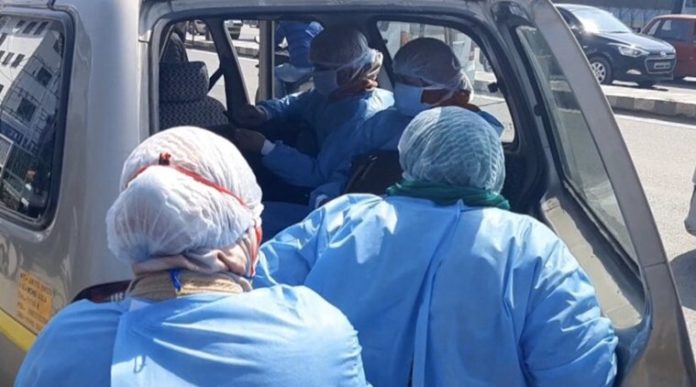
India’s Covid-19 tally nears 15 lakh; death toll at 33,425

New Delhi (NVI): The coronavirus cases in India saw a jump of 47,704 in the last 24 hours, rising the total number to 14,83,157, Union Health Ministry said.

The country’s death toll stands at 33,425 with 654 new fatalities being reported during this period.

So far, 9,52,744 patients have recovered all over the country. With this, the recovery rate also improves further to 63.92 per cent.

In terms of total number of cases, Maharashtra continues to be the worst affected state with 3,83,723 coronavirus cases followed by Tamil Nadu with 2,13,723 cases and Delhi with 1,31,219 cases.

The other worst affected states includes Gujarat, Uttar Pradesh, West Bengal and Rajasthan.

In terms of fatalities, Maharashtra tops the tally with 13,656 deaths, ministry said.

The death toll in the national capital surged to 3,853 while another 1,16,372 patients have recovered so far, healthy ministry data shows.

According to the Indian Council of Medical Research (ICMR), a total of 1,73,34,885 samples had been tested up to July 27. As many as 5,28,082 samples were tested yesterday.

Meanwhile, Prime Minister Narendra Modi yesterday said that efforts are being made to ramp up the testing capacity in the country to conduct up to 10 lakh COVID-19 tests per day.

-RJV

J&K: 79 travelers among 470 new cases, tally at 18,390

Abid Bashir

Srinagar (NVI): Jammu and Kashmir today recorded 470 fresh coronavirus cases including 79 travelers, taking the total number of positive cases in the Union Territory to 18,390.

With 470 new cases, the tally of positive cases in J&K has reached 18,490 including 14,457 from Kashmir and 3933 from Jammu division.

Officials said that among 470 new cases, 309 belong to Kashmir while 161 are from Jammu. The total number of positive cases in Kashmir has reached 14,457 including 8282 recoveries, while the total number of positive cases in Jammu has reached 3933 including 2120 recoveries. So far, 328 people have died in the UT, including 10 today.

They said that the total number of active cases in J&K is 7667 including 5877 from Kashmir and 1790 from Jammu. With 474 more recoveries, the tally of total recoveries in the UT has reached 10,402 which is 56.56 percent of the total cases, which was over 63 percent a few days before.

Pertinently, Srinagar district alone has 4133 positive cases which is more than the total number of positive cases in Jammu- 3933.

Cases tested positive in J&K include 132 from Srinagar, 11 from Baramulla, 23 from Kulgam, 1 from Shopian, 53 from Anantnag, 6 from Kupwara, 38 from Pulwama, 23 from Budgam, 20 from Bandipora and 2 from Ganderbal in Kashmir while 161 from Jammu include 37 from district Jammu, 10 from Kathua, 20 from Rajouri, 15 from Udhampur, 15 from Ramban, 12 from Samba, 15 from Doda, 3 from Poonch, 23 from Kishtwar and 11 from Reasi.

As per the daily information bulletin, 3,57,927 persons in J&K are under observation while 45,645 persons have been kept under home quarantine. Besides that, 7667 persons are in hospital isolation while 12 persons are under hospital quarantine.

According to the bulletin, 2,64,015 persons have completed the surveillance period and 40,267 persons are under home surveillance.

So far, results of 5,92,482 samples are available out of which 574,092 stand negative while 18,390 have been tested positive. Among positive cases, 7,667 are active, 10,402 have recovered.

-ARK

India lodges protest with Pak over attempts to convert gurdwara into mosque

Indo-Pak trade

New Delhi (NVI): India today lodged a strong protest with Pakistan over reports that attempts were being made by some people to convert a historic gurdwara in Lahore into a mosque.

The Ministry of External Affairs lodged the protest with the Pakistan High Commission over reported targeting of Gurdwara ‘Shahidi Asthan’, site of martyrdom of Bhai Taru Singh in the eastern city of Lahore.

“A strong protest was lodged with the Pakistan High Commission today on the reported incident whereby Gurdwara ‘Shahidi Asthan’, site of martyrdom of Bhai Taru Singh ji at Naulakha Bazaar in Lahore, Pakistan has been claimed as the place of Masjid Shahid Ganj and attempts are being made to convert it to a mosque,” External Affairs spokesperson Anurag Srivastava said while responding to a media query here.

Srivastava said that Gurdwara Shahidi Asthan Bhai Taru Ji is a historical gurdwara where Bhai Taru Ji made supreme sacrifice in 1745. The Gurdwara is a place of reverence and considered sacred by the Sikh community, he added.

“This incident has been viewed with grave concern in India. There have been calls for justice for the minority Sikh community in Pakistan,” he said.

The MEA spokesperson further said that India expressed its concerns, in strongest terms on this incident and called upon Pakistan to investigate the matter and take immediate remedial measures.

“Pakistan was also called upon to look after the safety, security, well-being of its minority communities including protection of their religious rights and cultural heritage,” he said.

This is yet another incident of religious persecution of minorities and disrespect to religious monuments of Hindus and Sikhs in Pakistan.

-ARK

One-third of fever outbreaks in India remain undetected: Report

New Delhi (NVI): A number of diseases remain “unknown and unnamed” in India because of limited diagnostic facilities and poor testing available, according to an investigation report that was released at a webinar today hosted by Centre for Science and Environment (CSE).

At the webinar on “Mysterious diseases: The failure of disease surveillance in India” organised by CSE, experts agreed on the report which noted that India’s surveillance system is in shambles at a time when mysterious diseases grip the country.

The coronavirus (Covid-19) pandemic is a little reminder that how limited we understand about a disease and how it can wreak havoc across sections of society- be it poor or rich, according to the report. Thanks to a global research base and WHO, we at least know that it is caused by a coronavirus (SARS-CoV-2).

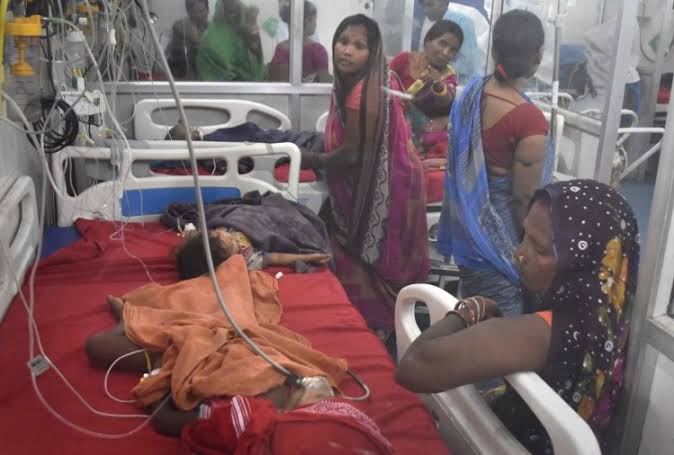
However, in the case of many “mystery diseases” that were discussed at the webinar, there has been no proper investigation to get to the root cause of the disease, says the report published by Down to Earth Magazine. Such diseases have affected children the most in some parts of the country and left the families devastated.

Vibha Varshney, associate editor, Down To Earth and the researcher-writer behind the investigation highlighted in her report that at a time when ‘mystery diseases’ grip India, surveillance is almost non-existent.

“COVID-19 has changed our lives. But this cannot be the only new microbe which triggers diseases and kill people. There have been regular and numerous reports of outbreaks happening across the country – the first step in combating such outbreaks is understanding their nature, identifying them.

“Surveillance of diseases is the best way to keep a tab on emerging and re-emerging diseases. Our investigation was done to find out if India’s disease surveillance system is effective enough in taking that first step,” said Varshney in her presentation at the webinar.

“What we have found is that the system is in shambles,” she added.

The Down to Earth investigation has also listed some of the major mysterious outbreaks that have happened in the recent past.

For instance, since 2005, encephalitis cases have been reported every year from Gorakhpur and its neighbouring districts in Uttar Pradesh. It has been variously identified as Japanese encephalitis or connected to an enterovirus or the scrub typhus – mistakenly because the disease continues to kill.

In September 2019, more than 1,000 cases of fever were reported from village Chaan in Sawai Madhopur (Rajasthan). Just 28 blood samples were collected — 15 of these were found positive for dengue, chikungunya and scrub typhus.

Out of another 15 throat swab samples, three were found positive for the diphtheria pathogen; only two of the 570 blood smears tested positive for malaria. This still left many undiagnosed patients.

In February 2020, 15 deaths were reported from just one village, Kenduguda, in Malkangiri district of Odisha. The patients complained of swelling in the legs and stomach and acute respiratory problems. Medical teams from Malkangiri diagnosed that the deceased could be suffering from kidney or heart ailments, or anaemia, or tuberculosis.

“These ‘mystery’ diseases are of concern as there is an increased fear of emerging and re-emerging diseases. Researchers have identified 43 emerging and re-emerging viral diseases that threaten India today — 23 of these are of zoonotic origin. There are reports that zoonotic diseases are spreading very fast across the country,” said Varshney.

“The Nipah virus, for instance, was reported from Siliguri in 2001,and became an outbreak in Kerala in 2018. Cases of kalaazarare coming up in Kerala, though the disease is typically reported from Bihar. These outbreaks can be fatal in absence of strategies and policies to fight them,” she said.

Also present at the webinar, Sunita Narain, Director General, Centre for Science and Environment (CSE), who anchored the webinar and moderated its discussions, said that such diseases if remain untraced, have the potential to turn in a Covid-19-like pandemic.

“What is alarming today is the declining interest in infectious diseases and in their control and prevention. We must remember that each of these mysterious diseases – perhaps perceived as ‘diseases of the poor’ –have a potential to turn into a COVID-19-like pandemic. Today, COVID-19 has shown us that there is no class divide: the ‘diseases of the poor’ can affect and ravage the rich as well with equal ferocity,” she said.

CSE DG Sunita Narain said that there is a need for the medical community to collaborate with media to indicates the first alarms of the outbreak of such diseases.

“We must have the wherewithal to find the causes of these diseases – we must catch it before it happens, in the words of the speakers who addressed today’s webinar. And in all this, the role that media plays is critical, especially in a scenario where official surveillance agencies are faltering – in many a case, the media’s has been the first voice to call out that there is a problem. This call must be heeded. The medical community can collaborate and work with the media to investigate these first alarms” she said.

-ARK

Locust attack: Centre carries out operation to prevent crop loss across states

New Delhi (NVI): The Centre has taken various steps to control locust swarms, and carried out operations in nearly 4.3 lakh hectares area since April 11 to prevent crop losses.

Elaborating on the actions, the release by Ministry of Agriculture & Farmers Welfare stated that on the intervening night of July 26-27, locust control operations were carried out at 36 places in 9 districts – Jaisalmer, Barmer, Jodhpur, Bikaner, Churu, Nagaur, Jhunjhunu, Hanumangarh and Sriganganagar of Rajasthan and 1 place in Kutch district of Gujarat against swarms and hoppers by Locust Circle Offices (LCOs).

Swarms of immature pink locusts, adult yellow locusts and hoppers are active in Jaisalmer, Barmer, Jodhpur, Bikaner, Churu, Nagaur, Sriganganagar, Jhunjhunu, Hanumangarh and Sriganganagar of Rajasthan and 1 place in Kutch district of Gujarat.

Starting from April 11, control operations have been done in 2,14,642 hectares area in states of Rajasthan, Madhya Pradesh, Punjab, Gujarat, Uttar Pradesh and Haryana by LCOs. In addition to this, till July 26, 2020, control operations have also been carried out in 2,14,130 hectares area by these state governments.

However, no significant crop losses have been reported in the Gujarat, Uttar Pradesh, Madhya Pradesh, Maharashtra, Chhattisgarh, Bihar and Haryana. Some minor crop losses have been reported in some districts of Rajasthan.

“Presently, 104 control teams with spray vehicles are deputed /deployed in State of Rajasthan, Gujarat, Madhya Pradesh and Uttar Pradesh and more than 200 Central Government personnel are engaged in locust control operations,” the statement said.

Further, five companies with 15 drones are deployed at Barmer, Jaisalmer, Bikaner, Nagaur and Phalodi in Rajasthan for effective control of locusts on tall trees and in inaccessible areas through spraying of pesticides.

A Bell helicopter has been deployed in Rajasthan for use in Scheduled Desert Area as per the need. Indian Air Force also has conducted trials in anti-locust operation by using a Mi-17 helicopter.

Food and Agriculture Organization’s Locust Status Update indicates that the risk of swarm migration from Horn of Africa prevails in coming weeks. In Somalia, the swarms are moving eastwards across the north and a limited number of swarms could migrate across the Indian Ocean to the Indo-Pakistan border area, during the remainder of this month.

-CHK

Rajnath Singh, Indonesian counterpart discuss bilateral defence co-operation

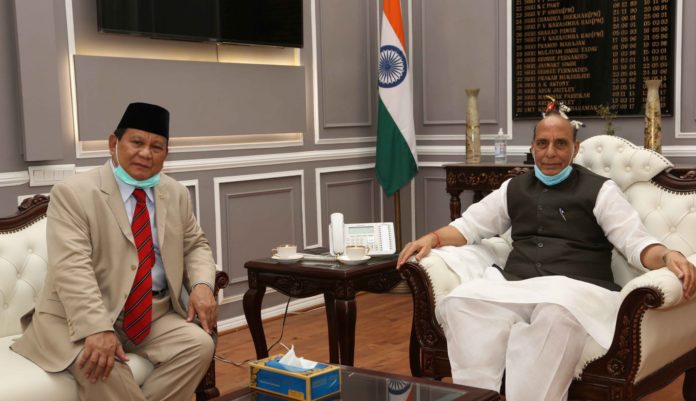
Defence Minister Rajnath Singh with Indonesian counterpart, General Prabowo Subianto

New Delhi (NVI): Defence Minister Rajnath Singh today held talks with his Indonesian counterpart, General Prabowo Subianto, with an aim to firm up the bilateral defence co-operation.

Indonesian Defence Minister is on a three-day visit to India for strengthening the ties between the two maritime neighbours.

During their conversation, Rajnath Singh reiterated the long history of mutually beneficial interactions between the two countries with a tradition of close political dialogue, economic and trade linkages as well as cultural and people to people interactions.

While conveying satisfaction on the military to military interactions, Singh indicated that the defence cooperation between India and Indonesia has witnessed an upswing in the recent years.

This is in consonance with the Comprehensive Strategic Partnership between the two sides, he added.

Moreover, both the ministers agreed to further enhance the bilateral defence cooperation in mutually agreed areas.

In addition to this, the potential areas of cooperation in the field of defence industries and defence technology were also identified by the two countries.

Both the leaders also committed themselves to further strengthen bilateral cooperation and take them to the next level of deliverables.

In a tweet, Rajnath Singh said, “I am delighted to welcome the Defence Minister of the Republic of Indonesia, General Prabowo Subianto in India. During today’s talks, we exchanged views on several bilateral and regional issues. We also discussed important issues pertaining to defence and mutual cooperation.”

The Indonesian Defence Minister also inspected the Guard of Honour at South Block lawns and paid tribute at the National War Memorial in New Delhi.

-RJV

India 3rd among top 10 countries gaining forest area: FAO

Representational image

New Delhi (NVI): Among the top 10 countries gaining forest cover in the last decade, India stands at 3rd spot, according to the Global Forest Resources Assessment (FRA) report by the Food and Agriculture Organization (FAO) of the United Nations.

The report indicates that India has ranked third among the top 10 countries that have gained forest area during 2010-2020

India accounts for two per cent of the total global forest area, it said.

The Asian continent reported the highest net gain in the forest area between 2010 and 2020, according to the report.  It recorded 1.17 million hectares (ha) per year net increase in forests in the last decade.

Besides, the South Asia sub-region reported net forest losses during 1990-2020.

During the decade, India reported 0.38 per cent annual gain in forest cover. This is 2,66,000 hectares of forest cover every year at an average.

According to the report, the top 10 countries that have recorded the maximum average annual net gains in forest area during last decade are China, Australia, India, Chile, Vietnam, Turkey, the United States, France, Italy and Romania.

The FRA 2020 has also credited the Indian government’s Joint Forest Management programme for the significant increase in community-managed forest areas in the Asian continent.

The report also showed that the forest area is managed by local, tribal and indigenous communities in India, which increased from zero in 1990 to about 25 million hectares in 2015.

However, the naturally regenerating forest rate is disappointing. It is also an indicator of the policies that India is pursuing.

India has been taking up massive afforestation and plantation schemes. So, the rate of increase in naturally regenerating forest was just 0.38 per cent, according to the FRA.

The report also examined employment in the forestry sector with data from 136 countries that represent 91 per cent of the world’s forests. Therefore, India reported the maximum employment in the forestry sector in the world.

Around 12.5 million people were employed in the forestry sector globally. Out of which, India accounted for 6.23 million, almost 50 per cent of forestry employment.

The FAO brings out the report once in every five years. This report assesses the state of forests in the memeber countries, their conditions and management.

-RJV/ARK

10 broad gauge locomotives handed over to Bangladesh

New Delhi (NVI): Ten Broad Gauge (BG) locomotives were virtually flagged off to Bangladesh today that will help handle the increasing volume of passenger and freight train operations in the country amid the Covid-19 pandemic.

The locomotives were flagged off in a handing over ceremony by External Affairs Minister, Dr S Jaishankar and the Minister of Railways and Commerce & Industry, Piyush Goyal, the Ministry of External Affairs said in a statement.

MEA said that the handing over of these locomotives, under grant assistance from the Government of India, fulfills an important commitment made during the visit of Bangladesh Prime Minister Sheikh Hasina to India, in October 2019.

“In keeping with the requirements of Bangladesh Railway, the locomotives have been suitably modified by the Indian side. These locomotives will help handle the increasing volume of passenger and freight train operations in Bangladesh,” the External Affairs Ministry said in a release.

Speaking on the occasion, External Affairs Minister S Jaishankar highlighted the depth of time tested India-Bangladesh ties, based on mutual trust and respect. He expressed his happiness that the COVID pandemic had not slowed down the pace of bilateral cooperation and conveyed that he looked forward to more such milestones in the ongoing historic Mujib Barsho (Mujib Year).

The government of Bangladesh has announced the commemoration of 2020–2021 as the Mujib Year on the occasion of the centennial birth anniversary of the founding leader of the country, Sheikh Mujibur Rahman.

On the occasion, Minister of Railways Piyush Goyal also underscored the significance of railway cooperation in enhancing bilateral trade and connectivity and in further boosting the economic partnership between the two countries.

India and Bangladesh have stepped up their rail cooperation in mitigating the impact of the COVID 19 pandemic recently, as trade via land border faced disruptions.

“Rail as a cost effective and environmental friendly solution, has helped in transporting essential commodities across the border. Both sides saw the highest ever exchange of freight trains in the month of June. A total of 103 freight trains were utilized for carrying essential commodities and raw materials,” MEA said.

Recently, parcel and container train services have also commenced between India and Bangladesh. This is expected to significantly enhance the scope of bilateral trade, the Ministry said.

Also present on the occasion were Minister of State for Railways, Suresh Angadi. From the Bangladesh side, Minister of Railway, Md. Nurul Islam Sujan and Minister of Foreign Affairs, Dr Abul Kalam Abdul Momen received the locomotives on behalf of the Government of Bangladesh.

-ARK

Odisha: 16 visually impaired test positive for coronavirus in Bhubaneswar

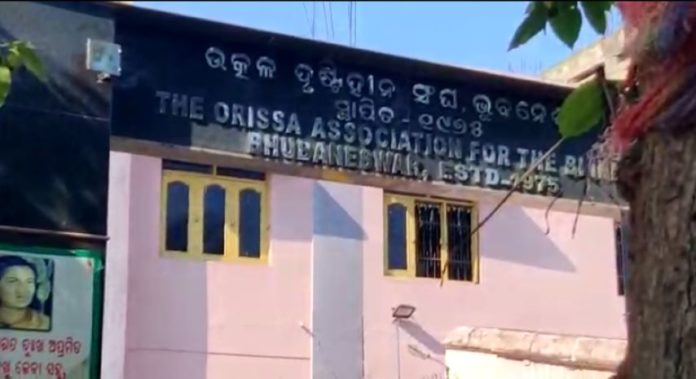
Odisha Association for the Blind

Subrat Kumar Sarangi

Bhubaneswar (NVI): At least 16 people with visual impairment have tested positive for the coronavirus in Bhubaneswar, Odisha. All of them were residing in the same campus of Odisha Association for the Blind (OAB) building.

However, most of the persons are found asymptomatic and the rest have mild symptoms.

There is no special Covid care centre available for persons with disability, especially for visual impairment.

Those who have tested positive are placed on one floor of the building under isolation and others are staying in another floor.

The Bhubaneswar Municipal Corporation (BMC), however, has not officially acknowledged the spread of infection among the visually challenged nor has taken any step to help them medically or otherwise.

-CHK

Covid-19: Sikkim extends lockdown till August 1

New Delhi (NVI): The government of Sikkim has extended the statewide lockdown till August 1, in the view of rising coronavirus cases in the state.

The state was already under lockdown which was to end on July 27, but seeing the rapid surge, the government decided to extend the lockdown till 6 am of August 1.

However, the step of extending the lockdown will help to combat the further spread of rising cases in several containment zones across the state, especially in the south and east Sikkim districts.

In a notification on twitter, the Sikkim government said that, “Considering the prevailing situation of Covid-19 in the State, the government has decided to extend the period of state-wide lock-down till 6am of 1st August, 2020.”

The notification of lockdown extension comes after the state reported its first COVID-19 death on Sunday, a 74-year-old man succumbed to the disease.

Notably, Sikkim has 397 active coronavirus and total cases are stands at 545. In the recovering cases, 149 people have been cured and discharged.

Meanwhile, all the existing COVID-19 guidelines will remain effective till 6 am of August 1, and all the educational institutions will remain close till August 31.

-RJV

MUST READ