Thursday, October 22, 2026
Home Blog Page 1305

Israeli team arrives in India to jointly develop rapid testing for Covid-19

New Delhi (NVI): An Israeli delegation comprising of senior officials from the country’s Foreign Affairs and Health ministries arrived in India today to participate in developing rapid Covid-19 testing techniques that will be able to diagnose the virus in a few seconds.

This comes after the Israeli embassy in India said Thursday that it will be sending a team of scientists to India to jointly develop a rapid testing technology that will be able to detect Covid-19 in less than 30 seconds.

Israel’s ambassador to India Ron Malka shared a video message on Twitter after the special flight landed in New Delhi this morning.

“We bring on this flight researchers, some of our best scientists from the DRDO of Ministry of Defence of Israel, accompanied by experts from our ministry of health that would come to cooperate and search together with our Indian counterparts,” Malka said in the video message.

Earlier, Israel’s Ministry of Defence tweeted that the special Israir flight has left for India from Tel Aviv airport.

“Our delegation with the MFA and Ministry of Health took off from Israel and is making its way to India!Once there, the delegation will test 4 promising corona diagnosis solutions together with our Indian partners and counterparts,” it said in a tweet.

The Israel embassy had said that its Ministry of Foreign Affairs, Ministry of Defence and Ministry of Health will lead an “unprecedented anti-Covid-19 cooperation operation” between the two countries.

“A special planned flight from Tel Aviv to New Delhi is set to carry a high ranking @Israel_MOD R&D team which has been working with India’s chief scientist @kvijayraghavan and @DRDO_India to develop rapid testing for #COVID_19 in under 30 seconds,” the Israeli embassy had said in a tweet last week.

The embassy had also acknowledged that the past few years have cemented the strategic relations between India and Israel and have included two historical visits of the Prime Ministers in Israel and in India.

-ARK

Most polar bears might disappear by 2100 due to global warming: Study

New Delhi (NVI): Scientists have predicted for the first time when, where and how polar bears are likely to disappear, warning that if greenhouse gas emissions stay on their current trajectory, all but a few polar bear populations in the Arctic will probably be gone by 2100.

According to a study by the University of Toronto in Canada, published in Nature Climate Change, by as early as 2040, it is very likely that many polar bears will begin to experience reproductive failure cause starvation due to melting of ice, leading to local extinctions.

The study says “aggressive” cuts to greenhouse gas emissions are needed now to save the animals from extinction.

The bears rely on the ice, which forms above the open waters, to reach their prey. A loss of the ice caused by global warming will force the animals on to land, where they must rely on fat reserves due to a lack of food.

The study examines how the bears will be affected under two different greenhouse gas emissions scenarios. The researchers found that under a business-as-usual emissions scenario, polar bears will likely probably only remain in the Queen Elizabeth Islands – the northernmost cluster in Canada’s Arctic archipelago – at the end of the century. And even if greenhouse gases are moderately mitigated, it is still likely that the majority of polar bear populations in the Arctic will experience reproductive failure by 2080.

Extinctions that would take about 10,000 years in normal evolutionary time frames are now occurring every century. Scientists said that this was the direct result of human intervention in the environment, in the form of degradation, pollution and climate change.

Scientists estimate that there are fewer than 26,000 polar bears left, spread out across 19 different subpopulations that range from the icescapes of Svalbard, Norway, to Hudson Bay in Canada to the Chukchi Sea between Alaska and Siberia.

Polar bears draw on energy reserves built up during the winter hunting season to make it through lean summer months on land or time spent on ice in unproductive waters. Though the bears are used to fasting for months, their body condition, reproductive capacity and survival will eventually diminish if they are forced to go too long without food.

The authors said their study was limited by the use of a single “earth systems model”, which is used to determine how sea ice will be affected, and because of uncertainties and variations in bear behaviour and energy usage among different sub-populations.

-CHK

India’s Covid-19 case fatality rate drops to 2.28%

File photo

New Delhi (NVI): The Case Fatality Rate (CRF) in India is progessivly falling and has improved to 2.28 percent, which is one of the lowest in the world, the Ministry of Health said.

In a official statement, the ministry said that, “The focused efforts of centre and State/UT governments on early detection and isolation through aggressive testing and efficient clinical management of hospitalized cases have shown results with continuously falling Case Fatality Rate and improving Recovery Rate.”

The ministry further added that, with effective containment strategy, aggressive testing and standardized clinical management protocols based on holistic standard of care approach, the Case Fatality Rate has significantly dipped.

Therefore, the Case Fatality Rate in India is progressively falling and currently, it is 2.28 per cent which is one of the lowest fatality rates in the world, it added.

The country has reported 30,000 recoveries per day for the fourth successive day.

As many as 31,991 patients were discharged in the last 24 hours taking the total recoveries over 9 lakh and the number currently stands at 9,17,567, the health ministry data shows.

With this, the recovery rate stands at 64 per cent in India.

As a result of low mortality and more people recovering, the recovered cases exceed the active cases (4,85,114) by 4,32,453 today.

However, medical attention continues to be provided to all active cases in hospitals and home settings, the ministry said.

-RJV

Baloch, Sindhi rebels form joint front to fight against Pakistan occupation

New Delhi (NVI): Baloch armed groups and Sindhi revolutionaries have decided to form a joint front to fight against Pakistan’s occupation and the atrocities inflicted by the Pakistani army on their people in the region.

Baloch Raji Ajoi Sangar (BRAS) an umbrella group of Baloch armed groups announced the formation of an alliance with Sindhi Armed group Sindhdesh Revolutionary Army (SRA) yesterday.

The joint front could be more headed towards targetting China Pakistan Economic Corridor (CPEC) as Baloch rebels had recently targeted the interests of Pakistan and China with a surge in deadly attacks on China’s ambitious Belt and Road projects in the region.

According to a recent media report, surging attacks by Baloch separatists have increased the risks and costs of BRI projects in Pakistan.

Meanwhile, with Baloch and Sindhi rebel groups coming up together, they will put up a strong fight against the expansionist ambitions of China and Pakistan. China, which always tries to exercise its expansionist policy on its neighbours, wants to fulfill its illegitimate political, economic and military interests across the region by taking full control of Sindh and Balochistan through the CPEC.


The Baloch Raji Ajoi Sangar (BRAS) is the umbrella organisation of four different revolutionary groups: Balochistan Liberation Front (BLF), Baloch Liberation Army (BLA), Baloch Republican Army (BRA) and the Baloch Republican Guard (BRG).

BRAS Sarmachaars (freedom fighters) have been fighting for the independence of Balochistan from Pakistan’s illegal occupation for the last several years.

Baloch Khan, spokesperson of BRAS in a statement said that in a meeting of the top Baloch commanders with the Sindh Revolutionary Army (SRA) at some secretive location, it was decided that Baloch and Sindh revolutionaries join hands to fight their common enemy- Pakistan.

“In our meeting held at a secret location it was decided to form a joint front and a joint strategy of our resistance for the liberation of occupied Balochistan and occupied Sindh from Pakistani occupation,” Baloch Khan said.

The spokesperson added that BRAS and SRA would also jointly conduct a detailed review of the latest geopolitical and strategic scenario of the region.

During the secret meeting, Baloch and Sindh revolutionaries also agreed that both Sindhi and Baloch have had common historical, political, cultural and cultural ties for thousands of years. In the present circumstances and especially to avoid further subjugation at the hands of Pakistan and China in the region, the common goal of both nations is to achieve independence from Pakistan.

“Therefore, the unity of both the historical and neighboring nations and the formation of a common resistance front is an important need in today’s situation,” Baloch Khan said in the statement.

The statement further said that Baloch people are the inheritors of 8,000-year-old Indus Valley Civilization and the 11,000-year-old Mehrgarh civilisation, and have been inhabiting this land for thousands of years, resisting various invaders, occupiers and looters at different times in history. Baloch people have always been able to protect their land, civilisation and freedom, the statement read.

“Today, at this point in history, we are fighting another invader, occupier and looter in the form of the unnatural state of Pakistan (Punjab). The time has come for the Sindhis and Baloch to defeat this occupying looter from their respective territories through a joint front,” said Baloch Khan in a statement.

It is pertinent to mention here that on August 11, 1947, the British government gave independence to Balochistan. Balochistan was then not part of Pakistan, which got independence three days later, on August 14. It was only on March 27, 1948, that the Pakistani Army forcibly occupied Balochistan, and declared it part of Pakistan.

Since then, Pakistan has exploited the region for its rich mineral resources and the people of Balochistan have been protesting against the ever-increasing human rights violation.

-ARK

First batch of 5 Rafale jets for India takes off from France

(File photo)

New Delhi (NVI): The first batch of five Rafale jets has taken off from Merignac airbase in Bordeaux, France, today to join the growing Indian fleet of aircraft and are scheduled to arrive in the country on July 29.

These five include three single-seater and two twin-seater aircraft. After the fighter jets arrive in the country, they will be officially inducted and join the Indian Air Force fleet in Haryana’s Ambala.

The five aircraft will be the first tranche of the 36 planes bought by India from France in a Rs 59,000-crore inter-governmental deal in 2016.

At least 12 IAF pilots and engineering crew members are fully trained on the Rafale fighter jets.

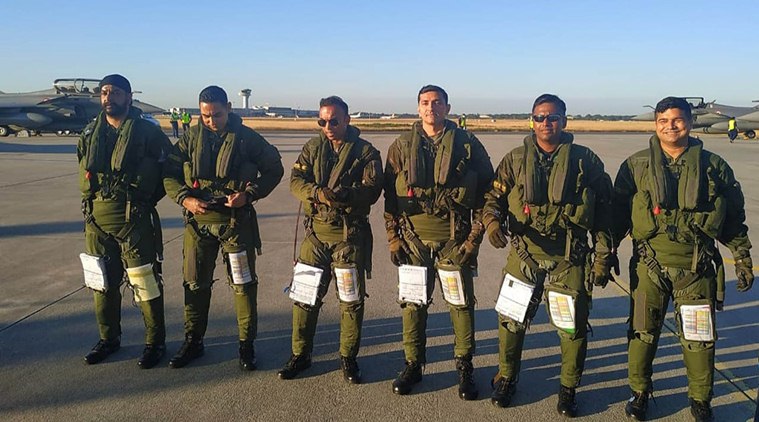
The crew of first batch of Rafale preparing to take off from Dassault Aviation Facility, Merignac, France today.

The ferry of the aircraft is planned in two stages and will be undertaken by the pilots of the IAF, who have undergone comprehensive training on the aircraft. The Air to Air Refuelling planned during the first leg of the ferry will be undertaken by these pilots with dedicated tanker support from the French Air Force.

The aircraft are likely to arrive at Air Force Station, Ambala, on 29 July subject to weather. No 17 Squadron, the “Golden Arrows”, is being raised at this base equipped with Rafale aircraft.

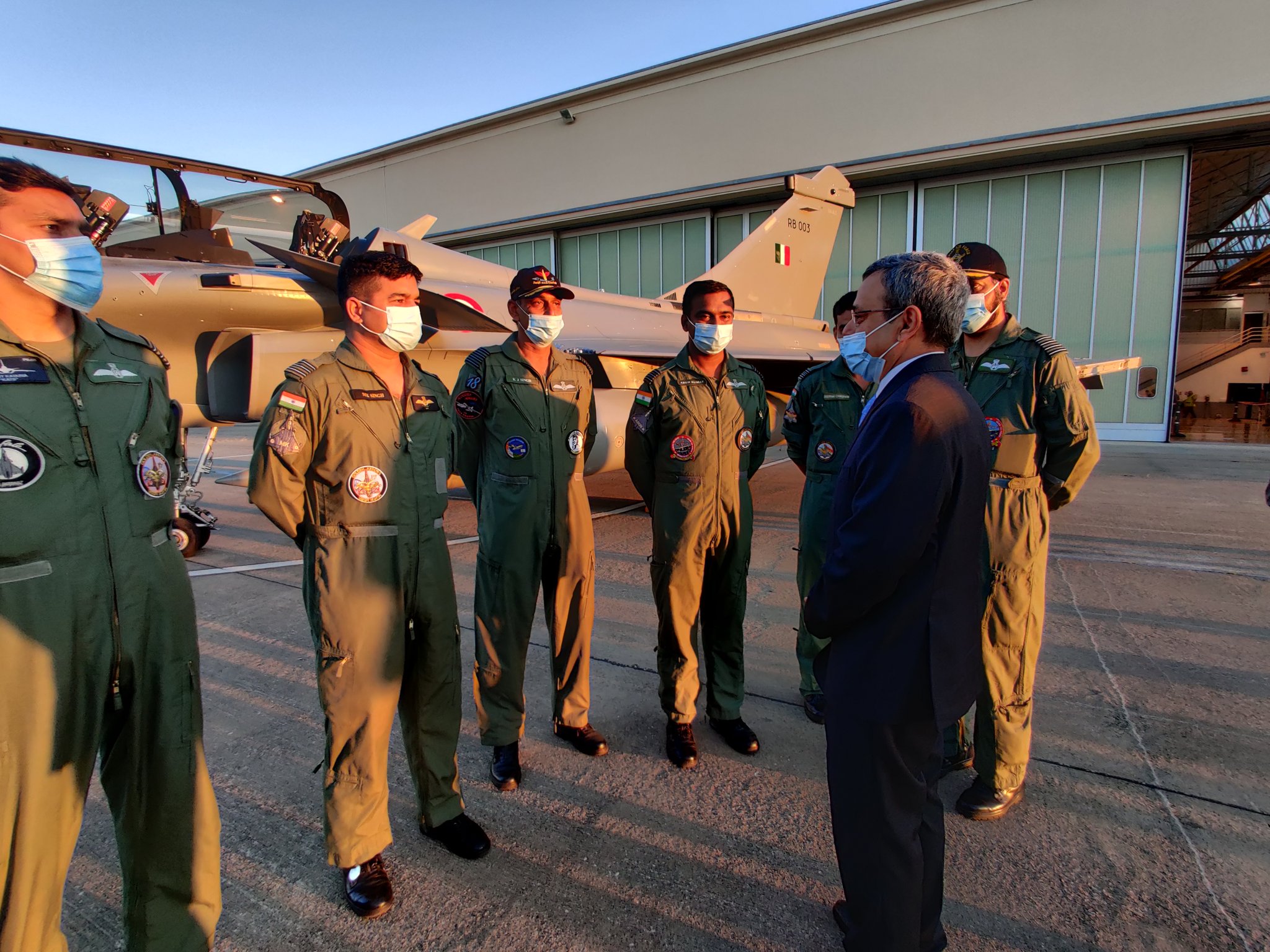
The Indian ambassador to France, Jawed Ashraf, interacted with the Indian pilots before they took off from France.

The Indian embassy in France tweeted, “Bon Voyage: Indian Ambassador to #France interacts with the Indian pilots of the Rafale. Congratulates and wishes them a safe flight to India with a single hop.”

Indian envoy to France Jawed Ashraf thanked the French government and Dassault Aviation for the timely delivery of the Rafale jets. He also said, “Our Air Force pilots tell us that these are extremely swift, nimble, versatile and very deadly aircraft. You might call them both ‘Beauty and Beast’.”

The aircraft will be refueled mid-air and on land at French airbase in the United Arab Emirates on their way to Ambala, an official release by the Indian embassy in France stated.

The Rafale fighter jets are capable of carrying a range of highly effective weapons, including the Meteor air-to-air missile and Scalp cruise missile.

The jets will come with various India-specific modifications, including Israeli helmet-mounted displays, radar warning receivers, low-band jammers, 10-hour flight data recording, infra-red search and tracking systems among others.

The new Rafales will add strategic depth and strength to India’s air combat capabilities. (Image credits: @Indian_Embassy)

The Air Force has also readied the required infrastructure to welcome the jets in its line-up. The first batch of Rafales is going to be a shot in the arm to the Indian Air Force, thereby enhancing its air prowess in present circumstances amid India-China border row.

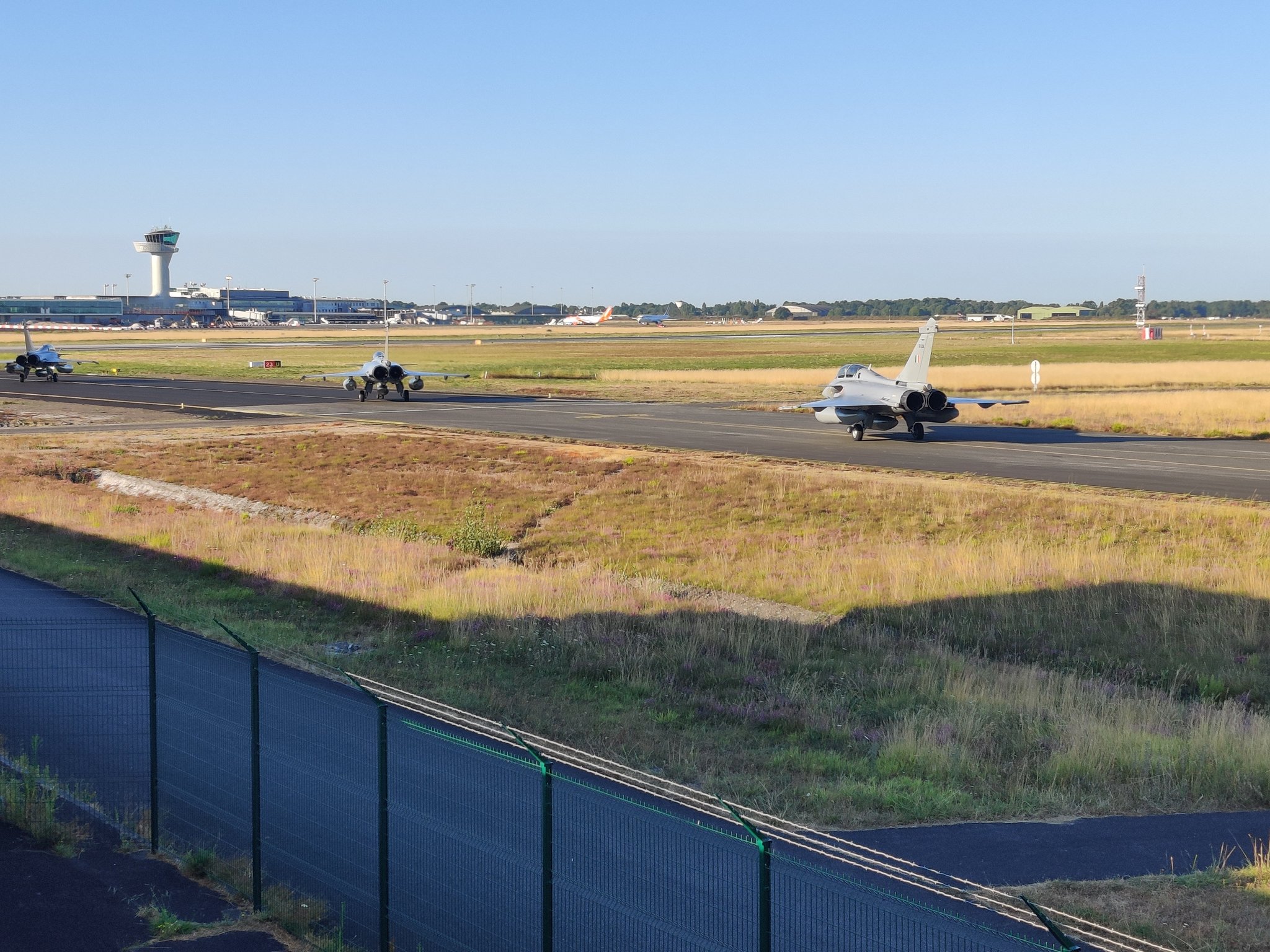
One of the Rafale jets ready to take off from France airbase to India.

-CHK/ARK

Over 8 lakh Indians repatriated under Vande Bharat Mission; fifth phase from Aug 1

Here are the new guidelines issued by Health Ministry for international arrivals
Representational image

New Delhi (NVI): More than 8 lakh Indians stranded abroad were repatriated under Vande Bharat Mission since May 6, Civil Aviation Minister Hardeep Singh Puri said.

In addition to this, the fifth phase of the Vande Bharat Mission will also begin from August 1 to bring back more stranded Indians from abroad and it will continue till August 31.

In a tweet, Puri said that, “More than 814K stranded Indians have returned through various means under VBM since 6 May 2020, out of which more than 270K returned on flights from 53 countries.”

“Now we prepare to dovetail Phase-4 of VBM into Phase-5 from 1st August 2020 & bring back more Indian citizens,” he added.

In another tweet, the minister said that, “Among other destinations, Ph-5 will connect India with USA, Canada, Qatar, Oman, UAE, Singapore, UK, Frankfurt, Paris, Saudi Arabia, Bahrain, New Zealand , Philippines & more. Like we did earlier, more destinations & flights will be added as this phase progresses.”

Puri also said that further details about ticket bookings will be shared by Air India and other airlines shortly.

Meanwhile, the scheduled international passenger flights continue to remain suspended in India.

Under the Vande Bharat Mission, the special international charter flights have been operating since May 6 to help stranded people reach their destinations amid the coronavirus pandemic.

Various international charter flights, by the foreign airlines as well as the Indian airlines, have been operating outside this mission too.

However, scheduled domestic passenger flights started operating from May 25, after a gap of two months due to the coronavirus lockdown.

-RJV

Pak resorts to ceasefire violation along LoC in J&K’s Poonch

Representational Image (File)

Abid Bashir

Srinagar (NVI): Pakistan resorted to unprovoked ceasefire violation (CFV) along the Line of Control (LoC) in Mankote sector of Jammu and Kashmir’s Poonch district, defence officials said today.

Officials said that at around 10.30am, Pakistan’s rangers fired mortars and small arms along the LoC in Mankote area. “Our troops are giving a befitting reply,” a defence official said.

Locals of Mankote, a village close to the LoC in Poonch district of Jammu said that initially a few sounds of loud bangs were heard but within no time, entire area started witnessing big bangs as there was heavy exchange of mortars between Indian and Pakistani armies. “We were out with the livestock and some of us were busy in the fields. We ran for safety after hearing intense exchange of fire,” said Ravi Kumar, a resident of Mankote.

However, there are no reports of any casualties so far. The defence sources said that th exchange of fire between the two sides was on when this report was being filed.

As per the official records, since January this year, over 1,730 ceasefire violations have taken place in J&K, majority of them in Poonch, Rajouri, RS Pura, Keran and Uri sectors of the union territory.

An army official said that it is the Pakistan army that violates the 2003 CF pact every time. “We are always giving them a befitting response. There have been casualties on both sides,” he said, adding that “This year so far, there is a surge in CFV from across the LoC.”

Pertinently, after a long gap of over three decades, the government of J&K has once again started construction of community bunkers. NVI was the first to break the story about construction of community bunkers in Uri, Tangdhar and Gurez sectors of north Kashmir’s Kupwara, Bandipora and Baramulla district. The construction of almost 140 bunkers was started after massive protests were held by the locals living close to the LoC and their threats of migrating from the villages.

-CHK

State-wise details of Covid-19 cases in India

New Delhi (NVI): The total number of coronavirus cases in India today crossed the 14 lakh-mark after 49,931 new cases were reported in the past 24 hours, the biggest single-day jump so far, taking the total number of cases to 14,35,453, according to Union Health Ministry data.

Meanwhile, the death toll stands at 32,771 after 708 new fatalities were reported in the country during this period.

With 3,75,799 confirmed cases of COVID-19 so far, Maharashtra remains the worst-affected state in the country, followed by Tamil Nadu with 2,13,723 cases and Delhi with 1,30,606 cases.

Total positive cases in States/UTs:

Andaman and Nicobar Islands- 324

Andhra Pradesh- 96,298

Arunachal Pradesh- 1,158

Assam- 32,228

Bihar- 39,176

Chandigarh- 887

Chhattisgarh- 7,450

Dadar Nagar Haveli & Diu – 705

Delhi- 1,30,606

Gujarat- 55,822

Goa- 4,861

Haryana– 31,332

Himachal Pradesh- 2,176

Jammu and Kashmir- 17,920

Jharkhand- 8,275

Karnataka- 96,141

Kerala- 19,025

Ladakh- 1,285

Madhya Pradesh- 27,800

Maharashtra- 3,75,799

Manipur- 2,235

Meghalaya- 702

Mizoram- 361

Nagaland- 1,339

Odisha- 25,389

Puducherry- 2,786

Punjab- 13,218

Rajasthan- 35,909

Sikkim- 545

Tamil Nadu- 2,13,723

Telangana- 54,059

Tripura- 3,900

Uttarakhand- 6,104

Uttar Pradesh- 66,988

West Bengal – 58,718

State/UT wise total death toll:

Andhra Pradesh- 1,041

Arunachal Pradesh- 3

Assam- 79

Bihar- 244

Chandigarh- 13

Chhattisgarh- 43

Delhi- 3,827

Goa- 35

Gujarat- 2,326

Haryana- 392

Himachal Pradesh- 12

Jammu and Kashmir- 312

Jharkhand- 85

Karnataka- 1,878

Kerala- 61

Ladakh- 4

Madhya Pradesh- 811

Maharashtra- 13,656

Meghalaya- 5

Nagaland- 4

Odisha- 140

Puducherry- 40

Punjab- 306

Rajasthan- 621

Tamil Nadu- 3,494

Telangana- 463

Tripura- 13

Uttar Pradesh- 1,426

Uttarakhand- 63

West Bengal- 1,372

However, a total of 9,17,568 people have been cured or discharged. Total active cases stand at 4,85,114.

-CHK

Tributes paid to APJ Abdul Kalam

New Delhi (NVI): Tributes were paid to former President of India APJ Abdul Kalam on his 5th death anniversary today.

Born on October 15, 1931, at Rameswaram in Tamil Nadu, Kalam became the 11th President of India in 2002 but he always referred to himself as a teacher first.

On this day, Defence Research and Development Organisation (DRDO) remembered Dr APJ Abdul Kalam, popularly known as the Missile Man of India.

“We remember Dr. APJ Abdul Kalam, on his 5th Death Anniversary today, i.e. 27th July 2020. He spearheaded the Integrated Guided Missile Development Program and headed DRDO as Chief during 1992-1999.First scientist to hold the highest office as President of India inspiring millions,” DRDO tweeted.

Vice President M Venkaiah Naidu also paid tributes to APJ Abdul Kalam and tweeted, “My humble tributes to former President, Dr APJ Abdul Kalam on his death anniversary today.”

“He was an outstanding scientist, a great human being and a ‘People’s President’, who inspired the people of the country, particularly the youth through his actions & words,” Naidu said.

Dr Kalam studied physics and aerospace engineering, and later served as a scientist and science administrator at the Defence Research and Development Organisation (DRDO) and Indian Space Research Organisation (ISRO).

On July 27 2015, Dr Kalam had breathed his last in Shillong while delivering a lecture to students at the Indian Institute of Management.

-RJV

J&K: CRFP man commits suicide by shooting himself in Srinagar

Service rifle
Representational image

Abid Bashir

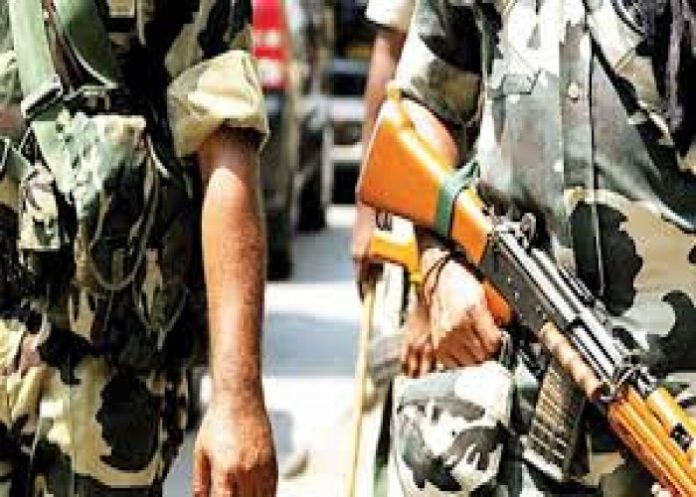
Srinagar (NVI): A Central Reserve Police Force (CRPF) personnel, posted at a Group Centre Rambagh, Srinagar, committed suicide by shooting himself dead with his service rifle, officials said today.

CRPF spokesman in Srinagar, Pankaj Singh, said that a CRPF man posted at a Group Centre Rambagh identified as Pintoo Mondal of West Bengal, shot himself dead this morning. “An inquiry has been ordered to know as to what forced him to take this extreme step,” Singh told NVI.

Despite regular counselling lessons being held to beat the stress in the wake of Covid-19 pandemic, there is no letup in the suicides among paramilitary CRPF ranks as another trooper shot himself dead, officials added.

A senior CRPF official said that there are many reasons why CRPF men were taking extreme steps and one of them is mental stress caused by the Covid-19 pandemic.

“Covid-19 has caused a huge level of depression among CRPF ranks as they are following social distancing norms within their units strictly. Secondly, they are not able to avail leave and meet their family members since March this year due to the pandemic,” he said.

Today’s incident is the second among the CRPF ranks in last eight days in Kashmir.

On July 19, a Central Reserve Police Force (CRPF) personnel also committed suicide by shooting himself dead with his service riffle at his unit in Pantha Chowk area of Srinagar.

He was posted with the 29 battalion F-Coy at Pathan Chowk area of Srinagar and was identified as Biswajit Dutta. An inquiry was ordered to find out the reason that led him to take this extreme step.

Furthermore, Pantha Chowk incident took place just three days after a CRPF man posted at a hotel in Dalgate area of Srinagar accidentally shot himself with his service riffle. He was critically injured and is battling for life at Army’s 92 base hospital in Srinagar.

On July 6, two Sashastra Seema Bal (SSB) men were killed in a fratricidal incident in a court complex in Kulgam district of south Kashmir. The duo had resorted to an argument before shooting themselves with their services riffles.

Earlier on May 12, two CRPF personnel had committed suicide by shooting themselves with their service rifles in two separate incidents in south Kashmir’s Anantnag district.

On the same day, a CRPF Assistant Sub-Inspector, Bengali Babu, committed suicide by shooting himself with his service rifle at his 49th battalion camp in Srinagar. Furthermore, on March 21, a CRPF man posted outside Civil Secretariat Srinagar, had committed suicide by shooting himself with his service riffle.

The rise in suicide cases among CRPF men has, however been directly linked with the prevailing pandemic as it has become evident by the suicide notes left by a couple of CRPF men. A suicide note of one of the CRPF men who shot himself dead read: “I am afraid, I may be Corona positive…. Better to die.”

A senior CRPF official told NVI that every incident is followed by an internal inquiry but one of the main reasons why “boys are taking extreme step” is that they are not able to go on leave and meet their families. “Back home, their families are worried too, which increases mental pressure for the boys on duty in Kashmir, which is a challenging place. Even though regular counseling sessions are being given to the CRPF men in the morning and evening, still the level of pressure on their minds remains high due to the coronavirus outbreak,” he said.

-CHK

MUST READ