Tuesday, October 20, 2026
Home Blog Page 1333

WHO reports record daily increase in COVID-19 cases globally; tally tops 12.9 mn

Coronavirus cases

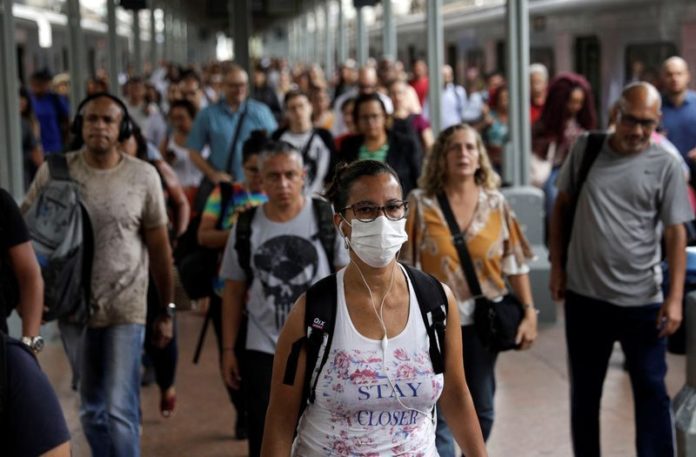
New Delhi (NVI): More than 12.9 million people around the world have been diagnosed with COVID-19 and more than 5,69,000 have died, according to a tally by the Johns Hopkins University. More than 7 million patients have recovered.

Meanwhile, World Health Organization (WHO) confirmed a record increase in global coronavirus cases, with the total rising by 2,30,370 in 24 hours.

In the US, another record increase of COVID-19 infections, with more than 66,500 new cases confirmed were reported in the past 24 hours.

In Brazil, the total number of coronavirus cases have topped 1.8 million while the death toll has exceeded 72,000 in the country.

Mexico’s coronavirus death toll passed Italy’s on Sunday, becoming the fourth-highest globally, with at least 35,006 fatalities over the course of the pandemic so far. The country has 2,95,268 confirmed cases.

South Africa has reported 13,497 new coronavirus cases, reaching a total of 264,184, including 3,971 deaths.

The number of confirmed coronavirus cases in Germany increased by 159 to 198,963. The reported death toll rose by one to 9,064, the tally showed.

-CHK

India to see negative growth, says FICCI survey

New Delhi (NVI): India’s annual median growth in the current financial year could dip to (-) 4.5 per cent, according to FICCI’s Economic Outlook Survey, which says the COVID-19 pandemic has severely hit the economy that was already witnessing a slowdown.

The minimum and maximum growth estimate stood at (-) 6.4% and 1.5%, respectively, for 2020-21, it said.

The quarterly median forecasts indicate GDP to contract by (-) 14.2% in the first quarter of 2020-21, said the survey conducted in the month of June and drawing responses from leading economists representing industry, banking and financial services sector, according to a press release issued by the industry body FICCI.

The official growth numbers for the first quarter are expected to be released by the end of August 2020.

“There were already signs of an impending slowdown in the economy, which have been sharply accentuated by the COVID-19 pandemic induced lockdown. The spread of COVID-19 pandemic has severely hit global as well as domestic growth,” it said.

Agriculture seems to be the only sector with a silver lining right now.  There is an apparent upside as far as the performance of monsoon is concerned this year and the water reservoir levels in the country stand at good levels.

Economic activity wise annual forecast indicated a median growth of 2.7% for agriculture and allied activities for 2020-21, the FICCI said.

The rural sector supported by a steady agriculture performance and hopefully a contained number of COVID-19 cases will be a key demand generator for India this year. Further, the direct income support through PM-KISAN and increased allocation to MGNREGA is helping the returnee migrants – lending support to the rural economy, it added.

Besides, there has been a significant focus in the economic package on the agriculture sector and the focus has clearly been on bridging the existing gaps while creating the potential for new opportunities.

Industry and services sector, on the other hand, are expected to contract by 11.4% and 2.8%, respectively in 2020-21, it said, adding weak demand and subdued capacity utilization rates were already manifesting into a drag on investments and the Covid-19 pandemic has further extended the timeline for recovery.

Even though activity in sectors like consumer durables, FMCG etc. is gaining traction, majority of the companies are still operating at low capacity utilization rates. Labour availability and feeble demand remain as major issues for the companies.

Therefore, fresh investments will be difficult to come by in the near to medium term. Also, a significant change in consumption patterns is expected on back of uncertainty with regard to jobs and income losses. Expenditure on non-essential goods is likely to remain under check for some time. In fact, the share of private final consumption expenditure in GDP has already reported a decline from 59.9% in Q3 FY20 to 55.9% in Q4 FY20, it said.

Absence of demand stimulus, a second wave of the pandemic and continuation of social distancing and quarantine measures will weigh heavy on growth prospects. With demand and investment outlook muted, robust government expenditure has been the only saviour. Nonetheless, growth is likely to bottom out post the second quarter of current fiscal year.

Some of the stimulus measures are reaching to the ground – especially through the credit guarantee scheme for MSMEs and support through MGNREGA – which is positive.

In addition to the forecast of key macro variables, economists were asked to share their views on certain contemporary subjects as well.

Economists were asked to share their views on the fiscal stimulus package 2.0 and any additional measures that can be undertaken. Participants were of the view that government measures in Stimulus 2.0 focussed broadly on saving lives and on undertaking deep structural reforms, the FICCI release said.

They, therefore, felt that while the quasi fiscal measures and structural reforms announced were undoubtedly steps in the right direction, on ground implementation and results will take a long time to work through in the present environment.

A majority of economists believed that the government could have undertaken a more aggressive fiscal stance than what has been announced in the two packages combined.

Participating economists highlighted that the measures announced by both RBI and the government focussed largely on addressing supply side constraints with limited support for creation of demand.

They strongly felt that there is a need to provide more measures to boost demand conditions in the economy. Reviving demand in the economy currently holds greater importance not only because India is broadly a consumption driven economy but also because investments driven growth is unlikely to gather momentum despite all the right measures as corporate India is reeling with excess idle capacity.

Apart from pure cash transfers, the government could also consider GST rate reductions especially in the non-essential goods segment which has the potential to drive demand. Furthermore, some sort of tax waivers could also be undertaken for low income groups. Alongside, sector specific measures could also support recovery in a big way.

Sectors with high backward and forward linkages such as automobile, construction, housing etc. could be revived without incurring fiscal strain. Steps such as announcing of vehicle scrappage policy coupled with cash rebates which could be funded by additional GST revenue flowing from higher production, providing sovereign guarantee on incomplete housing projects should be considered.

India’s COVID-19 tally crosses 8.78 lakh; death toll at 23,174

New Delhi (NVI): India has recorded the biggest single-day spike of 28,701 cases in the last 24 hours, rising the total number to 8,78,254, Union Health Ministry said.

The death toll in the country stood at 23,174 with 500 new fatalities being reported in the past 24 hours.

As many as 5,53,470 COVID-19 patients have been cured and discharged so far. With this the recovery rate stands at 63 per cent.

With 2,54,427 confirmed cases of COVID-19 so far, Maharashtra remains the worst-affected state in the country, followed by Tamil Nadu with 1,38,470 cases and Delhi with 1,12,494 cases.

Maharashtra has also reported the highest number of fatalities at 10,289, followed by 2,045 in Gujarat and 1,966 in Tamil Nadu.

The death toll in the national capital rose to 3,371, while 89,968 patients in Delhi have recovered so far, the healthy ministry data shows.

The other states with high virus included are Gujarat (41,820), Uttar Pradesh (36,476), West Bengal (30,013) and Rajasthan (24,392).

According to ICMR, a cumulative total of 1.18 crore COVID samples have been tested till July 12, with 2.19 lakh samples tested yesterday.

Meanwhile, the Uttar Pradesh government yesterday announced that it will continue putting the state under lockdown during weekends to curb the spread of COVID-19.

-RJV

Dry chillies from Guntur: Indian Rlys loads special parcel train to Bangladesh

New Delhi (NVI): In a first, Indian Railways has sent a special parcel train to transport chillies from Reddipalem in Guntur district of Andhra Pradesh to Benapole in Bangladesh amid the ongoing Covid-19 pandemic, the Ministry of Railways said today.

“For the first time the Indian Railways, loaded special Parcel train beyond the country borders to Benapole in Bangladesh with Dry Chillies from Reddipalem in Guntur District of Andhra Pradesh state,” the ministry said in a statement.

384 metric tonnes of dry chillies was loaded for export to Bangladesh from Guntur in Andhra Pradesh through South Central Railways.

Union Railways Minister Piyush Goyal also shared a video on Twitter on the development. “On the Forefront to Increase Exports: For the 1st time, Railways sends Special Parcel Train to transport chillies from India to Bangladesh,” he tweeted.

South Central Railway also tweeted: “For the first time across the #IndianRailways South Central Railway loads Special Parcel Train beyond the country borders to Benapole in #Bangladesh Bangladesh with Dry Chillies from Reddipalem in Guntur District of #AndhraPradesh state @RailMinIndia.”

Guntur and its surrounding areas in the state of Andhra Pradesh are well known for Chillies cultivation. The quality of this farm produce is internationally renewed for its uniqueness in taste and brand, the Railways Ministry said in a statement.

Earlier, the farmers and merchants in and around Guntur area have been transporting Dry Chillies by road to Bangladesh in small quantities and that was costing around Rs 7000 per tonne. During the lockdown period, they could not move this essential commodity by Road. Then Railway staff and Officials approached the consignors and explained the facilities to transport by Rail. Accordingly, they have moved the Dry Chillies by Rail in bulk through goods trains.

But for moving the consignment by Goods trains, it is mandatory for the farmers and merchants to mobilise the quantity in bulk i.e. at least more than 1500 tonnes in each trip, the ministry said.

To mitigate this problem and to facilitate the Rail users to move their quantities in smalls i.e., up to a maximum of 500 tonnes in each trip, Guntur Division of South Central Railway took the initiative and moved the Special Parcel Express to Bangladesh. This has helped the farmers and merchants of Guntur to market their farm produce beyond the country border by transporting the Dry Chillies in small quantities through Special Parcel Express.

Accordingly, one Special Parcel Express train consisting of 16 Parcel Van moved to Benapole in Bangladesh. Each Parcel Van was loaded with 466 Dry Chillies bags, weighing around 19.9 Tonnes and the total weight carried by the Special Parcel Express is around 384 Tonnes. The cost per tonne for carrying by Special Parcel Express is Rs. 4,608 and which is very cheap and economical as compared to Road transport which is amounting to Rs. 7,000 per tonne.

It may be noted that Indian Railways has taken a series of steps to boost parcel train traffic during the Covid period.

Transportation of essential items like medical supplies, medical equipment, food, etc in small parcel sizes are a very important items that needed for business as well as consumption purposes. In order to fill in this vital need, Indian Railways has made railway parcel vans available for quick mass transportation by E-Commerce entities and other customers including State governments. Railways has been running time-tabled Parcel Special trains on select routes, to ensure an uninterrupted supply of essential items.

According to the Ministry of Railways, a total of 4434 parcel trains have run March 22 till July 11, out of which 4,304 have been time-tabled trains.

-ARK

Lashkar terrorist among 3 ultras killed in encounter in J&K’s Baramulla

July 18 Shopian encounter: Army completes summary of evidence
An encounter site in Kashmir (File Pic)

Abid Bashir

Srinagar (NVI): A Pakistan-based Lashkar-e-Taiba terrorist was among three militants killed in an encounter with security forces in Reban village of Sopore in north Kashmir’s Baramulla district today, Kashmir zone police said.

A Pakistani LeT terrorist, who was also involved in recent terror attack in Sopore was killed in today’s encounter, it said.

“#SoporeEncounterUpdate: #Pakistani LeT #terrorist Usman killed in #encounter. He was involved in recent #terror attack at #Sopore in which one CRPF jawan was martyred and one civilian was killed. Big success for Police & SFs: IGP Kashmir,” Kashmir zone police said quoting IGP Kashmir Vijay Kumar.

On July 1, terrorists had attacked a CRPF party at model town Sopore, in which a CRPF jawan and an elderly man were killed. Police and CRPF had claimed that the attack was carried by two Lashkar militants from a mosque.

The slain elderly man was traveling to Sopore along with his three-year-old grandchild, who tried to wake up his grandfather after he was shot in the attack by terrorists on the CRPF party. The heart-wrenching pictures of the incident had gone viral on social media.

“Two more terrorists killed (Total three terrorists killed). Joint Operation in progress,” defence spokesman Colonel Rajesh Kalia told NVI earlier.

Acting on a tip-off, joint teams of Police, Army and the CRPF cordoned off village Reban in Sopore at around 4:30 am today. “After zeroing in on a suspected spot, the hiding militants opened fire at the forces, triggering an encounter. Heavy firing is going on from both sides,” a police official told NVI.

Sources said that more reinforcements of Quick Reaction Teams (QRTs) were rushed to Reban area as militants were changing their positions.

Earlier, sources in the security grid said post-July 1 attack, a massive operation was launched in the area to nab the attackers, and those killed in the gunfight today were the same who carried out the Sopore attack.

-ARK

Indian Coast Guard rescues 15 fishermen near West Bengal coast

New Delhi (NVI): The Indian Coast Guard (ICG) successfully rescued 15 fishermen last night who were stranded in rough sea conditions with their boat in Kakdwip near West Bengal after the vessel lost its propellers.

Indian Coast Guard ship Vijaya, which was on operational duty, received a distress call from Krishna Kanaiya, the stranded fishing boat. ICG Vijaya immediately rushed to the rescue of the stranded vessel, considering the rough weather.

“#IndianCoastGuard ship Vijaya rescued Indian fishing boat on night of 11 jul with 15 fishermen on board & stranded in rough sea due loss of propellers. ICG ship on receiving distress call swung into action n rescued in tiring conditions. #HarKaamDeshKeNaam,” the PRO Defence Kolkata said in a tweet.

The operation was conducted swiftly under the command of DIG Vijay Singh on locating the distressed fishing boat. According to the boat owners, the vessel had lost its propellers in the rough sea conditions and had drifted about 15 nautical miles due to strong winds.

In a successful and well-planned operation, Coast Guard Ship Vijaya towed the fishing boat to a safe location near the coast of West Bengal.

-ARK

J&K: Lockdown reimposed in Srinagar amid rise in corona cases, deaths

(Updating earlier copy)

Abid Bashir

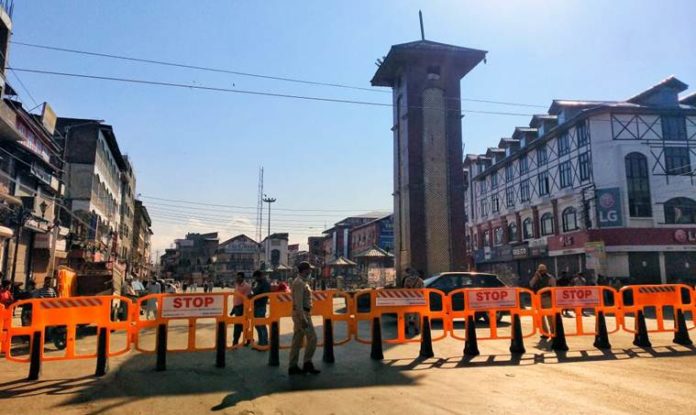
Srinagar (NVI): In the wake of continuous rise in Covid-19 cases and a spike in new virus deaths, the Jammu and Kashmir administration today reimposed lockdown in Srinagar to contain further spread of the deadly pandemic.

Deputy Commissioner Srinagar, Dr Shahid Iqbal has said that fine for violators has also been increased from Rs 500 to Rs 1000.

Natipora area of Srinagar being sealed again. (Photo via arrangement)

In this regard, a high-level meeting was held at Civil Secretariat Srinagar yesterday, where top officials from the Kashmir administration were present. “The officers deliberated over the suggestions that had poured in from various quarters that lockdown should be re-imposed so that virus spread is contained,” sources privy to the meeting told NVI.

Earlier, doctors, traders, civil society activists and other sections of the society had urged the Divisional Commissioner Kashmir to take steps in this direction. “There is a demand for re-imposing lockdown. We are seriously discussing it. Lieutenant Governor GC Murmu has taken it up with all his advisors,” said Divisional Commissioner PK Pole said, adding a final announcement will be made soon.

Sources said that in the late evening meeting held at Srinagar Civil Secretariat yesterday, where Deputy Commissioner Srinagar, Shahid Iqbal Choudhary was also present, a unanimous decision was taken that lockdown will be re-imposed in 90 per cent area of Srinagar to prevent further spread of Covid-19. “Srinagar administration is ready to enforce lockdown again,” a source privy to the meeting told NVI earlier.

Interestingly, since Unlock-2, Kashmir witnessed a huge spurt in Covid-19 positive cases as J&K UT yesterday crossed 10,000 cases while 175 deaths have been reported so far of which 158 people died in Kashmir alone. Srinagar district tops the list of positive cases at 10,000 and 41 deaths.

All 175 people, who died due to the virus, breathed their last in Covid-19 designated hospitals in Srinagar. The Srinagar administration had received requests from doctors, paramedics, traders and other sections who had demanded re-imposition of lockdown. Kashmir Traders and Manufacturers Federation (KTMF) chairman Muhammad Yasin Khan said the first priority is life, then business. “If the government decides to re-impose lockdown to prevent the spread of the virus further, we will abide by the decision,” he said.

Doctors Association Kashmir president, Dr Nisar-ul-Hassan said the virus had changed its behavior and had become more active in the Valley. “The only way to prevent its spread is to impose lockdown for at least two weeks,” he told NVI. “We are receiving patients at SHMS hospital with acute symptoms of bilateral pneumonia who need oxygen immediately. This is alarming and signifies dangerous change in virus behavior,” Dr Nisar said.

He said either the virus would take a dangerous turn in Unlock-2 or remain as mild as it is. “But given the present situation, it has taken a dangerous turn. Imagine, 30 patients arriving at SMHS hospital with acute bilateral pneumonia, who all need oxygen. All of them were prime suspects of Covid,” he added.

Dr Saleem Khan, Nodal officer for Covid-19 for Kashmir, said that the rise in virus cases and deaths suggest that the Valley was heading towards a catastrophic phase. “Situation is not far when hospitals will be full and ventilators would fall short in number to treat patients. I advocate immediate imposition of lockdown to deal with the situation,” he said earlier.

-ARK

Neutralise killers of J&K BJP leader, provide security to all workers: Ram Madhav

Abid Bashir

Srinagar (NVI): Bharatiya Janata Party (BJP) General Secretary Ram Madhav today visited the residence of slain BJP leader Waseem Bari and said that those behind the gruesome killing must be neutralised soon. He also demanded proper security cover for all party workers in Kashmir who are vulnerable to such attacks.

The BJP General Secretary had recently condemned the killing of the young party leader and his family members in Bandipora. Waseem Bari, his father and brother were shot dead last week, just outside their Muslimabad residence in Bandipora.


Madhav arrived along with MoS PMO, Jitendra Singh, and party’s J&K affairs leader Avinash Rai Khanna this afternoon and right away went to the Muslimbad residence the slain leader.  Madhav, along with the other BJP leaders, expressed solidarity with the bereaved family of BJP leader Waseem, especially his wife.

On July 8, terrorists killed Waseem at his shop cum residence in Bandipora along with his father and brother. Waseem was BJP’s face in north Kashmir and was a party’s executive committee member.

Madhav spent almost more than 15 minutes at Bari’s residence. Later talking to reporters, the BJP National General Secretary said that the entire BJP leadership is pained over the killing of Waseem. “This is a tragic incident. We want those who have committed this gruesome act should be neutralized. Our all workers and leaders should be provided with security cover. This is our demand,” he said.

Earlier, BJP’s J&K president Ravinder Raina too had demanded security cover for the BJP leaders and workers vulnerable to militant attacks. BJP’s J&K General Secretary (Organisation) Ashok Koul recently said that the matter of providing security cover to BJP leaders who don’t have it yet has been taken up with DGP Dilbagh Singh and IGP Kashmir.

-ARK

Aishwarya, daughter test corona positive

New Delhi (NVI): A day after Bollywood superstar Amitabh Bachchan and his son Abhishek Bachchan were tested positive for coronavirus, actress Aishwarya Rai Bachchan and her daughter Aaradhya were also diagnosed with the virus today.

Aishwarya and Aaradhya are asymptomatic and the Brihanmumbai Municipal Corporation (BMC) has said they will take a written declaration from Aishwarya if she and her daughter want to be treated at home.

However, Aishwarya’s mother-in-law and Big B’s wife, Jaya Bachchan has tested negative for the virus, as per media reports.

Amitabh has been admitted under the Respiratory Isolation Unit at the Nanavati Hospital in Mumbai, according to media reports. His condition is stated to be stable with mild symptoms.

“I have tested CoviD positive .. shifted to Hospital .. hospital informing authorities .. family and staff undergone tests, results awaited .,” the 77-year-old megastar tweeted last night.

The star family lives in Mumbai, which has been one of the worst-hit cities by the deadly respiratory disease in India, recording over 90,000 cases and 5,244 deaths so far, second only to Delhi.

-ARK

Covid-19 will push over 71 mn people into extreme poverty: UN Report

Representational Image

New Delhi (NVI): An estimated 71 million people will be living in extreme poverty in 2020 due to Covid-19 with unemployment, rising prices and lack of social protection leaving those previously secure at additional risk, according to a new UN report.

According to the Sustainable Development Goal Report 2020, southern Asia and sub-Saharan Africa are expected to see the largest increases in extreme poverty, with an additional 32 million and 26 million people, respectively, living below the international poverty line as a result of the pandemic.

“Southern Asia and sub-Saharan Africa are expected to see the largest increases in extreme poverty, with an additional 32 million and 26 million people, respectively, living below the international poverty line as a result of the pandemic,” it said.

As per the report, the share of the world’s population living in extreme poverty declined from 15.7 per cent in 2010 to 10.0 per cent in 2015. “However, the pace of global poverty reduction has been decelerating. Nowcast estimates put the global poverty rate in 2019 at 8.2 per cent,” the report says.

Even before COVID-19, baseline projections suggested that 6 per cent of the global population would still be living in extreme poverty in 2030, missing the target of ending poverty, it said.

Assuming the pandemic remains at levels currently expected and that activity recovers later this year, the poverty rate is projected to reach 8.8 per cent in 2020. “This is the first rise in global poverty since 1998, and close to the 2017 level,” says the report.

The Sustainable Development Goals Report 2020 presents an overview of progress towards the SDGs before the pandemic started, but it also looks at some of the devastating initial impacts of COVID-19 on specific Goals and targets. The report was prepared by the United Nations Department of Economic and Social Affairs in collaboration with over 200 experts from more than 40 international agencies, using the latest available data and estimates

-ARK

MUST READ