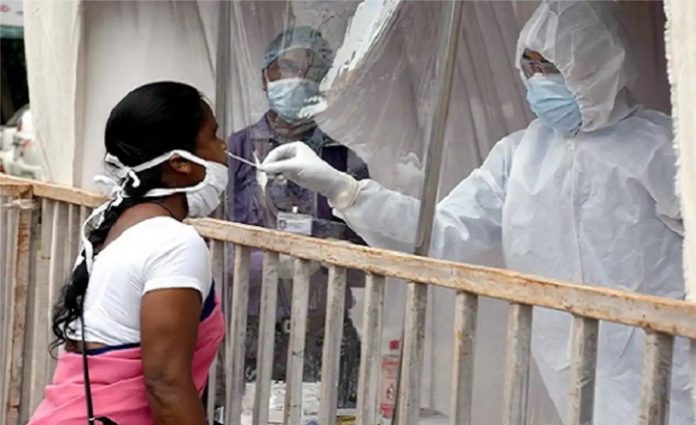
New Delhi (NVI): The global count of coronavirus cases has reached more than 57 million, with over 13,71,200 deaths reported, according to Johns Hopkins University data.
Over 36.7 million patients have recovered from the deadly contagion globally.
In the US, the total number of coronavirus cases have reached more than 11.8 million. The total number of fatalities have surpassed 2,54,300 in the country.
Brazil’s coronavirus cases has surpassed 6 million becoming third country to pass the milestone, while the country accounts for the second highest number of fatalities at 1,68,613.
Mainland China reported 16 new COVID-19 cases on November 20, down from 17 the previous day, with seven cases of local transmission and nine cases originating overseas, the country’s health authority said.
France has surpassed Russia to become the worst-affected nation in Europe. The country has registered over 21,60,300 confirmed coronavirus cases, while the death toll rose to 48,341.
Meanwhile, Canada’s largest city Toronto and much of its suburbs will be placed under lockdown beginning from November 23 due to the spread of COVID-19.
In Mexico, the COVID-19 death toll has passed 1,00,000. The country’s health ministry reported 6,426 new coronavirus infections, pushing the official caseload to 1,025,969.
Furthermore, Iran will also impose tougher restrictions nationwide as the Middle East country hardest hit by the coronavirus battles a third wave of infections.
New Delhi (NVI): India has registered 46,232 new infections of COVID-19 in the last 24 hours, pushing the overall caseload to 90,50,598, according to the Ministry of Health.
The country’s death toll has gone up to 1,32,726 with 564 fatalities reported within past 24 hours.
Notably, 84,78,124 patients have been cured and recovered all over the country, while active COVID-19 cases remained below 4.5 lakh mark and currently stands at 4,39,747.
Maharashtra, with, 17,68,659 positive cases, remains the worst affected state in the country, followed by Karnataka with 8,69,571 cases and Andhra Pradesh with 8,59,932 positive cases.
Other states with a high virus hit included Tamil Nadu (7,66,677) Kerala (5,51,669) and Uttar Pradesh (5,21,988).
Meanwhile, of the total deaths, Maharashtra again tops the tally with 46,511 fatalities, followed by 11,621 in Karnataka and 11,568 in Tamil Nadu.
The total coronavirus cases in Delhi stands at 5,17,238 with 6,608 new cases, while the death toll in the national capital rose to 8,159, the healthy ministry data shows.
According to the Indian Council of Medical Research (ICMR) data, more than 13 crore samples tested for COVID-19 up to November 20. Of these 10,66,022 samples were tested yesterday.
Furthermore, Maharashtra is considering curbs on flights and train services between Mumbai and Delhi as the national capital struggles with a rise in COVID-19 infections.
New Delhi (NVI): In another incident of hate crime against minorities in Pakistan, a doctor belonging to Ahmadi community was shot dead by a teenage boy in Nankana Sahib that falls in the country’s Punjab province.
The 31-year-old doctor died while his father and two uncles also recieved injuries when the family were offering Friday prayers at their house in Murh Balochan area of Nankana, the Dawn reported. As per reports, the boy’s father has received critical injuries.
The news website reported that when Tahir went to open the door after hearing a knock, a boy carrying a pistol opened fire at him. The teenager then opened fire on the family, injuring three others, including Tahir’s father. The attackers was nabbed by the residents when he tried to flee.
The Dawn report said that when the teenager was taken into custody, he “confessed to having attacked the family over religious differences”.
This is the 5th targeted attack on members of Ahmadiya community in the span of just four months in Pakistan, reports Daily Times.
In another hate crime, a teenager shot dead Ahmadi doctor Tahir Mahmood and injured three others in Nankana Sahib. The family was gathered to offer Friday prayers at their home when they were attacked. pic.twitter.com/RrN5GRRUxq
Earlier this month, an octogenarian was shot dead by unidentified assailants at a bus terminal in the outskirts of Pakistan’s northwestern city of Peshawar. India had condemned the killing of the 82-year-old man from the minority Ahmadi community in Pakistan while stating that the incident is sad reflection of the state of minorities in Pakistan.
New Delhi (NVI): Calling for including a ‘child-centric’ approach in response to climate change, Vice President M Venkaiah Naidu today said that child rights should be interwoven into key national climate change and adaptation strategies, policies and planning documents.
The Vice President’s remarks came while delivering the keynote address on online webinar- ‘Climate Parliament with Children’ organized by the ‘Parliamentarians’ Group for Children’ on the occasion of World Children’s Day today.
“India and the world finds itself at a pivotal juncture – our children are at tremendous risk due to climate change and as policymakers, leaders, upstanding members of the society, parents and grandparents, it is only us, who can come to their rescue. We cannot let apathy jeopardize our children’s future,” Naidu said.
While looking forward to hearing the perspective of children on these challenges, he said, “Child rights should be interwoven into key national climate change strategies, policies and planning documents. It is our response to climate change that needs to include a child centric approach that can be done through such platforms.”
UNICEF in partnership with the Parliamentarians’ Group for Children (PGC) organized a Climate Parliament with Children, in the presence of Vice President Naidu, Minister, Women and Child Development, Smriti Irani and 30 Members of Parliament.
The special event was organised by UNICEF while Observing 31 years since the adoption of the Convention on the Rights of the Child (CRC) on November 20, that defined the rights of all children everywhere.
150 children representing children’s groups discussed the impact of climate change with the parliamentarians and presented an eight-point Charter of Demands on climate action. Approximately 7000 children were involved in the process supported by CivilSociety Organization networks across the country.
Speaking at the Children’s Climate Parliament, Women and Child Development Minister, Smriti Irani said, “It is wonderful to see such informed representation from children coming together with us to discuss the impact of climate change and working to dedicate ourselves to create an environmentally conscious future.” Outlining the efforts of the
government, she said, “We pledge to our children that we in our actions are committed to being environmentally responsible and prudent in resource actualization.”
Dr Yasmin Ali Haque, UNICEF India Representative said, “Millions of children around India are facing difficult times. Today we want to bring into focus the urgency for the pandemic recovery to be child centric, green and sustainable. Children are among the major stakeholders in the debate on climate change. It is important for them to be a part of the solution to one of the greatest challenges faced by humanity today.”
The eight – point Charter of Demands for Climate Action (attached) highlights the need for: Greener Public Transportation Options; clean environment, banning single-use plastics; prioritizing afforestation; creating greater awareness in schools and communities; research linking climate change and public health; stronger enforcement of environment regulations by
local government bodies; bridging the digital divide and building a climate movement.
UNICEF said that the current pandemic has demonstrated how quickly global risks can multiply and spread, and why resilience and timely actions are vital to protecting the world from major threats that the climate change pose. Young people across the world are speaking up about climate risks and the action that governments across the world need to take, it said in a release.
On the occasion, well-known celebrities also expressed solidarity with children and their rights for World Children’s Day and through the pandemic. They included UNICEF Global Goodwill Ambassador, Amitabh Bachchan; Sachin Tendulkar, Regional Ambassador, UNICEF South Asia; Ayushmann Khurrana, UNICEF Celebrity Advocate; Kareena Kapoor Khan, UNICEF Celebrity Advocate.
Representative pic of Pakistan-occupied Jammu and Kashmir.
New Delhi (NVI) A movement is set to be launched by activists and residents of Pakistan-occupied Jammu and Kashmir against Pakistan government’s policy of using them as cannon-fodder.
The movement has been planned in the backdrop of recent development where Pakistan Army stationed its artillery guns in civilian areas of Neelum Valley near the Line of Control (LoC) and shelled Indian Army positions, thus inviting retaliation in the same direction which resulted in some civilian casualties.
Prof Sajjad Raja, Chairman of National Equality Party of Jammu, Kashmir and Gilgit-Balitstan, said a major demonstration was held by the local Kashmiris in Neelum Valley on November 14, a day after the cross-LoC shelling. They protested against placing of artillery guns by Pakistan Army in civilian areas and using these to target Indian side, thus endangering the lives of the locals.
“There is already agitation going on… We are very seriously thinking on it,” he said when asked whether residents of PoK would be highlighting how Pakistan is causing harm to them.
The prominent political leader from PoJK said they would be highlighting the problems they are facing at the hands of Pakistan Army even at the international fora.
“People of Pakistan-occupied Jammu and Kashmir are not happy with Pakistan. They know Pakistan deliberately wants them to suffer,” Raja said.
To press his point, he said a recent survey had revealed that 73.3 per cent of people of PoJK don’t want to stay with Pakistan.
Raja said “an uprising” is already taking place in PoJK “but we believe in peace and democracy” and not in armed struggle.
“Pakistan has used us and abused us, not only in areas under Pakistani occupation but on the other side as well. Pakistan sends ‘jihadis’ across the LoC and what has been happening in Kashmir since 1989 is Pakistan’s strategy to get Kashmiris killed on both sides of the divide,” the Kashmiri leader said.
“Pakistan is not a democratic state, it is a terrorist state. It has only one institution and that is the Army,” he added.
He appealed to India to intervene and ensure well-being of people in territories of Jammu and Kashmir under Pakistani occupation.
“We are citizens of India under the Constitution of India and it is the responsibility of government of India to look after us,” he said.
New Delhi (NVI): The second phase of Malabar maritime exercise, which saw the participation of navies from four QUAD countries — India, US, Japan and Australia — to counter the growing assertiveness of China in the Indian Ocean Region, concluded at the Arabian sea today.
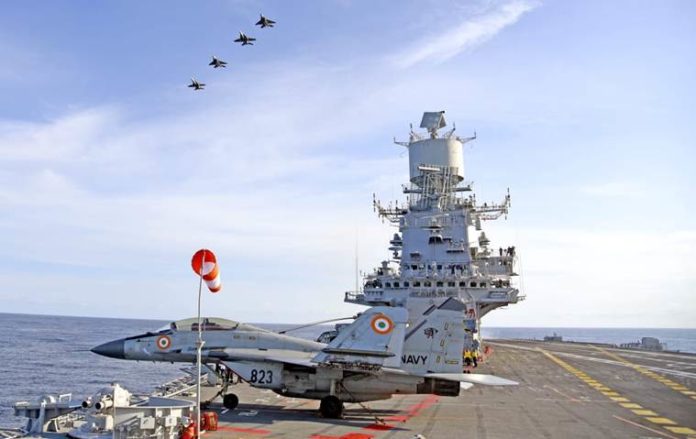
The last day of second phase saw Indian MiG-29K and American F18 fighter jets carry out simulated attacks and coordinated firing on a surface target in the Arabian sea. The second phase of the four-nation maritime exercise also witnessed naval war games featuring India, the United States, Japan and Australia.
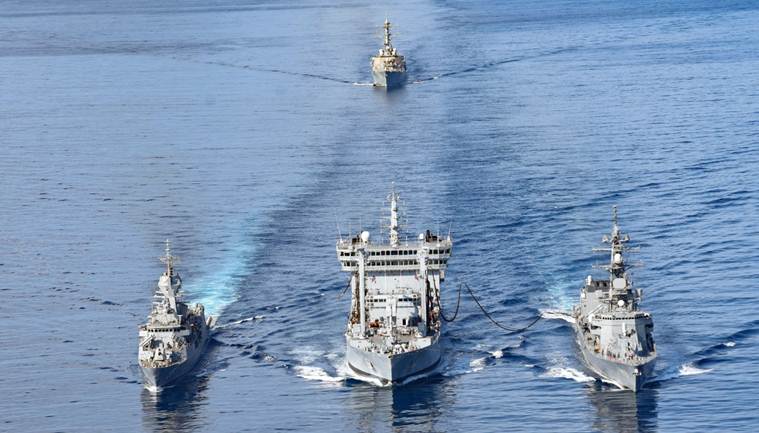
Navies of 4 QUAD nations in action during second phase of Malabar-2020.
With this, the 24th edition of the annual naval exercise, which was hosted by the Indian Navy in two phases, came to a close.
It is pertinent to mention here, that the exercise holds utmost importance in the wake of China’s unilateralism in the Indo-Pacific region. The joint exercise by the QUAD group of nations is a key instrument of deterrence for a free and open Indo-Pacific region, keeping China in mind.
Notably, this is the first time in years, that all four members of the alliance are taking part. The exercise also took place amid escalating tensions between India and China over Ladakh border issue.
Earlier, Phase 1 of the exercise involving participation by Indian Navy (IN), United States Navy (USN), Japan Maritime Self Defense Force (JMSDF) and Royal Australian Navy (RAN), was conducted off Visakhapatnam in Bay of Bengal from 3-6 November.
India, Japan, US and Australia navies during phase 1 of the Malabar exercise.
The second phase was conducted in the Arabian Sea from 17-20 November, PIB’s Defence Wing said in a release.
Phase-1 witnessed participation of Indian Navy units with United States Ship (USS) John S McCain, Australian Ship (HMAS) Ballarat with integral MH-60 helicopter, and Japan Maritime Self Defence Ship (JMSDF) Onami, with integral SH-60 helicopter.
Indian Navy’s participation in this phase was led by Rear Admiral Sanjay Vatsayan, Flag Officer Commanding Eastern Fleet and included destroyer Ranvijay, indigenous frigate Shivalik, Offshore Patrol Vessel Sukanya, Fleet Support Ship Shakti, submarine Sindhuraj, P8I and Dornier maritime reconnaissance aircraft and Advanced Jet Trainer Hawk, the Defence Wing said.
During Phase 2, the four navies participated in joint operations centered on the Vikramaditya Carrier Battle Group of the Indian Navy and Nimitz Carrier Strike Group of the US Navy.
The two aircraft carriers, along with other ships, submarine and aircraft of the participating navies, engaged in high intensity naval operations including cross-deck flying operations and advanced air defence exercises by MIG 29K fighters of Vikramaditya and F/A-18 fighters and E2C Hawkeye from Nimitz.
US Navy’s Strike Carrier Nimitz was accompanied by cruiser Princeton and destroyer Sterett in addition to P8A maritime reconnaissance aircraft. The Royal Australian Navy and JMSDF were represented by frigate Ballarat and destroyer Murasame respectively, along with their integral helicopters.
Indian Navy’s participation in Phase 2 was led by Rear Admiral Krishna Swaminathan, Flag Officer Commanding Western Fleet and included aircraft carrier Vikramaditya, indigenous destroyers Kolkata and Chennai, stealth frigate Talwar, Fleet Support Ship Deepak and the integral helicopters of these warships, indigenously built submarine Khanderi and P8I and IL-38 maritime reconnaissance aircraft.
In addition to ‘Dual Carrier’ operations, advanced surface and anti-submarine warfare exercises, seamanship evolutions and weapon firings were also undertaken during both phases of MALABAR 2020, demonstrating the synergy, coordination and inter-operability between the four friendly navies.
The Malabar series of exercises, which began as an annual bilateral naval exercise between India and the US in 1992, has seen increasing scope and complexity over the years. The 24th edition of MALABAR, conducted in a ‘non-contact at sea only’ format in the backdrop of COVID-19 pandemic, was reflective of the commitment of the participating countries to support a free, open, inclusive Indo-Pacific as well as a rules-based international order.
New Delhi (NVI): Prime Minister Narendra Modi today greeted the nation on Chhath Puja and wished happiness and prosperity for all.
PM Modi took to twitter and wrote, “Wishes to everyone in the country on the grand festival of worshipping the sun. May Chhathi Maiyya grant happiness, prosperity and vitality of the Sun God to everyone.”
सूर्य की आराधना के महापर्व छठ की समस्त देशवासियों को बहुत-बहुत मंगलकामनाएं। छठी मइया सभी के जीवन में सुख-समृद्धि और सूर्यदेव के ओज का संचार करें। pic.twitter.com/MK1j3jkhXk
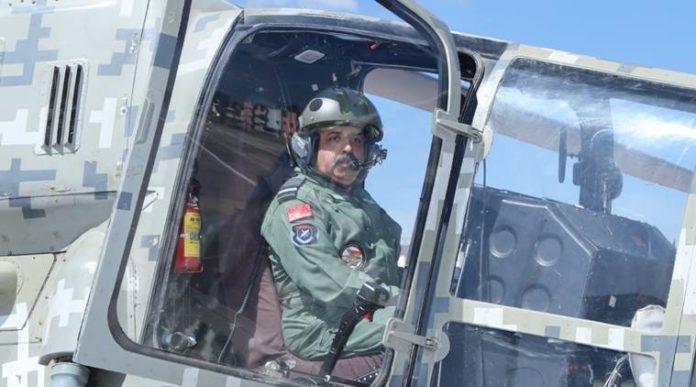
New Delhi (NVI): Indian Air Force (IAF) Chief RKS Bhadauria today undertook a maiden sortie on an indigenously developed Light Combat Helicopter (LCH) by Hindustan Aeronautics Limited (HAL) in Bengaluru today.
The sortie, which was conducted at 11.45 am, lasted for around an hour. The IAF Chief CAS was accompanied by HAL’s Deputy Chief Test Pilot, Wg Cdr (Retd) SP John, the HAL said in a release.
“It was a very good sortie. I was able to look at the important flying characteristics and status of sensors already installed. The LCH is a potent platform due to excellent D&D efforts and well-supported flight test team,” Bhadauria said while thanking all stake holders of LCH project.
He said the IAF is keenly looking forward to the induction of this aircraft and expressed confidence that HAL will give required focus on productionisation at a fast pace.
On the occasion, R Madhavan, CMD, HAL, thanked the Air Chief and said that HAL is geared up for productionisation of LCH to meet all the requirements of the Air Force.
New Delhi (NVI): Chief Minister of Assam Sarbananda Sonowal has recently launched the Virtual Court (traffic) and e-Challan project in the state.
The initiative has been undertaken by Information and Communication Technology (ICT) Committee of Gauhati High Court in association with government of Assam and Assam Police, under the aegis of e-Committee of Supreme Court of India.
“E-challan solution is an initiative of the Union Ministry of Road Transport and Highways (MoRTH) whereas the software has been developed by National Informatics Centre (NIC),” the Ministry Of Law & Justice said in a statement.
This will replace the present concept of manual challan with an electronically generated digital challan.
On the other hand, virtual court is an initiative of E-Commitee of Supreme Court along with Department of Justice, Ministry of Law and Justice, Government of India, the ministry said.
It is an online court being managed by virtual judge whose jurisdiction can be extended to entire state and working hours may be 24×7. However, there is no brick and mortar building of the court.
During a trial at Virtual Court, neither litigant shall come to the court nor will Judge have to sit physically in the court to adjudicate the case. The communication may only be in electronic form and the sentencing and further payment of fine or compensation will also be online.
Moreover, it may be proactive admission of guilt by the accused or proactive compliance of the cause by defendant on receipt of the summons in electronic form. On payment of fine, such matters may be treated as disposed off. Citizen neither have to wait in lines in courts nor have to confront Traffic Police man.
Due to virtual court in Assam, work of 10 judges will be done by only single judge thus sparing 9 Judges for judicial work, the statement noted.
New Delhi (NVI): The Central Board of Secondary Education (CBSE) is preparing to conduct board exams in a few months despite the coronavirus pandemic and the schedule for the same would be shared soon, board secretary Anurag Tripathi said today.
“With a view to conduct annual board exams after a few months, CBSE is making plans and will soon reveal as to how it will do test assessments,” Anurag Tripathi, IRPS, Secretary, CBSE, said at an ASSOCHAM webinar held today.
The ASSOCHAM webinar was held on the theme – ‘New Education Policy (NEP) 2020: Brighter future of school education’. “During March-April we were flummoxed as to how to move forward, but our schools and teachers rose to the occasion and transformed, trained themselves in using new technology for teaching purposes and within few months conducting online classes using different apps became normal,” he said.
Further noting that a common aim of all education policies including NEP 2020 has been to shift students from rote learning to experiential learning, Tripathi said that the entire NEP 2020’s thrust and main aim is to make a shift to skill and competency-based education.
“We need to move students away from knowledge-based education to competency and skill based learning,” he said.
The Secretary said that NEP 2020 provides a solution to implement skill-based, competency based education where there is a need to transform and follow entire pedagogy based teaching-learning process be it classroom teaching, face-to-face teaching or online teaching.
“The pedagogy based teaching-learning process is more about making students more curious, innovative, creative and providing them experiential learning and this can be achieved only when schools, teachers and principals change the teaching pedagogy,” he added.
The only solution to this, he said, is while selecting teachers and principals, it is important for schools to gauge the capacity and competency.
Besides, how to upgrade them and train them for using latest education technologies, he stated.
In a nutshell, he said NEP focuses on four aspects – competency based learning skill education; transforming teaching pedagogy, teachers’ selection, recruitment, training and upgradation and lastly, 360-degree view to check learning outcome through assessment examination.
Further stating that NEP 2020 encourages our students to learn how to stand on their feet and contribute in country’s growth and development, Tripathi said, “If we need to usher a revolution and match the global standards in every aspect then education is the only tool to help make a big leap to transform the country and our generations to come.”