Thursday, March 19, 2026
Home Blog Page 29

Kashmir: 11 tourist spots being reopened after Security clearance

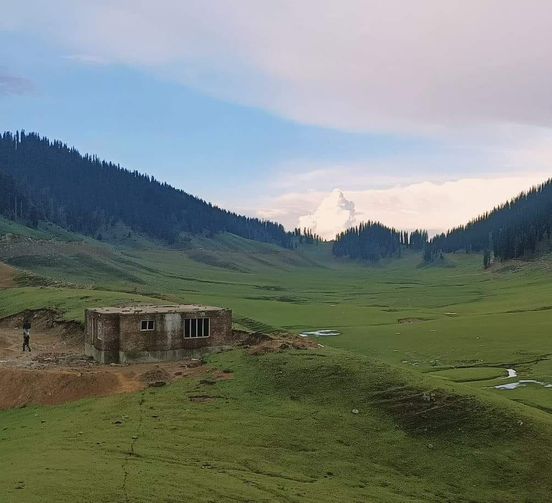
Kashmir Valley (File Pic)

Srinagar, Feb 17: Nearly 11 months after the ghastly Pahalgam terror attack, 11 tourist spots in Kashmir Valley, which were temporarily closed, are being reopened.

An order regarding this has been issued by Jammu and Kashmir Lt Governor Manoj Sinha after a thorough security review and discussion.

These spots were temporarily closed as precautionary measures, according to a statement issued by the Jammu and Kashmir government.

On April 22, three terrorists struck at the tourist spot of Baisaran in Pahalgam in South Kashmir, killing 25 tourists and a local person.

This led to closure of a number of tourist spots which were believed to be vulnerable on security grounds.

The 11 tourist spots being reopened in the Kashmir valley are:

Yousmarg and Doodhpathri in Budgam; Dandipora Park in Kokernag, Anantnag;

Peer Ki Gali, Dubjan and Padpawan in Shopian;

Astanpora and Tulip Garden in Srinagar;

Thajwas Glacier and Hung Park in Ganderbal and

Wullar/ Watlab in Baramulla to be reopened immediately.

Three tourist spots in Jammu Division have also been reopened.

These are:

Devi Pindi in Reasi, Mahu Mangat in Ramban and Mughal Maidan in Kishtwar.

Three sites in Kashmir Division- Gurez and Athwatoo in Bandipora, Bangus in Kupwara and One site in Jammu Division- Ramkund in Ramban will be reopened once snow gets cleared, the statement said. (NVI)

TTP carries out 33 attacks on Pakistani military, killing and injuring scores of soldiers

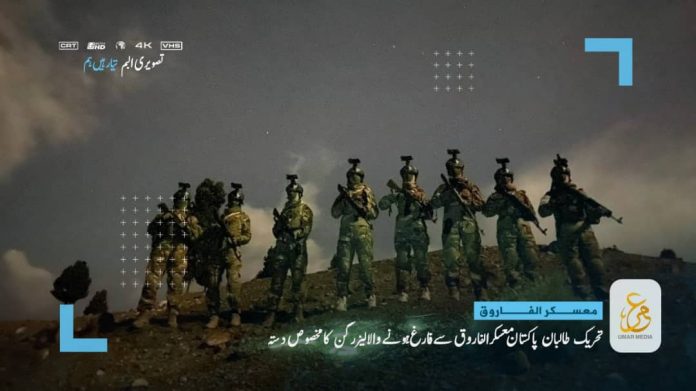
Tehreek-e-Taliban Pakistan (TTP) cadre in specialised gear. File pic released by TTP

Peshawar (Pakistan): Tehreek-e-Taliban Pakistan (TTP) carried out 33 operations against the Pakistani military and affiliated forces at multiple places in Khyber Pakhtunkhwa Province over the last three days, killing and injuring scores of soldiers and destroying substantial assets of the military.

Giving details, a TTP statement said three operations were carried out in North Waziristan, two each in Tank and Kohat districts, and one each in Bannu, South Waziristan, Dera Ismail Khan, Bajaur and Khyber districts.

A soldier of paramilitary force Frontier Corps (FC) was killed and another injured in a sniper attack at their post in Gariom in North Waziristan yesterday.

The TTP also ambushed a vehicle of the FC in Woladin in Gariom in North Waziristan yesterday, after which it fell into a deep gorge, killing and injuring 5 soldiers.

In Mir Ali in North Waziristan, the TTP fighters ambushed a military convoy, including an armoured vehicle, near a military camp in Hasokhel area yesterday, forcing the enemy forces to retreat to the camp, the statement said.

In Tank district, the TTP carried out an assault on an FC fort camp in Gomal, caused unspecified number of casualties to the enemy, it said.

Another sniper attack was carried out on a military post in Kot Azam area of Gomal, resulting in the killing of one soldier.

In Kohat district, an attack was carried out on a military post in Tor Chappar in Darra Adam Khel, resulting in losses to the enemy, the TTP said.

Subsequently, more military vehicles arrived for reinforcement, which were ambushed by TTP, resulting in killing and injuries to multiple sooldiers, the statement said.

In Bannu district, the TTP fighters captured an officer of Counter-Terrorism Department (CTD), identified as Qadeer, in a raid at his residence and set his house on fire in Domel area.

“This action was carried out in response to the government demolishing the homes of Mujahideens. If the army does not stop demolishing houses, Tehreek-e-Taliban Pakistan has the capability to carry out further retaliatory operations,” the statement said.

In South Waziristan, TTP fighters ambushed a military convoy in Tipar Sar area of Shaktui, resulting in unspecified number of casualties.

In Dera Ismail Khan, three Pakistani soldiers were killed in a clash with TTP in Sra Garha area of Prova, it said.

In Bajaur district, a mortar attack by TTP on a Pakistani military post destroyed a large portion of it and possibly caused casualties in Safari area of Wara Mamond.

In Khyber district, a Pakistani soldier was killed and another injured in a sniper attack on a military post in Akakhel Khungi in Bara.

Earlier, on Thursday, a mortar attack was carried out by TTP on a Pakistani military post in Norang area of Lakki Marwat district, the statement said, adding there is a strong possibility of casualties.

TTP fighters also carried out an attack on Pakistani military in Sarai Dargah area of Norang in Lakki Marwat and possibly multiple casualties were caused to the enemy.

In Takhti Khel area of Norang, a mortar attack was carried out at the residence of so-called ‘Peace Committee’ head Sardaraz, injuring several members of his outfit.

The ‘Peace Committees’ are the militia propped up and backed by the Pakistani military as its proxies.

Another attack on ‘Peace Committee’, using a rocket launcher, was carried out near the Tip Takhti Khel Football Ground in Norang, causing unspecified number of casualties, according to the TTP.

Two Pakistani soldiers, including a Major, were killed and several injured in a mortar attack by TTP in Sarai Dargah area in Norang.

In Dera Ismail Khan, a police officer, Nasrullah, was killed in an operation in Prova area.

In a separate incident in Prova, the Pakistani army and so-called Peace Committee members jointly ambushed the TTP fighters in Sadda Garah, the statement said, adding in the counter attack, enemy casualties are reported, while the fighters managed to withdraw safely.

In Daraban district, an attack was carried out by TTP on a police checkpost, causing casualties and severe damage to it.

In Kulachi, a vehicle of the DSP was ambushed by TTP fighers near Hathala on Tank Road, due to which it fell off the road, possibly causing casualties, the statement said.

There is also possibility of casualties in a hit-and-run attack by TTP fighters on a military position in Jalir Zakarkhel in Mir Ali in North Waziristan, it said.

Separately, the TTP said, its fighters have cut off the ground link between Hasokhel military camp and Khaisur in Mir Ali, by laying a siege around the facility and planting mines at a number of places, it said.

In Shash Kroz area of Mir Ali, an attack using heavy weapons was carried out at a military post, the statement said, adding there is a strong possibility of casualties.

In Miranshah district, an attack was carried out by TTP on the Piran military checkpoint in Tapi and there is a strong possibility of enemy casualties, it said.

South Waziristan saw an ambush by TTP on Pakistani soldiers tasked to protect a military convoy on the Wana-Dera Ismail Khan road, resulting in the killing of one soldier and injuries to several others.

One more soldier was killed in a sniper attack in Spin Warsak in Wana.

Casualties were also caused to the Pakistani military in a TTP attack on the Torwam fort camp in Tiarza.

A sniper attack was also carried out on a military post in Tapersar in Shaktoi.

In Peshawar district, a police post built on a piece of land belonging to a DIG was destroyed using a mine explosion in Amir Gul village.

At least 2 soldiers were killed in the blast, the TTP statement said, adding the premises was being used by military personnel for immoral activities.

In Bannu district, 3 military personnel were injured in a clash that erupted at Gulbahar Chowk on the CPEC highway in Miryan when the TTP fighters were stopped at a checkpost.

In Chaman area of Pishin district, an FC official was killed in a targeted attack.

Casualties were also caused to the military in an attack by TTP in Kot Azam in Gomal in Tank district, the statement said.

Major Development: IAF instructors to train fighter pilots of UK

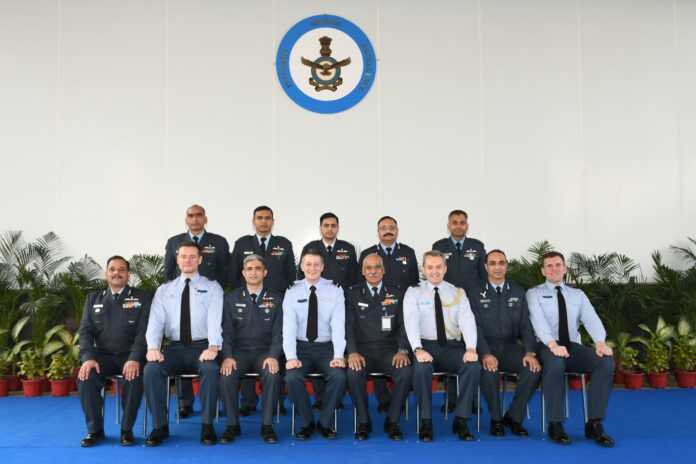
New Delhi: For the first time in history, Indian Air Force (IAF) instructors will impart training to the pilots of the Royal Air Force (RAF) of the United Kingdom (UK), a country which rules India for over 200 years.

For this purpose, the IAF will depute three Qualified Flight Instructors (QFI) to the RAF Valley in the UK, which is the training base for British fast jet pilots.


The deployment will be initially for a period of two years.


An agreement in this regard was reached between the two sides after the 19th UK-India Air Staff Talks on February 12 in New Delhi.


The agreement was part of the mutual endeavour to further enhance military training engagements.


The development follows the first-time deployment in January this year of an IAF officer as an instructor to the Royal Air Force College Cranwell – the air academy that trains the next generation of RAF officers.


This marked all three British military academies now hosting Indian officers as instructors from respective services, according to a statement issued by the British High Commission here.


“The signing of this Letter of Agreement is a significant step in strengthening the longstanding relationship between the Royal Air Force and the Indian Air Force. Bringing Indian QFIs into UK Military Flying Training Systems deepens our cooperation, enhances interoperability and reinforces our shared commitment to excellence in aircrew training,” said Air Vice Marshal Ian Townsend, Assistant Chief of the Air Staff, of the RAF.


“Together, we are investing in the foundation of a long-term collaboration and shaping a partnership that is both enduring and strategic in its outlook,” he added.


Commodore Chris Saunders MBE Royal Navy, Defence Adviser, British High Commission, said: “The forthcoming deployment of Indian Qualified Flying Instructors to the UK represents another significant milestone in our expanding defence relationship, positively building on the mandate of UK-India Vision 2035.


“It reinforces the mutual trust and shared experience that underpins our training cooperation and exemplifies the increasingly sophisticated levels of interoperability we are building together across our services.


“From the presence of Indian training officers instructing in each of the UK’s three officer training academies, to this next step of Indian instructors integrated into our professional flying training squadrons, we continue to build depth, understanding and cooperation at every level of the UK-India defence relationship.”


The Air Staff Talks are part of annual engagements, with both sides usually represented by a 2-star officer or above to discuss areas of military collaboration. The previous edition of the staff talks was held in London in 2025.


An agreement on cooperation in military training was signed between the UK and India during PM Keir Starmer’s visit to Mumbai in October 2025.

Indian Air Force instructors will deploy to RAF Valley to instruct on the BAE Hawk T2 or Texan T1 aircraft.

During their tenure, the Indian QFIs will remain under IAF command while working for RAF commanders on instructional duties.

The Britannia Royal Naval College Dartmouth has an officer from the Indian Navy as one of its instructors since May 2024. This development was followed by the deployment of an Indian Army officer to Royal Military Academy Sandhurst in May 2025 as an instructor.

In 2025, the UK and India conducted the largest ever maritime exercise involving the Carrier Strike Groups of both the navies. This was closely followed by joint army exercise Ajeya Warrior in Rajasthan.

In 2023, the Indian Air Force participated in the UK’s multilateral air exercise Cobra Warrior for the first time. In 2024, the Royal Air Force was amongst the participants for IAF’s first multilateral air combat exercise Tarang Shakti.

First Baloch Air Unit “QAHR” Officially Operational – BLA

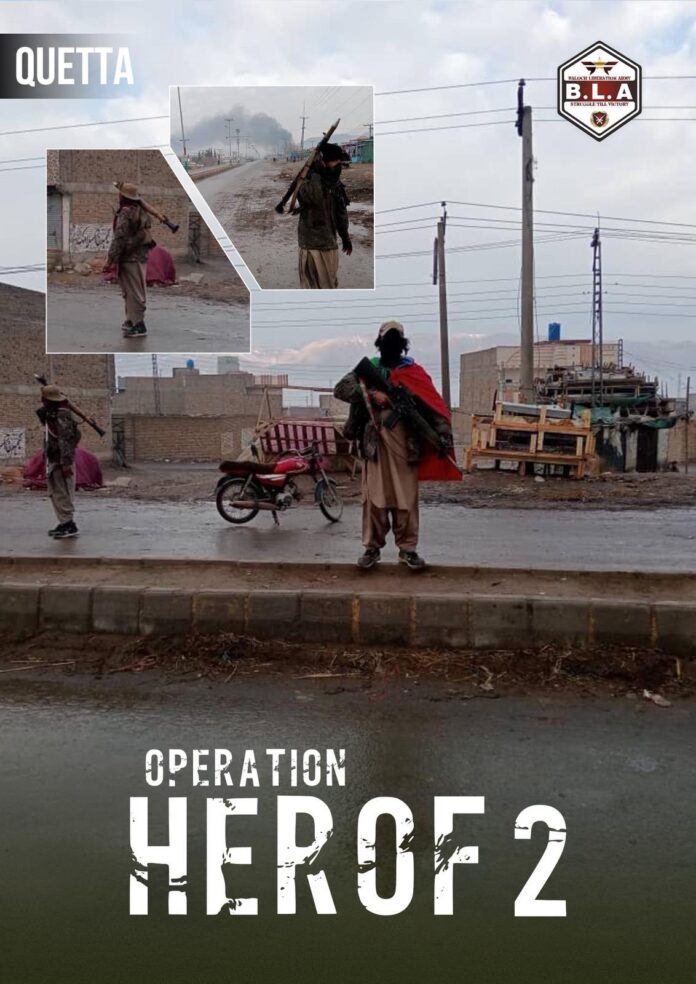
Image released by Baloch Liberation Army (BLA) during Operation Herof 2

Quetta: Baloch Liberation Army (BLA) has declared that its modern air and drone warfare unit “QAHR” (Qazi Aero Hive Rangers) is fully operational and it successfully executed initial missions during the recent ‘Operation Herof phase II’.

QAHR represents stage of BLA military development aligning Baloch resistance with latest combat requirements. This unit continues organization’s intellectual vision that believes in advancing resistance not just as reaction but as planned scientific and sustainable strategy. Organization attributes “QAHR” unit to intellectual and organizational legacy of senior commander Abdul Basit Zehri alias Qazi who gave fundamental importance to technology research and institutional building in resistance ranks and played significant role in establishment of “QAHR”.


QAHR executed debut operations in Operation Herof 2.0. Most prominent of these operations was systematic and coordinated drone attacks on Gwadar Port. These attacks targeted enemy’s military infrastructure, port facilities and communication infrastructure, inflicted heavy casualties and structural damage to the enemy. These attacks not only proved decisive militarily but also added new dimension to situation of Baloch National Liberation Movement.


Drone technology grants organization ability to carry out long-range strike capacity and power to reach enemy’s sensitive areas, monitor them and target them at unexpected moments, which creates stability in domain outside ground war zone. BLA understands modern battlefield exists not only on ground but has expanded into air and cyberspace and “QAHR” is initial but powerful expression of organization’s presence in these domains.


Drone strikes carried out on various fronts of Operation Herof 2.0 created pressure for enemy to upset war balance, effects of which were clearly seen on morale, mobility and speed of reaction of enemy’s ground forces.


Baloch Liberation Army confirms “QAHR” unit will remain important component of organization’s strategy in future as well and through it organization’s combat capabilities will expand further. This unit will not only be used in operations against enemy but all domains such as intelligence, communication networks support and coordination of ground units will now be included in scope of this air unit.


BLA believes national resistance can only be sustainable when it stands up to enemy in intellectual, scientific and technological fields. “QAHR” is starting point in this long resistance campaign that enters liberation struggle into new era defined by air superiority, information dominance and technological capability, elements that transform political ideas into decisive action.

Proposals worth Rs 3.60 Lakh Cr cleared by DAC to enhance defence readiness

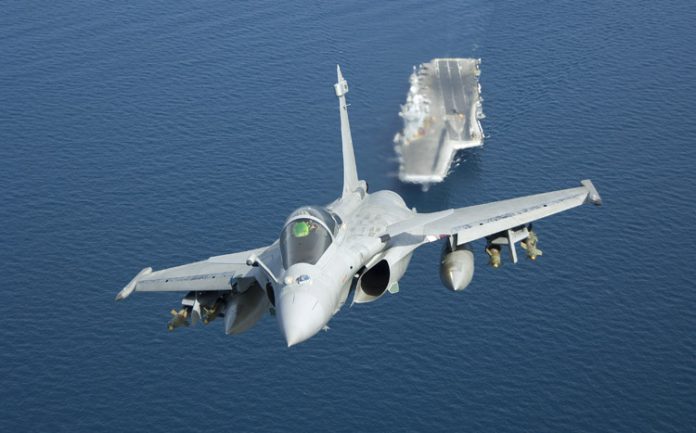
Marine version of Rafale fighter plane

New Delhi: A top-level government body today approved various defence acquisition proposals, including procurement of more Rafale Multi-Role Fighter Aircraft, Combat Missiles and Air and Ship-based High Altitude Pseudo Satellites (AS-HAPS) at an estimated cost of Rs 3.650 lakh crore.


The Acceptance of Necessity (AoN) for these proposals for these acquisitions was cleared by the Defence Acquisition Council, under the chairmanship of Defence Minister Rajnath Singh here.


The procurement of MRFA will enhance the capability of undertaking air dominance roles across the spectrum of conflict and significantly boost the deterrence capabilities of IAF with long range offensive strikes.


The majority of MRFA to be procured will be manufactured in India.


The Combat Missiles will enhance the stand-off ground attack capability with deep strike power and very high accuracy.


The AS-HAPS will be utilised towards carrying out persistent Intelligence, Surveillance and Reconnaissance, Electronic Intelligence, telecommunication and remote sensing for military purposes.


For the Indian Army, AoN was accorded for the procurement of Anti-Tank Mines (Vibhav) and overhaul of Vehicle Platforms of Armoured Recovery Vehicles (ARVs), T-72 Tanks and Infantry Combat Vehicles (BMP-II).


Vibhav mines will be laid as an anti-tank obstacle system to delay the advance of enemy mechanized forces.


The overhaul of vehicle platforms of ARVs, T-72 Tanks and BMP-II will enhance service life of equipment ensuring readiness and operational effectiveness of the Indian Army.


For the Indian Navy, AoN was cleared for 04 MW Marine Gas Turbine based Electric Power Generator and P8I Long Range Maritime Reconnaissance Aircraft.


Induction of 04 MW Marine Gas Turbine based Electric Power Generator under Make-I category of Defence Acquisition Procedure 2020 will minimise the dependency on foreign manufacturers, ensure self-reliance in power generation requirement of Indian Navy.


The acquisition of P8I aircraft will significantly boost the Navy’s combat/war-fighting capability of long-range anti-submarine warfare, maritime surveillance and maritime strike capability.

For the Indian Coast Guard (ICG), AoN was accorded for the procurement of Electro-Optical/Infra-Red system for Dornier aircraft. The procurement will assist in enhancing the efficacy of maritime surveillance capability of the ICG.

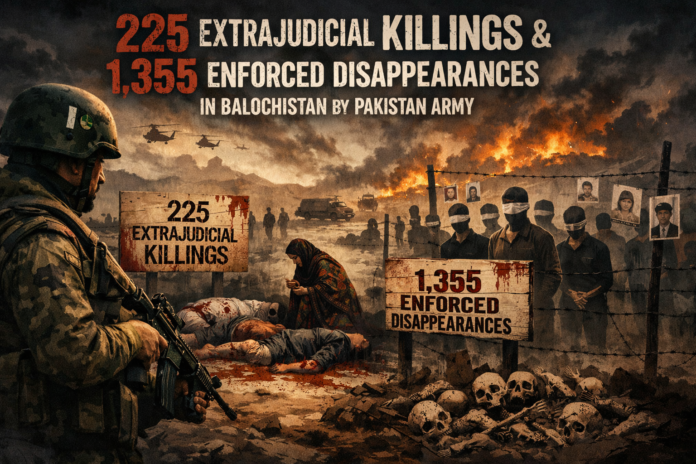
Balochistan: 225 extra-judicial killings, 1,355 abductions by Pakistani military during 2025

Paank report on human rights violations by Pakistani forces in Balochistan in 2025

Quetta, Feb 11 (NVI) Pakistani military and affiliated agencies killed 225 Baloch people in an extra-judicial manner and abducted 1,355 others in Balochistan during the last year, according to a human rights body.

In its detailed annual report, it notes that Pakistan Army, intelligence agencies, and the paramilitary force Frontier Corps (FC) have been systematically targeting students, activists, and local intellectuals, as a deliberate strategy to dismantle the cream of the Baloch nation.

Drone strikes, helicopter gunship operations, and a ‘kill-and-dump’ policy have become routine, while anti-terrorism laws and the Maintenance of Public Order Ordinance (MPO) have been used to criminalize peaceful civic movements such as the Baloch Yakjehti Committee (BYC), says the report by Paank, the human rights organisation of Baloch National Movement (BNM).

“These widespread human rights violations represent a clear state policy of collective punishment against the Baloch nation,” it says.

Paank’s report highlights the intensification of Pakistani repression against the people of occupied Balochistan.

According to the report, the Pakistan Army has not limited itself to traditional, low-intensity actions but has deployed full-scale military force against civilians, including aerial attacks.

“The first half of 2025 saw the highest number of enforced disappearances, with 785 cases, reflecting state policies aimed at suppressing growing peaceful political activity and crushing leadership,” says Paank.

In the later months, the number of disappearances declined, but extrajudicial killings increased.

It says 407 forcibly disappeared individuals were released after detention in torture cells, with many suffering severe physical and psychological trauma, demonstrating the use of state terror.

The report records key incidents, including a drone attack in Buleda on 29 October, where four young people celebrating a picnic were killed despite having military permits; an aerial bombardment in Zehri on 17 September, which killed three civilians and injured a child; and an attack at Chiltan hills on 28 October, in which several teenage youths were seriously injured.

“These incidents constitute repeated violations of international human rights law,” Paank underlines.

The report highlights the extensive misuse of law and state terrorism as a tactic to silence dissent.

Prominent BYC activists, including Dr. Mahrang Baloch, Sabghatullah, Bibgar, Bibo, and Gulzadi, were arbitrarily detained under the MPO and Anti-Terrorism Act, often exceeding the 90-day legal limit of the MPO.

Thirty-two activists were placed under the Fourth Schedule of the Anti-Terrorism Act, restricting their freedom of movement.

“Pakistan accelerated measures to curtail civil rights, including blocking ID cards, suspending SIM cards, restricting travel, and freezing bank accounts,” the report highlights.

Paank urged the international community to recognize that despite abundant resources, the local population of Balochistan faces the greatest deprivation.

“Projects such as Reko Diq, Sandak, and Gwadar Port exploit Baloch resources, while locals demanding basic rights are crushed through military pressure and atrocities,” the human rights organisation says.

“The European Union’s GSP Plus monitoring mission in 2025 expressed concern over enforced disappearances, freedom of expression, and misuse of the Anti-Terrorism Act, confirming the deteriorating human rights situation in Balochistan,” it says.

The report calls for the end of enforced disappearances, halting extrajudicial killings, stopping aerial attacks on civilians, repealing oppressive laws, and releasing political prisoners.

It observes that without international intervention, human rights violations in Balochistan will continue, setting a dangerous precedent for authoritarian regimes worldwide. (NVI)

Operation Herof 2 has concluded, 362 Pakistani soldiers killed, objectives achieved: BLA

Image released by Baloch Liberation Army (BLA) during Operation Herof 2

Quetta, Feb 6 (NVI) On the 7th day after its launch, the ‘Operation Herof 2’ was today declared as concluded by the Baloch Liberation Army (BLA) which claimed to have achieved “strategic and tactical objectives” after killing 362 personnel of Pakistani military and allied forces and destroying dozens of military and administrative assets of Pakistan in Balochistan.

The BLA said it lost 93 of its fighters during the operation which began on the morning of January 31 with thousands of heavily-armed freedom fighters targeting 48 locations across Balochistan simultaneously in a coordinated and highly-professional manner.

“Operation Herof II, carried out by the Baloch Liberation Army, was a six-day campaign of coordinated urban combat that stands as the most extensive, intense, and organized military engagement in the modern history of the Baloch national resistance,” said BLA statement issued by spokesman Jeeyand Baloch.

“The operation commenced at 5:00 AM (Pakistan time) on January 31 and concluded at 4:00 PM (Pakistan time) on February 6 after successfully achieving its strategic objectives,” he said.

Fourteen cities across Balochistan were targeted, with Baloch fighters carrying out simultaneous attacks and establishing effective control over numerous enemy posts, military installations, and urban sectors, he said.

“In several cities, BLA units maintained uninterrupted dominance over occupying forces for six consecutive days, causing significant political, psychological, and military damage to the enemy,” the spokesman said.

He said over 362 enemy personnel were killed, including members of the Pakistani Army, Frontier Corps, police, and state-sponsored death squads.

At least 17 Pakistani soldiers were captured, of whom 10, identified as Baloch nationals, were released with warnings.

“The other 7 remain in BLA custody and will face trial for war crimes and acts of genocide,” he  said.

“Dozens of military facilities were destroyed, weapons stockpiles were seized, and the unified, disciplined resistance delivered a substantial blow to the military superiority of the occupying state,” the spokesman said.

He said all major BLA units participated in the operation, including Majeed Brigade, STOS, Fateh Squad, ZIRAB (intelligence wing), and Hakkal (media wing).

“During the operation, 93 BLA fighters were martyred. These included 50 fidaeen from the Majeed Brigade, 26 fighters from the Fateh Squad, and 17 from the Special Tactical Operations Squad (STOS),” he informed.

“At the conclusion of the operation, the BLA confirms that all tactical and strategic goals of Herof II have been fully accomplished.

The operation pursued three primary objectives: to demonstrate the capability of Baloch fighters to strike and control urban centers at will, to reaffirm to the Baloch nation that this resistance is rooted in collective strength and organizational discipline, and to dismantle the illusion of unchecked authority that the occupying forces have attempted to project across Balochistan,” Jeeyand Baloch said. (NVI)

Suicide bomber targets Shia mosque in Islamabad, 31 killed, 170 injured

20 injured in Mumbai cylinder blast
Representative pic of a blast

Islamabad, Feb 6 (NVI) At least 31 Muslim worshippers were killed and more than 170 were injured today in a massive explosion caused by a suicide bomber at a Shia mosque here, marking one of the worst attacks targeting the minority community in recent years in Pakistan.

The powerful blast at Khadijatul Kubra mosque-cum-Imambara in the Tarli area of Islamabad took place at the time of Friday prayers, according to eyewitnesses.

The suicide bomber detonated explosives attached to his body at the gate of the mosque when he was stopped there, the eyewitnesses and police said.

TV footage showed several bodies lying around the premises along with pieces of glass and debris.

Hours after the explosion, Islamabad district administration posted on X that at least 31 people were killed and 169 others injured in the incident.

The death toll is likely to rise as several injured are stated to be in critical condition.

Emergency was declared in the hospitals of Islamabad as rescuers continued to bring in the injured people.

No group immediately claimed responsibility for the blast.

Tehreek-e-Taliban Pakistan (TTP), which was sought to be blamed by the authorities, issued a statement tonight, saying it was not involved in the explosion as its “targets are clear and well defined — Pakistan’s security institutions and their collaborators”.

The attack came less than three months after a suicide bomber killed 12 people in a blast outside a district and sessions court building in Islamabad.

The massive explosion took place at a time when Uzbek President Shavkat Mirziyoyev was in the town, on a State visit since yesterday. (NVI)

Oman govt orders training naval ship from India’s Swan Defence

SDHI Shipyard in Gujarat
Mumbai, Feb 6 (NVI) The Government of Oman has ordered a training vessel for its Navy from Swan Defence and Heavy Industries (SDHI) of India.
The vessel, scheduled to be delivered within 18 months, will feature a state-of-the-art navigation system, an advanced communications suite, and the capability to conduct helicopter operations, according to a statement issued by SDHI.

Measuring 104.25 m in length, the ship will have a beam of 13.88 m and displacement of up to 3500T, according to the statement.

The vessel will be equipped with modern classrooms, training offices and accommodation facilities and house an auditorium to provide a world-class learning environment at sea for up to 70 officer cadets.

“This contract stands as a testament to our advanced technical expertise and world-class shipbuilding capabilities that meet global benchmarks. Earning the confidence of the Royal Navy of Oman reinforces SDHI’s commitment to excellence and drives us to consistently deliver high-quality vessels distinguished by innovation, reliability and performance,” said Rear Admiral V.K. Saxena (retd), CEO of SDHI. (NVI)

Balochistan: BLA says Operation Herof continues, Pakistani military spreading lies

Image released by Baloch Liberation Army (BLA) during Operation Herof 2

Quetta, Feb 5 (NVI) Calling out Pakistani military for spreading lies, Baloch Liberation Army (BLA) tonight said its ‘Operation Herof 2’ is underway even after passage of 6th day “with full determination, consistency and success”, contrary to the claims made otherwise by Pakistan’s Inter-Services Public Relations (ISPR).

In a statement, BLA said the conclusion of ‘Operation Herof 2’, which was launched at multiple places in Balochistan on January 31, would be announced by the outfit itself with complete proof.

“ISPR’s latest propaganda regarding Operation Heirof is another chapter of lies,” said the statement issued by BLA spokesman Jeeyand Baloch while commenting on the false claims by ISPR that “all the attackers” were killed and the attacks ended on the first day itself.

“The Baloch Liberation Army once again makes it absolutely clear that Operation Heirof 2 continues into its sixth consecutive day with full determination, consistency, and military success,” the spokesman said.

“Until and unless the BLA itself announces the conclusion of an operation, all claims by the occupying state and its media apparatus, including ISPR, must be regarded as propaganda. These claims have no basis in ground realities and carry no credibility among the Baloch people,” he added.

The BLA spokesman referred to a recent ISPR press release, saying it is “merely a continuation of the falsehoods that began on the very first day of Operation Herof.”

“On day one, the occupying Pakistani State falsely claimed that it had concluded the operation and eliminated ‘all attackers’. That same claim has been repeated every single day for the past six days,” he said.

“Every new press release contradicts the previous one, and each so-called ‘success’ actually reflects a new form of failure,” Jeeyand Baloch asserted.

“Any independent journalist or clear-minded observer can easily see that the Pakistani military is not only facing consistent defeat on the battlefield but is also completely exposed in the narrative domain,” he added.

The BLA spokesman said the Pakistani army “hides the bodies of its mercenary soldiers, conceals their identities, and buries their coffins in silence because it knows that these individuals were consumed by a war that lacks moral foundation, political legitimacy, and public support.”

He said the daily claims by ISPR of “killing dozens of Sarmachars (freedom fighters) serve two central purposes.

“First, to mask the continuous military failures and large-scale corruption of occupying state institutions, especially before the Punjabi population, by fabricating fake victories so that no one questions how such a heavily funded army, equipped with modern technology, remains unable to establish control and occupation over Baloch Land.

“Second, to lend credibility to their false narrative by executing forcibly disappeared persons and presenting their bodies as combatants, thereby concealing the crimes of enforced disappearances and the brutal reality of torture cells operated by the state.”

On the other hand, the spokesman said, BLA’s fighters and ‘fidayeens’ enter the struggle with the belief that martyrdom is an honorable culmination of resistance.

“For us, the martyrdom of any Sarmachar is a matter of pride, a renewal of our revolutionary resolve, and a symbol of endurance for future generations. The BLA proudly publishes the names, photographs, numbers, and circumstances of its martyrs, and preserves their ideological legacy at the heart of the movement,” Jeeyand Baloch said.

He said throughout the ‘Operation Herof’, the BLA has received an unprecedented level of practical support, intelligence cooperation, and moral solidarity from the Baloch people.

“The occupying state cannot even begin to comprehend the depth of this support. While its institutions attempt to sustain military control through force, they also try to depict themselves as victims through media manipulation,” he said.

The BLA has “transformed this liberation struggle into an unbreakable force through principled resistance, territorial connection, and an uninterrupted chain of sacrifices,” he said.

“We reiterate that the conclusion and outcome of Operation Herof will be determined solely by the Baloch Liberation Army. The occupying power, which tries to hide its defeat behind daily inflated statistics, holds no authority to make such declarations,” the spokesman said.

“When the BLA does announce the conclusion of the operation, it will be accompanied by clear proof of territorial control, intelligence victories, and the enemy’s repeated retreats,” he said.

He noted that over the past six days, BLA has already published verified images and videos of captured areas, destroyed enemy posts, and seized military assets through its official media channels. (NVI)

MUST READ