Monday, May 18, 2026
Home Blog Page 14

Rain, Thunderstorms Likely in J&K; MeT Issues Advisory

Rainfall
Representational image

Srinagar, May 4 (NV): The Meteorological Department on Monday forecast generally cloudy weather with spells of rain and thunderstorms across Jammu and Kashmir, issuing an advisory warning of lightning, hailstorms and gusty winds in parts of the Union Territory.

According to the MeT Centre Srinagar, most places are likely to witness one or two spells of light to moderate rain or thundershowers on May 4, accompanied by thunder, hailstorm and gusty winds with speeds of 40–50 kmph at a few locations.

On May 5, scattered places may receive brief spells of light rain or thundershowers, mainly towards the afternoon, the department said.

The weather is expected to remain generally dry from May 6 to 9, although brief showers at isolated places during afternoon hours cannot be ruled out.

From May 10 to 12, conditions are likely to stay largely dry, with brief spells of light rain or thundershowers at scattered locations, it added.

The MeT has advised caution, warning of possible lightning, hailstorms and gusty winds at a few places in both Kashmir and Jammu divisions.

Authorities have urged people to suspend boating and shikara riding activities during inclement weather and advised residents to stay indoors during thunder and lightning, and avoid loose structures, electric poles and wires, officials said.(NVI)

Trump announces ‘Project Freedom’ on Hormuz, Iran issues warning

Donald Trump
US President Donald Trump (File Pic)

Washington, May 4: As the impasse continued over the Strait of Hormuz, US President Donald Trump has said his country’s military will “support” ‘Project Freedom’ from today to restore freedom of navigation for commercial shipping through the maritime critical for global energy supplies.

Iran reacted strongly to this declaration, saying “Any American interference in the new maritime regime of the Strait of Hormuz will be considered a violation of the ceasefire.”

“Countries from all over the World, almost all of which are not involved in the Middle Eastern dispute going on so visibly, and violently, for all to see, have asked the United States if we could help free up their Ships, which are locked up in the Strait of Hormuz, on something which they have absolutely nothing to do with — they are merely neutral and innocent bystanders,” Trump posted on his social media handle

“For the good of Iran, the Middle East, and the United States, we have told these Countries that we will guide their Ships safely out of these restricted Waterways, so that they can freely and ably get on with their business…

“I have told my Representatives to inform them that we will use best efforts to get their Ships and Crews safely out of the Strait… This process, Project Freedom, will begin Monday morning, Middle East time…,” he added.

The US military’s Central Command, deployed in the West Asian waters, said, “The mission, directed by the President, will support merchant vessels seeking to freely transit through the essential international trade corridor. A quarter of the world’s oil trade at sea and significant volumes of fuel and fertilizer products are transported through the strait.”

CENTCOM commander Adm. Brad Cooper said, “Our support for this defensive mission is essential to regional security and the global economy as we also maintain the naval blockade.”

Last week, the U.S. Department of State announced a new initiative, in partnership with the Department of War, to enhance coordination and information sharing among international partners in support of maritime security in the strait.

The Maritime Freedom Construct aims to combine diplomatic action with military coordination, which will be critical during Project Freedom.

U.S. military support to Project Freedom will include guided-missile destroyers, over 100 land and sea-based aircraft, multi-domain unmanned platforms, and 15,000 service members.

Reacting to this, Head of National Security Commission of Iran Ebrahim Azizi said, “Any American interference in the new maritime regime of the Strait of Hormuz will be considered a violation of the ceasefire. The Strait of Hormuz and the Persian Gulf would not be managed by Trump’s delusional posts! No one would believe Blame Game scenarios!”

Meanwhile, reports said the new move of the US will not necessarily include its Navy ships escorting commercial ships.

Rather, these Navy ships will be “in the vicinity” in case they need to prevent Iran’s military from attacking commercial ships moving through the strait

The U.S. Navy is going to provide commercial ships with information on the best maritime lanes in the strait especially when it comes to using lanes that were not mined by the Iranian military, the reports said. (NVI)

Civil Secretariat Reopens in Srinagar as Annual Darbar Move Concludes

Srinagar, May 4 (NVI): The Civil Secretariat resumed functioning in Srinagar on Monday as the Jammu and Kashmir administration shifted from Jammu following the conclusion of its six-month winter session, officials said.

All government offices, including that of Chief Minister Omar Abdullah, have started functioning in the summer capital from today as part of the annual Darbar Move, they said.

The Chief Minister was accorded a ceremonial guard of honour on the occasion.

The Secretariat in Jammu concluded its winter session last week, after which departments began relocating to Srinagar. Authorities had undertaken preparatory works, including road repairs and infrastructure arrangements, to ensure a smooth transition.

As per official orders issued earlier by the General Administration Department, five-day offices in Jammu closed on April 30, while six-day offices ceased operations on May 2.

Officials said around 38 departments have fully shifted to Srinagar, while some are functioning on a camp basis with limited staff.

The working hours for Secretariat departments in Srinagar have been fixed from 9:30 am to 5:30 pm, while other offices will function from 10:00 am to 4:30 pm.

A summer secretariat will continue to operate in Jammu.

The bi-annual Darbar Move is a longstanding practice under which the government functions alternately from Jammu and Srinagar to ensure administrative accessibility in both regions.(NVI)

Zero Tolerance on Narcotics: LG Orders Crackdown, Property Seizures Across J&K

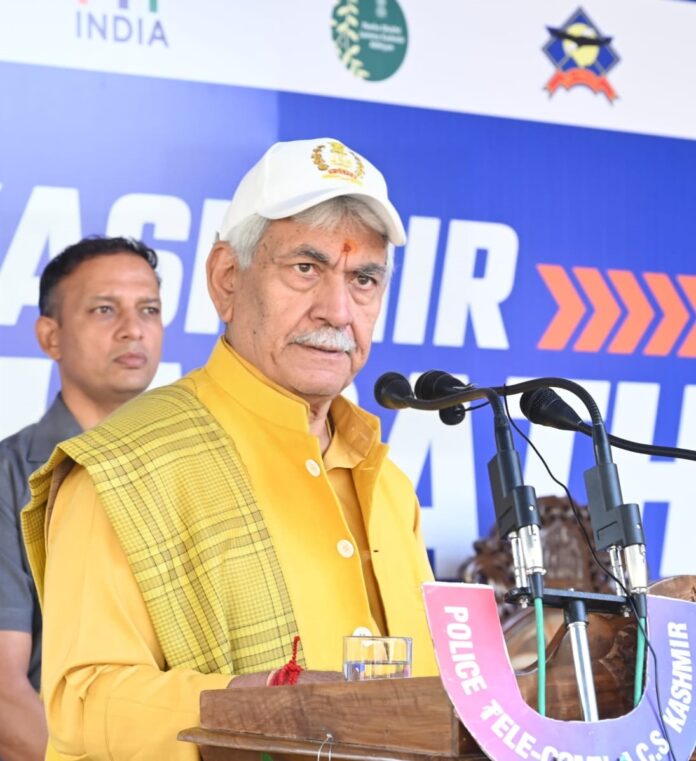
Srinagar, May 4 (NVI): Jammu and Kashmir Lieutenant Governor Manoj Sinha on Sunday set a 78-day deadline for district administrations to intensify efforts to curb drug abuse and dismantle narcotics networks across the Union Territory.

Chairing a high-level review meeting at the Civil Secretariat here, Sinha assessed the progress of the ongoing ‘Nasha Mukt Jammu and Kashmir Abhiyaan’ and directed officials to adopt a focused, time-bound and result-oriented approach to tackle the menace.

He asked Deputy Commissioners and senior police officials to ensure strict implementation of anti-narcotics measures at all levels with measurable outcomes, emphasizing a zero-tolerance policy against drug trafficking and narco-terrorism.

The Lieutenant Governor called for intensified grassroots mobilisation at Panchayat and ward levels, urging active participation of community stakeholders including religious leaders, teachers, traders and youth groups to turn the campaign into a mass movement.

Highlighting the role of youth engagement, Sinha directed officials to develop playfields in all panchayats and organise regular sports and recreational activities to steer young people away from substance abuse.

He also ordered strict enforcement action against drug peddlers, including cancellation or suspension of driving licences, passports and other documents, and speedy identification and seizure of properties linked to narcotics trade.

The Lieutenant Governor stressed enhanced surveillance around educational institutions and vulnerable areas, along with regular inspection of pharmaceutical shops to check misuse of prescription drugs.

He further directed authorities to identify and take action against unauthorised de-addiction centres, ensuring only certified institutions operate as per norms.

Sinha underscored the need to strengthen Mahila Samitis and youth clubs for awareness campaigns and community monitoring, and asked officials to use Block Diwas and Thana Diwas platforms for grievance redressal.

The meeting was attended by Chief Secretary Atal Dulloo, Director General of Police Nalin Prabhat and other senior civil and police officials.

The Lieutenant Governor also directed officials to ensure adequate arrangements for the smooth conduct of upcoming events, including the annual Amarnath Yatra and Muharram, with focus on public safety and convenience.(NVI)

Balochistan: 11 Pakistani military personnel Killed in attacks, says BLA

Balochistan
Special Tactical Operations Squad (STOQ) of Baloch Liberation Army (BLA).

Quetta, May 4: Baloch Liberation Army (BLA) tonight claimed to have killed 11 personnel of occupying Pakistani forces, injured several others and captured three of the Military Intelligence (MI) in operations across Balochistan.

The personnel of Pakistani forces were killed between April 28 and May 3 in operations targeting the occupying Pakistani army, vehicles transporting minerals, and their local collaborators, BLA spokesman Jeeyand Baloch said in a statement to NVI.

In four IED attacks, the occupying army was dealt severe personnel and financial losses, while three MI personnel were taken into custody, he said.

He gave the following details:

April 28: BLA fighters launched a hand grenade attack on the quarters of construction company employees in Dalbandin, injuring five personnel.

In Panjgur: BLA fighters attacked Pakistani army personnel as they reached a security post to provide cover for convoys; two personnel were killed on the spot.

April 29: BLA fighters fired several rounds from a grenade launcher at the central camp of the Pakistani army in Kalat city, causing personnel and financial losses to the enemy.

May 2: In the Chedgi area of Panjgur, BLA fighters targeted a vehicle of occupying Pakistan army with a remote-controlled IED. Five personnel were killed and two others severely injured in the blast, while the vehicle was completely destroyed.

Shadi Kaur, Pasni: BLA fighters targeted an occupying army vehicle with an IED at Shadi Kaur, destroying it. Four personnel on board were killed instantly, and four others were critically injured.

Loni, Duki: BLA fighters used a remote-controlled IED to target personnel of an armed militia formed by the occupying forces to protect mineral transport vehicles. Two personnel on a motorcycle were severely injured in the blast.

May 3: In Al-Mark, Kharan, BLA fighters targeted the Bomb Disposal Squad of the occupying Pakistani army with an IED while they were engaged in ‘clearance’ operations for the army’s aggression. Three personnel were injured in the explosion.

Earlier on April 25, three personnel of the Pakistani secret agency MI were detained in Dasht area of Mastung district while they were moving through the area in disguise, Jeeyand Baloch said, adding tracking devices were recovered from them, and further investigation of the detainees is ongoing

The BLA lost three fighters in a clash with Pakistani forces in Nushki district on April 24,  he said, identifying them as Asad alias Baba Darwesh, Shakeel-ur-Rehman alias Sheikh Atta, and Shehak alias Siddiq.

The spokesman also paid tributes to the fallen colleagues and said their sacrifice would not go in vain. (NVI)

India rejects Nepal’s territorial claim over Lipulekh, route of Kailash Mansarovar Yatra

India Nepal flags
Representational Image

New Delhi, May 3: India tonight rejected Nepal’s claims over Lipulekh area, saying those are “neither justified nor based on historical facts and evidence.”

External Affairs Ministry spokesman Randhir Jaiswal issued a statement in response to media queries regarding claims related to border issues made by Foreign Ministry of Nepal in the context of the annual Kailash Manasarovar Yatra.

“India’s position in this regard had been consistent and clear. Lipulekh Pass has been a long standing route for the Kailash Manasarovar Yatra since 1954 and the Yatra through this route has been going on for decades. This is not a new development,” Jaiswal said.

The statement came after reports that Kathmandu had sent diplomatic notes to India and China over the proposed Kailash Mansarovar pilgrimate route through Lipulekh, which Nepal claims as its territory.

Nepal’s Foreign Ministry spokesman Lok Bahadur Poudel Chhetri, according to those reports, said his country has conveyed its “position and concerns” to both neighbours through diplomatic channels regarding the Kailash Mansarovar Yatra which is slated to take place in the coming months after a gap of 6 years.

“As regards territorial claims, India has consistently maintained that such claims are neither justified nor based on historical facts and evidence. Such unilateral artificial enlargement of territorial claims is untenable,” he added.

His reaction came after Nepal’s Foreign Ministry objected to Lipulekh being a route for the annual Kailash Mansarovar Yatra, saying it falls within its sovereign territory.

Jaiswal added that “India remains open to a constructive interaction with Nepal on all issues in the bilateral relationship, including on resolving agreed outstanding boundary issues through dialogue and diplomacy.”

Chhetri earlier reportedly said in the day that under the Sugauli Treaty of 1816, Limpiyandhura, Lipulekh and Kalapani — areas east of River Mahakali — are integral parts of Nepal.

He said Nepal said it has “consistently urged India to refrain from activities in the region, including road construction, expansion, border trade and pilgrimages.” (NVI)

Uri–Baramulla Highway Restored After Massive Landslide

Uri–Baramulla Highway Restored After Massive Landslide
Srinagar, May 03: Traffic movement on the vital Uri–Baramulla highway was successfully restored on Sunday, May 3, 2026, following a nine-hour suspension. The disruption was caused by a major landslide at Lagama in Uri, triggered by recent heavy rainfall in the region.

The Obstruction

The landslide brought down a significant volume of debris and mudslides, completely blocking the road. For the safety of commuters, authorities halted all traffic immediately after the incident occurred.

Rapid Response and Diversions

To manage the crisis, the local administration took the following steps:
  • Emergency Clearance: Men and machinery were deployed on a “war footing” to clear the heavy debris.
  • Traffic Diversion: While the highway was blocked, traffic was redirected through the Bandi–Paranpillan–Dachi route to maintain connectivity to Uri.
  • Sustained Efforts: After nine hours of continuous clearing operations, the road was declared trafficable.

Safety Advisory

Although the highway is now open for vehicular movement, officials have urged commuters to exercise extreme caution. The prevailing weather conditions in North Kashmir continue to pose a risk of further minor slips or mudslides.

Iran Oil Wells ‘About to Explode’? Trump Claim Sparks Debate Can It Really Happen?

Iran Oil Wells ‘About to Explode’? Trump Claim Sparks Debate Can It Really Happen?

New Delhi, May 03: Recent geopolitical tensions involving the United States and Iran have brought renewed attention to Iran’s oil sector. A controversial claim made by former US President Donald Trump suggested that Iran’s oil wells could “explode” if storage capacity runs out during export blockades. The statement sparked confusion and debate, prompting energy experts to clarify how oil production actually works and whether such a scenario is technically possible.

Why This Issue Is in the News

The discussion emerged during escalating tensions in the Gulf region, where maritime routes and oil exports remain strategically sensitive. The focus has been on restrictions affecting Iran’s ability to export crude oil through key shipping routes such as the Strait of Hormuz.

According to the political narrative presented by Trump, blocking Iran’s oil exports could force economic pressure strong enough to compel negotiations. However, his claim that oil wells would physically “explode” has been widely questioned by energy experts.

What Trump’s Claim Means

Trump’s statement suggested that if Iran cannot export oil due to blockades or sanctions, and if storage tanks become full, pressure would build up in oil wells leading to explosions.

The argument was tied to economic warfare logic:

  • Block exports
  • Cut Iran’s oil revenue
  • Force economic strain
  • Push Iran toward negotiations on broader geopolitical issues

However, this interpretation mixes economic pressure with a technically inaccurate understanding of oil production systems.

How Oil Production Actually Works

Oil is extracted from underground reservoirs where it exists under natural pressure. These reservoirs are trapped between layers of rock, and when drilled, oil rises due to pressure differences.

In practical terms:

  • Oil is located deep underground in porous rock formations
  • Wells act as controlled channels for extraction
  • Initial flow is often driven by natural reservoir pressure
  • Over time, pressure decreases and pumps or injection techniques are used to maintain production

Iran produces around 3 to 3.2 million barrels of oil per day, with a portion used domestically and the rest intended for export.

Can Oil Wells Really Explode?

Experts in petroleum engineering reject the idea that oil wells “explode” simply because storage is full or exports are blocked.

Key technical reasons:

  • Oil wells are controlled systems with valves and pressure regulation
  • If export capacity is blocked, production can be reduced or shut in
  • Pressure does not build indefinitely because operators manage flow rates
  • Reservoirs are not closed containers; they are porous rock systems, not sealed tanks

In real-world scenarios, shutting down wells can cause operational issues such as:

  • Reduced efficiency when restarting production
  • Possible contamination from water or gas intrusion
  • Economic losses due to idle infrastructure

But there is no mechanism that leads to spontaneous explosion due to “overflow pressure.”

What Actually Happens When Exports Are Blocked

In situations like sanctions or shipping restrictions affecting Iran’s oil exports, the industry typically responds in predictable ways:

1. Production Adjustments

Oil production is reduced rather than maintained at full capacity.

2. Storage Use

Crude oil is stored in onshore tanks or floating tankers at sea.

3. Alternative Trade Routes

Iran has historically used unofficial or “shadow” shipping networks to continue exports, often involving ship-to-ship transfers.

4. Economic Pressure

The main impact is financial, not physical damage to oil infrastructure. Iran’s storage capacity is estimated to be large enough to handle short-term disruptions, but prolonged blockades would mainly cause revenue stress rather than physical hazards.

Role of Strategic Maritime Routes

A major factor in the discussion is the importance of the Strait of Hormuz, through which a significant portion of global oil shipments pass.

Any disruption in this narrow passage can:

  • Affect global oil prices
  • Delay exports from Gulf producers
  • Increase shipping insurance and logistics costs

This is why tensions in the region often have global economic implications.

Reality Check: What Experts Agree On

Energy specialists broadly agree on the following points:

  • Oil wells cannot explode simply due to export blockages
  • Production can be slowed or halted safely
  • Infrastructure damage occurs only through accidents, sabotage, or technical failures—not storage overflow
  • The biggest impact of sanctions or blockades is economic, not physical destruction of wells

The claim that Iran’s oil wells are “about to explode” is not supported by petroleum engineering principles or real-world evidence. While geopolitical tensions can heavily disrupt oil exports and strain Iran’s economy, oil wells operate within controlled systems designed to prevent such outcomes.

The real issue lies in export restrictions, storage limitations, and geopolitical pressure—not physical explosion risks in oil fields.

Pakistan: TTP claims killing 318, injuring 378 personnel of Pakistani forces in April

TTP
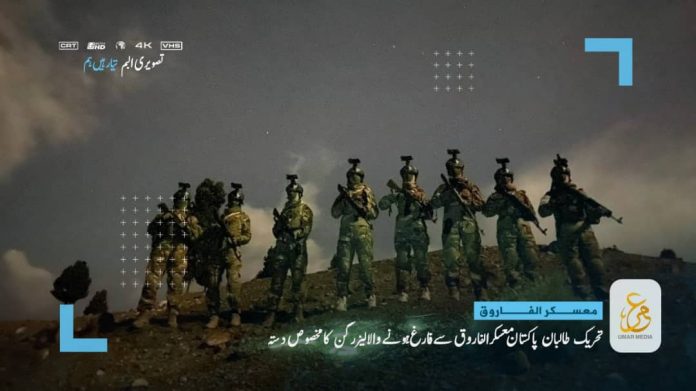
Special squad of Tehreek-e-Taliban Pakistan (TTP) undergoing training. (File Pic)

Peshawar, May 3:  Reflecting continued setbacks to the Pakistani armed forces, at least 318 of their personnel were killed and 378 injured in 409 operations conducted by TTP during the month of April.

The TTP, or Tehreek-e-Taliban Pakistan, also claimed to have captured 13 personnel of the Pakistani forces during the month.

These operations spanned the provinces of Khyber Pakhtunkhwa, Punjab and Sindh as well as occupied Gilgit-Baltistan region and Balochistan.

In a comprehensive statement, TTP spokesman Muhammad Khorasani said these operations affected 283 installations and assets of the Pakistan Army and its Special Services Group (SSG), 189 of the paramilitary Frontier Corps (FC), 186 of the Police and 38 of the Intelligence Agencies and so-called ‘Peace Committees’ , which are proxies of the Pakistani military.

Types of operations:

Sniper/Laser attacks: 109
Guerrilla attacks: 67
Direct assaults: 63
Ambush attacks: 45
Grenade/Bomb explosions: 41
Targeted attacks: 31
Missile attacks: 31
Counterattacks: 22

Pakistan: TTP killed 255, injured 375 Pakistani soldiers, policemen during March month

Destruction:

These operations resulted in the destruction of a large number of military and police assets, including an armoured Tank, 66 other vehicles and 37 Military and police infrastructure, according to the spokesman.

Seizures:

The TTP also seized a large quantity of equipment and arms and ammunition from the Pakistani forces, he said.

The seized items include:

Various vehicles: 10
Various firearms: 5
Mine detection devices: 2
Motorcycles: 2
Quadcopter drone: 1
Military rations including fuel, livestock, and various other military equipment

Locations of operations:

Khyber Pakthunkhwa Province (District wise):

Southern Waziristan:                             90
Peshawar:                                            63
North Waziristan:                                  60
Bajaur :                                               33
Dera Ismail Khan:                                 32
Bannu:                                                 29
Tank:                                                   23
Lakki Marwat:                                       16
Khyber:                                                13
Orakzai:                                               13
Mohmand:                                              7
Karak:                                                    6
Khurram:                                                6
Kohat:                                                    3
Mehran Mardan:                                      2
Pishin:                                                    1
Charsadda:                                             1
Lower Dir:                                              1

Punjab Province:

Southern Punjab:                                   1

Sindh Province:

Karachi:                                                1

Balochistan:

Quetta & Harnai Province:                      2

Gilgit-Baltistan:                                   6

Prohibitory orders Imposed in Doda in J&K

section 144
File photo

Doda, May 3 (NVI): Authorities have imposed prohibitory orders in Doda in Jammu and Kashmir, banning unauthorized gatherings of five or more persons in parts of the district to maintain public order.

The District Magistrate has imposed restrictions under Section 163 of the Bharatiya Nagarik Suraksha Sanhita (BNSS), which bars unauthorized gatherings of five or more persons in parts of the district to maintain public order, officials said

An order issued by District Magistrate Krishan Lal (JKAS) cited inputs indicating that certain groups were planning demonstrations that could disturb peace and tranquility.

The restrictions cover key locations, including Clock Tower Chowk, roads leading to the Sports Stadium, areas up to Akramabad, and the stretch from Clock Tower to the Old Bus Stand. A 100-metre radius around the JK Sports Stadium Doda has also been brought under the prohibitory order. Events with prior permission have been exempted.

The administration said such gatherings could inconvenience commuters and escalate into law and order issues.

The Senior Superintendent of Police (SSP), Doda, has been directed to ensure strict enforcement of the order. Violators will face action under Section 223 of the BNSS, 2023.

The order, issued on May 3, will remain in force for two months. Authorities have also directed wide publicity through newspapers and social media to inform the public.

Officials have urged residents to cooperate in maintaining peace and stability in the district.(NVI)

MUST READ