Thursday, July 23, 2026
Home Blog Page 15

J&K DGP reviews security arrangements in downtown Srinagar amid July 13 restrictions

Srinagar, Jul 13 (NVI): Director General of Police (DGP) Nalin Prabhat on Monday reviewed the security arrangements in downtown Srinagar in view of restrictions imposed in parts of the city to maintain law and order, officials said.

Accompanied by Inspector General of Police (Kashmir) V K Birdi, Deputy Inspector General of Police, Central Kashmir Range, and Senior Superintendent of Police, Srinagar, Dr Sundeep Chakravarthy, the DGP inspected security deployments and assessed arrangements at key locations in the downtown area, they said.

The officers reviewed the deployment of security personnel, traffic management and other measures to ensure smooth maintenance of law and order, the officials said.

According to the officials, adequate security arrangements have been put in place to maintain peace and prevent any untoward incident.

Police have appealed to the public to cooperate with the security agencies and adhere to the advisories issued for the day, they added.(NVI)

India-Japan Defence Talks Focus on Indo-Pacific Security, Strategic Cooperation

New Delhi, Jul 13 (NVI): India and Japan on Monday reaffirmed their commitment to further deepen bilateral defence cooperation and promote a free, open and rules-based Indo-Pacific region during the eighth India-Japan Defence Policy Dialogue held in Tokyo.

The Indian delegation was led by Defence Secretary Rajesh Kumar Singh, while Japan was represented by Vice Minister of Defence for International Affairs Kano Koji.

According to an official statement, the two sides reviewed progress in bilateral defence cooperation since the previous dialogue and reaffirmed their resolve to strengthen the India-Japan Special Strategic and Global Partnership.

The discussions covered the regional and global security environment as well as the full spectrum of bilateral defence engagements, including military-to-military exchanges, cooperation between joint headquarters, maritime security, defence exercises, capacity building, and defence equipment and technology cooperation.

The two countries also explored ways to expand collaboration in emerging domains such as defence industrial cooperation, technological innovation, cyber security and space.

Both sides welcomed the steady expansion of defence ties and stressed the need to maintain regular high-level exchanges and dialogue mechanisms. They also discussed preparations and expected outcomes of the forthcoming ministerial engagements, including the India-Japan 2+2 dialogue later this year.

The two delegations reiterated their commitment to working closely in the Indo-Pacific and emphasised that the region should remain free, open and rules-based, founded on respect for international law.

On the sidelines of the dialogue, Singh called on Japanese Defence Minister Shinjiro Koizumi and conveyed greetings from Defence Minister Rajnath Singh. He also extended an invitation to the Japanese defence minister to visit India at the earliest opportunity.

Earlier, the Defence Secretary laid a wreath at the Self-Defense Forces Memorial Stone in Tokyo to pay tribute to members of the Japan Self-Defense Forces who laid down their lives in service of the nation.

The Defence Ministry said the visit reflected the growing depth of India-Japan defence ties and the two countries’ shared commitment to peace, security and stability in the Indo-Pacific region.(NVI)

POJK Agitation: Uprising Against Oppression And Gross Discrimination

Mass protests across Pakistan-occupied Jammu and Kashmir

Column

By Ajay Kaul

For the last 5 weeks, lakhs of people of Pakistan-occupied Jammu and Kashmir (POJK) have been on the roads and streets, raising their voice vehemently against the oppression and illegalities committed on them by Pakistan.

The Pakistani establishment, true to its character, has been using extreme means of brutalities in an attempt to crush the agitation, akin to a revolt, but has failed miserably.

Lakhs of Pakistani forces have been unable to dampen the spirit of the people of POJK, even after firing bullets into peaceful protesters, violating the modesty of women at their homes and denying basic essentials like food and medicine to the occupied region’s population comprising Muslims.

The Pakistani military, which claims to follow Islam, did not hesitate in firing at Muslim devotees even during the Namaz at Mosques.

However, the people of POJK are unfazed and are pledging now to be cowed down this time before the illegal occupier – Pakistan.

They have finally realized that Pakistan has been fooling them for the last 78 years after militarily occupying the region in October 1947.

Even though Pakistan calls the region ‘Azad Kashmir’ (Independent Kashmir), the ground realities are hugely different as there is hardly any freedom of any kind in the occupied region and Kashmiris are treated in the most disrespectful manner.

The people of POJK have been treated in a pathetic manner by Pakistan which has been having extreme distrust in them and has been looting their rich resources, particularly the wealth of hydropower.

Here are some of the examples of Gross Discrimination:

1 – The Legislative Assembly of so-called ‘Azad Kashmir’ is a lame duck one as Pakistan has disallowed it powers to make any kind of legislation.

2 — No local person from POJK can become Inspector General of Police (IGP), the top most police post of the region. The post is reserved for a Pakistani national and appointment is made not by the POJK government but by the Pakistan government. Local Kashmiri police officers cannot rise beyond the post of DIG.

3 — A local person cannot become the Chief Secretary of POJK, the top bureaucratic position. This post too has been reserved for a Pakistani national and the appointment is made by Pakistan government.

4 — The Secretaries of Finance and Health in POJK are also appointed by the Pakistani military generals from Punjab, since they do not trust the local Kashmiris.

5 — Even in the Pakistan Army, people from POJK are not allowed to rise to the rank of Lt General. They have to settle for lower posts.

All this is because Pakistan does not trust Kashmiris, even though the establishment in Islamabad, whoever is in power, keeps shouting from the roof that “Kashmir is our jugular vein”.

The reality is that Pakistan has been treating Kashmiris like slaves and cannon fodder, just like any illegal occupier does with the people of occupied territories.

Besides, Pakistan has been looting the rich natural resources of POJK and depriving people of the occupied region of their rightful energy dues.

For example, the occupied region has two big and 30 small hydro projects, producing 15,000 MW of electricity, most of which is transferred to Pakistan, particularly Punjab.

These discriminations are besides the control over the polity of POJK, maintained through the provision of 12 of the 53 seats in the Assembly reserved for “refugees of Jammu and Kashmir”.

These “refugees”, according to Islamabad, are those people who migrated to Pakistan in 1947, 1965, and 1971, the three wars involving Jammu and Kashmir.

Interestingly, these “refugee constituencies” are not in PoJK, but in Punjab, Sindh, and Khyber Pakhtunkhwa.

So, the locals in POJK cannot vote for these seats in the Assembly which is supposed to belong to so-called ‘Azad Kashmir’.

The value of the vote of a PoJK citizen is less than that of a “refugee vote” cast 500 km away.

Effectively, these 12 members of the Assembly, who become crucial for government formation, are chosen by voters who don’t even live in POJK and mostly have mysterious and dubious credentials.

This amounts to remote-controlled representation from Islamabad.

The scheme was designed under the 1974 “Interim Constitution Act”, which centralised power under the Ministry of Kashmir Affairs (Pakistan), ensuring that no government in PoJK could ever act independently.

Every time, people of POJK raise their voice for basic needs, rights and jobs, the system deploys these 12 external seats to tilt majorities and manufacture consent.

So, whenever Pakistan talks of “freedom for Kashmir,” remember that it has kept the people of territories under its occupation as slaves without any voice for the last 78 years.

Locals say that “Azadi” under Pakistan means “governance without geography”.

The locals call it the “representation without residency” model, a colonial relic disguised as constitution.

Whenever Pakistan talks about “disputed territories,” it should be asked: How are you treating POJK?

People of POJK, having seen the real character of Pakistan, are now in no mood to pardon the occupier and want their ongoing movement to be taken to the final conclusion.

The mass agitation against Pakistan, which started on June 7, is strengthening and building each day in all parts of POJK and also the occupied regions of Gilgit-Baltistan.

There is massive participation of people, including women and children, in rallies and demonstrations which continue day and night, braving brutalities by Pakistani forces and the inclement weather.

They are determined to reshape their future and destiny.

Ends

Rescued: Python entangled in plastic waste, Wolf Snake trapped in washing machine

An eight-foot Indian rock python found critically entangled in discarded telephone wire and a plastic bottle

Agra (UP), July 13 (NVI) A critically injured python, entangled in discarded plastic waste, and a wolf snake trapped inside a washing machine, have been rescued by a wildlife NGO in Agra in Uttar Pradesh.

The Wildlife SOS said its Rapid Response Unit carried out two unusual reptile rescues from the Sikandra area in Agra.

In one case, an eight-foot Indian rock python was critically injured after getting entangled in discarded telephone wire and plastic waste.

In another case, an Indian wolf snake was trapped inside a washing machine.

“Together, the incidents underscore how unmanaged waste and growing urbanisation are increasingly putting wildlife at risk,” the NGO said.

The python had become dangerously entangled in discarded telephone wire and a plastic bottle, both carelessly dumped near a forested area in Sikandra, Agra.

The severely-injured snake was found barely able to move, with each struggle, the wire cut deeper into the snake’s body.

The python was swiftly extricated by the Wildlife SOS team and shifted to Agra Bear Rescue Facility (ABRF), where veterinarians surgically removed the embedded wire and freed the python from the plastic bottle.

Radiographic examination confirmed no skeletal injuries.

The snake remains under intensive veterinary care and will be released once fully recovered, the Wildlife SOS said.

Rajesh Kumar, IFS, DFO Agra &  Deputy Conservator of Forests, National Chambal Sanctuary Project, said, “When garbage accumulates, wildlife pays the price. This python’s near-fatal entanglement is a direct result of irresponsible waste disposal in areas bordering critical habitats. Swift action by Wildlife SOS, assisting the Forest Department, saved the python’s life — but prevention is the only lasting solution.”

In a separate case, residents of a housing colony in Sikandra contacted the Wildlife SOS helpline number after spotting an Indian wolf snake taking shelter inside their washing machine.

The rescue team carefully dismantled the washing machine and safely rescued the snake. The reptile was found unharmed and was released into a suitable habitat.

Listed as Near Threatened on the IUCN Red List, the Indian rock python (Python molurus) receives the highest level of legal protection under Schedule I of the Wildlife (Protection) Act, 1972.

Kartick Satyanarayan, Co-founder and CEO, Wildlife SOS, said, “Wild animals are increasingly paying the price for human negligence. Something as ordinary as a discarded plastic bottle or a piece of wire can become a deadly trap when waste is dumped near natural habitats. Protecting wildlife begins with simple actions such as responsible waste disposal and keeping our shared landscapes free of hazardous litter.”

Geeta Seshamani, Co-founder and Secretary, Wildlife SOS, added, “Every rescue reminds us that wildlife is adapting to landscapes that are becoming increasingly dominated by people. Garbage dumped near forests does not just harm the environment, it kills wildlife.”

Baiju Raj M.V., Director – Conservation Projects, Wildlife SOS, said, “Snakes are vital to maintaining healthy ecosystems by naturally controlling rodent populations. When they are injured or trapped in human spaces, the safest course of action is to leave them undisturbed and call trained rescue teams so they can be handled without risk to people or the animal.”

Dr. S. Ilayaraja, Deputy Director – Veterinary Services, Wildlife SOS, said, “When the python arrived, the wire had cut through its skin and the reptile was in severe respiratory distress. Removing the entanglement and cleaning the wounds were the immediate priority. The radiographic examination was reassuring, there is no skeletal damage, but the wounds are deep and will require consistent daily care before it can be safely released.” (NVI)

The Road Back from the Red Corridor

Maoist leader Papa Rao (file pic)

Column 

By Bhaavna Arora

For years, villagers in the forests of south Bastar refrained from mentioning his name.

In the Maoist movement’s stronghold, Papa Rao epitomized its authority. His presence in a village could determine who would be interrogated, punished, and, according to security agencies, who would live under constant suspicion of being a police informer. Fear was his most potent weapon.

However, today, that fear has shifted its allegiance.

Papa Rao no longer fears the pursuit of security forces. Instead, those responsible for safeguarding him are the very police and paramilitary forces he spent years battling.

This change is not due to the erasure of the past. It is because the consequences of that past have become inescapable.

Villagers who once lived under Maoist influence have not forgiven him. Panchayat members harbor deep resentment over the violence associated with his years in the underground movement.

Security officials acknowledge that without protection, the threat to his life would not originate from the police but from those who believe justice was never served.

Many of the victims, they say, were ordinary villagers falsely accused of being police informers. Some were teenagers.

Such accusations have long been a dark aspect of insurgencies worldwide, where suspicion often fuels violence.

In response, the administration has taken an unusual approach. Officials have engaged with village leaders, urging them not to seek revenge.

Their message is straightforward: once an insurgent formally surrenders, the responsibility for their safety shifts to the government.

Whether one agrees with this policy or not, it reflects a crucial principle of rehabilitation that promises made to those who lay down arms must be honored if others are expected to follow suit.

Papa Rao’s ascent through the ranks of the Maoist organization was marked by a consistent progression.

He began his career as an Area Committee member and after ascended to the position of South Sub-Zonal Commander in 2025.

Security agencies attribute to him a substantial role in many attacks against law enforcement agencies, including the Central Reserve Police Force (CRPF) and the Border Security Force (BSF), over the years.

These operations collectively resulted in the fatalities of over a hundred security personnel and left many others injured.

However, by early 2026, the organization he had dedicated his life to was experiencing unprecedented strain.

Months of sustained counterinsurgency operations had significantly reduced the operational space available to Maoist formations.

Senior leaders were being eliminated through various means, including assassination, arrest, and surrender.

Communication between units became increasingly challenging, and uncertainty permeated the ranks. The confidence that had once sustained the movement gave way to doubts about its long-term viability.

In this challenging environment, Papa Rao and 18 other Maoists surrendered on March 24, 2026.

Security officials regard this event as one of the most significant setbacks to the insurgency in recent years.

Beyond its immediate impact, it conveyed a message to Maoist ranks that even experienced commanders were no longer convinced that the movement could sustain itself indefinitely.

In the later months, more cadres surrendered across various districts of Chhattisgarh.

As part of the rehabilitation process, the government has placed Papa Rao under close observation.

While he is eligible to receive the reward amount declared on him—₹25 lakh—along with ₹3 lakh for surrendering his AK-47 rifle, these benefits are contingent upon his continued compliance with the rehabilitation framework. Authorities intend to monitor his conduct before considering him fully rehabilitated.

It is crucial to emphasize that his surrender should not be misconstrued as absolution. A surrender cannot obliterate the suffering endured by victims or the anguish of families who lost their loved ones.

Furthermore, it does not erase allegations of violence perpetrated during his tenure in the underground. Those memories stay profoundly ingrained in the villages where the conflict happened.

However, his surrender signifies a far greater significance than the fate of a single commander.

It represents a conflict transitioning into a new phase one where the authority once exercised through fear is diminishing, where commanders who once dictated terms are opting for negotiation over armed struggle, and where the State’s most significant challenge is no longer solely defeating an insurgency, but ensuring that those who abandon it never feel compelled to return.

Presently, Papa Rao’s life is defined by a reality that would have once appeared unimaginable. The individual who once instilled fear now lives because others are preventing fear from reaching him.

Ends

(Bhaavna Arora is a bestselling author known for transforming years of meticulous research into powerful human stories).

BJP Hiding Behind Courts, Not Politics, Says CM Omar Abdullah

Oplus_16908288

Srinagar, Jul 13 (NVI): Jammu and Kashmir Chief Minister Omar Abdullah on Monday said the legal notice served on him by the BJP was a “mark of respect” and accused the party of hiding behind courts instead of responding to him politically.

Addressing reporters at the National Conference (NC) headquarters here, Abdullah said he had received an electronic copy of the legal notice and viewed it as an acknowledgment of his political relevance.

“I consider it a mark of respect because it tells me that I am a political force they cannot ignore,” he said.

The chief minister said he had made his remarks at a political platform expecting a political response from the BJP rather than legal action.

“I made the point on a political stage expecting the BJP to respond politically. They have chosen not to. They take political fights and hide behind the courts,” he alleged.

Abdullah also announced that the National Conference would issue legal notices to BJP leaders over what he described as defamatory and baseless allegations against the party and its leadership.

He alleged that senior BJP leaders had been making “baseless and slanderous” remarks against the NC for the past several months.

“From now on, we will begin the process of sending legal notices to one particular BJP leader and a few others,” he said.

On the proposed NC protest at Jantar Mantar in New Delhi, Abdullah said the party was awaiting permission from the Delhi Police and expected a response within the next couple of days.

Referring to restrictions imposed on July 13, Abdullah said preventing him and other NC leaders from visiting the Martyrs’ Graveyard to pay tributes raised questions over claims of normalcy in Jammu and Kashmir.

He also questioned the security arrangements for the ongoing Amarnath Yatra, saying the closure of the Jammu-Srinagar National Highway for pilgrims reflected concerns over the security situation.

“We were not talking about lakhs of people or even thousands. We would not have gone there with more than 100 or 150 people. If they feel threatened even by such a small gathering, that discredits them, not us,” Abdullah said.(NVI)

18 Amarnath Pilgrims Injured in Multi-Vehicle Collision on Jammu-Srinagar Highway in Ramban

Shivam Bakshi

Jammu, Jul 13 (NVI): At least 18 Amarnath Yatra pilgrims were injured after two Jammu and Kashmir Road Transport Corporation (SRTC) buses collided in Ramban district on Monday, triggering a chain collision involving two other vehicles, officials said.

The accident occurred at Langar Point in the Chanderkote area when one SRTC bus hit another bus travelling in the Pahalgam-bound convoy. The impact pushed the second bus into a Nexa XL6, which subsequently collided with a private bus, they said.

Officials said 18 pilgrims sustained injuries in the accident and were shifted to the District Hospital Ramban for treatment. The injured are stated to be residents of Uttar Pradesh, Rajasthan, Maharashtra and Punjab.

The condition of the injured was stated to be stable, officials said.

Police have taken cognisance of the incident, while further investigation is underway.—(NVI)

BJP to Omar Abdullah: Prove ‘poaching’ charge or face ₹100 crore defamation suit

J&K CM Omar Abdullah

Srinagar, Jul 13 (NVI): The Bharatiya Janata Party (BJP) in Jammu and Kashmir has asked Chief Minister Omar Abdullah to substantiate his allegations that the party was attempting to “poach” legislators by offering them money, warning that it would file a ₹100 crore defamation suit if he failed to produce evidence or issue a public apology.

In a letter sent to the chief minister, the BJP sought proof of his recent claim that the party was allegedly offering ₹20–30 crore to MLAs to engineer defections.

The BJP described the allegations as “baseless” and “defamatory”, saying such claims could not be made without credible evidence.

The controversy arose after Abdullah, while addressing National Conference workers at the Dargah, alleged that the BJP was trying to lure elected representatives with monetary inducements.

The BJP said the chief minister should either furnish evidence supporting his allegations or withdraw the remarks and apologise publicly.

Failing that, the party said it would initiate legal proceedings against Abdullah and seek ₹100 crore in damages through a defamation suit.(NVI)

Dream Big, Stay Rooted in Heritage: LG Sinha to J-K Youth

Srinagar, Jul 12 (NVI): Lieutenant Governor Manoj Sinha on Sunday urged the youth of Jammu and Kashmir to dream big, work hard and remain rooted in India’s rich spiritual and cultural heritage, saying nation-building is a shared responsibility and the future depends on a generation guided by values.

Addressing the Lal Ded Literary Awards ceremony and the release of author Dr Vaidehi Taman’s book “Lal Ded: The Mother of Kashmir”, Sinha called upon writers, teachers, artists and intellectuals to inspire the younger generation by preserving and promoting India’s spiritual and cultural legacy.

He said India’s strength lies in its spiritual, scientific and cultural traditions and urged the youth not to lose touch with their roots while embracing modernity.

Sinha said the younger generation should strive for excellence, contribute towards building a self-reliant Jammu and Kashmir and play an active role in nation-building through patience, hard work and collective effort.

The Lieutenant Governor also appealed to writers and educators to connect young people with their cultural roots while equipping them with values, confidence and knowledge to face future challenges.

He said literature and education together create responsible citizens capable of leading the nation forward and stressed the need to document and preserve the country’s rich cultural heritage.

Responding to a demand for a museum dedicated to Kashmiri mystic poet Lal Ded and other eminent personalities, Sinha assured that appropriate steps would be taken.

Former Uttarakhand chief minister Tirath Singh Rawat, author Dr Vaidehi Taman, eminent writer Prof Neerja Mattoo and several literary personalities attended the function.—(NVI)

Three Publishers Arrested Over Books Eulogising separatists in J&K

J-K Police
Representational image

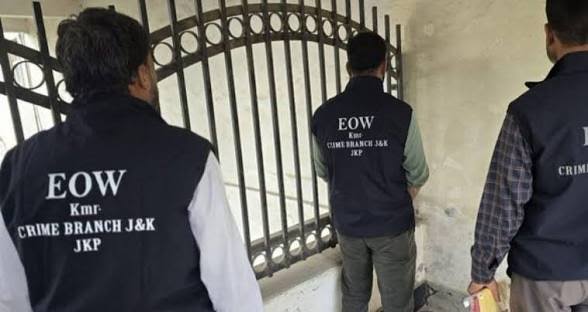
Jammu, July 12 (NVI): Jammu and Kashmir Police has arrested three publishers in connection with the ongoing investigation into the publication and distribution of books which contained material eulogising separatists.

Officials said the arrests by Counter Intelligence (CI) were made during coordinated operations carried out in Jammu and Delhi as part of the probe into two controversial books that were found in government school libraries.

The arrested publishers have been identified as Inderpaul of Jammu-based Oberoi Book Service and Amardeep Singh and Girish Arora of Noida-based Dominant Publishers.

Officials said the CI unit had registered an FIR on July 4 under relevant provisions of the Bharatiya Nyaya Sanhita (BNS), including charges of criminal conspiracy, promoting enmity, publishing false statements, and endangering the sovereignty, unity and integrity of India, besides Section 13 of the Unlawful Activities (Prevention) Act.

The books under investigation are Personalities and Legends of J-K, authored by Hilal Ahmad and Santosh Meena and published by Oberoi Book Service, and Great Personalities of Jammu and Kashmir, authored by Sushant Giri.

According to officials, both Oberoi Book Service and Dominant Publishers had already been blacklisted by the government, while raids were conducted at their premises on July 6 as part of the investigation.

Officials further said that 123 copies of one book were distributed to schools in Jammu, Ramban and Udhampur districts, while 128 copies of the other book were supplied to schools in Jammu and Baramulla districts.

“The investigation is underway and further arrests are likely,” officials said.

The arrests come a day after Lieutenant Governor Manoj Sinha suspended eight officials of the School Education Department, terminated the services of a contractual employee and ordered an inquiry into the inclusion of the two books in government school libraries.

The School Education Department had withdrawn both books from schools on July 3 following objections from various political parties, which alleged that the books glorified separatist leaders.—(NVI)

MUST READ