
Monday, May 18, 2026
Home Blog Page 18

Travel between Srinagar and Jammu in less than 5 hours from tomorrow

Vande Bharat trains
Vande Bharat trains

Jammu, May 1: From tomorrow, you can travel between Srinagar and Jammu city in less than 5 hours, which so far takes at least 8-9 hours by road.

The reduced travel time will be possible because of the extended service of Srinagar-Katra Vande Bharat express up to Jammu Tawi Railway Station.

Two pairs of services will operate across the corridor, covering a distance of around 266 km in 4 hours 50 minutes.

The first service (Train No. 26401) will depart Jammu Tawi at 6:20 AM, halt at Shri Mata Vaishno Devi Katra, Reasi, and Banihal and arrive at Srinagar at 11:10 AM.

Its return (Train No. 26402) will leave Srinagar at 2:00 PM and reach Jammu Tawi by 6:50 PM.

This pair will run six days a week, except Tuesday.

The second service (Train No. 26404) will depart Srinagar at 8:00 AM, halt at Banihal and Katra, and arrive at Jammu Tawi by 12:40 PM.

Its return (Train No. 26403) will depart Jammu Tawi at 1:20 PM and reach Srinagar by 6:00 PM.

This pair runs six days a week, except Wednesday.

These will be 20-coach trains, instead of the 8-coach ones in operation currently.

Together, the two pairs ensure that passengers have a morning and an afternoon Vande Bharat option from both ends of the corridor on most days of the week, giving travellers meaningful flexibility in planning their journeys.

Until now, pilgrims and passengers arriving at Jammu Tawi Railway Station from Delhi, Mumbai, and beyond had to change trains or arrange separate road transport to reach Katra to visit Mata Vaishno Devi shrine situated in the Trikuta mountains.

With the extension, they will be able to board the Vande Bharat directly at Jammu Tawi and reach the Vaishno Devi base camp at Katra, and travel onwards all the way to Srinagar, without a single interchange.

The same seamless journey works in the other direction too. A traveller boarding at Srinagar will now be able to reach Jammu Tawi in a single, unbroken ride, connecting directly to the national rail network.

The Pilgrim: A Blessed Journey Made Easier

For the millions of devotees who travel each year to seek the blessings of Shri Mata Vaishno Devi, this extension removes a persistent inconvenience, the mandatory interchange at Katra.

Until now, a pilgrim had to alight at Katra and board a separate Vande Bharat to continue onward, or vice versa. That break in journey is now eliminated.

More significantly, for the growing number of pilgrims who combine the Vaishno Devi darshan at Katra with the Amarnath Yatra, whose base camps at Pahalgam and Baltal are accessed from Srinagar, the entire pilgrim circuit of J&K is now achievable on a single, unbroken rail journey, without a change of train, a second reservation, or the anxiety of a missed connection.

For the Indian and international tourist, this extension opens an entirely new way to experience Jammu & Kashmir.

A visitor flying into Jammu can now board the Vande Bharat at Jammu Tawi and ride through some of the most breathtaking terrain on the subcontinent, past the Shivalik foothills, across the engineering marvel of the Chenab and Anji bridges, through tunnels carved into the Himalayan rock and arrive in Srinagar, ready to experience the Dal Lake, the Mughal Gardens, and the legendary hospitality of the Valley.

No highway delays, no mountain road anxiety, no weather-dependent road closures.

The extension is expected to give a significant boost to tourism across the entire J&K corridor, making the region accessible to a far broader segment of travellers who may have been deterred by the logistics of the journey. (NVI)

Soldier Found Dead in Jammu, Probe Launched

Representational Pic

Jammu, May 1 (NVI): An Army soldier was found dead under suspicious circumstances in the Satwari area of Jammu, officials said on Friday.

The soldier’s body was recovered from his quarters, they said, adding that the cause of death was not immediately known.

Police and Army authorities have launched an investigation to ascertain the circumstances leading to the death, officials said.

Further details are awaited.(NVI)

Lt Gen Balbir Singh takes charge as Commander of Srinagar-based Chinar Corps of Army

Lt Gen Balbir Singh takes charge as Commander of Srinagar-based Chinar Corps of Army from Lt Gen Prashant Shrivastava

Srinagar, May 1 (NVI): Lieutenant General Balbir Singh, a highly decorated Army officer with over 34 years of service including in Jammu and Kashmir, is the new Commander of Srinagar-based Chinar Corps which oversees operations across the Union Territory and the Line of Control (LoC).

Lieutenant General Balbir Singh assumed command of the Chinar Corps today, taking the baton from Lieutenant General Prashant Srivastava who held the charge for 19 months and is proceeding to take over as the Quarter Master General at the Army Headquarters in New Delhi.

Lt Gen Singh has extensive experience in counter-infiltration and counter-terrorism operations in Jammu and Kashmir and the North East.

He has previously commanded the Counter Insurgency Force (Victor) in south Kashmir.

Soon after taking charge, Lt Gen Singh paid tributes to fallen soldiers at the Chinar War Memorial here.

In his address, he emphasised close coordination with the civil administration and the people of Kashmir to further strengthen peace and stability in the region.

Lt Gen Srivastava oversaw key operations, including Operation Sindoor and Operation Mahadev, which targeted those involved in the Pahalgam attack. The period also witnessed the smooth and incident-free conduct of the Amarnath Yatra in 2025, officials said.

Under his leadership, the Corps recorded operational successes in counter-infiltration along the Line of Control and counter-terrorism operations in the hinterland, they added.

During his tenure, the Corps focused on strengthening the security architecture in Kashmir, enhancing coordination among various agencies and contributing to overall peace and stability in the Valley, they said. (NVI)

Commercial LPG cylinder to cost much more, price increased by Rs 993

LPG cylinders

New Delhi, May 1: Prices of commercial LPG cylinder and the one used at roadside stalls have been hiked substantially with immediate effect, a decision that is likely to make eating at a restaurant or a dhaba expensive.

Announced today, the price of commercial LPG cylinder of 19 kgs has been hiked by Rs 993, because of which it will now cost Rs 3,071.50 in Delhi.

At the same time, the price of 5 kg LPG cylinder has been increased by Rs 261, as a result of which it will now cost Rs 1,754.5.

Impact on Eateries:

The sharp hike in the prices of these types of cylinders is likely to affect entities involved in the food and dining, such as roadside eateries, dhabas, restaurants and hotels.

Even small-scale manufacturing establishments are likely to be affected since these businesses rely heavily on commercial LPG and 5 Kg cylinders for operations.

The higher input costs are likely to be passed on to the customers, as a result of which the food prices, especially in restaurants and street food segments, are likely to increase.

What about Domestic LPG cylinders?

As of now, the prices of domestic LPG cylinders have not been changed but there is anxiety among people about these too as any increase will impact the households of the people.

Criticism:

The decision to increase the prices evoked criticism from opposition parties like Congress and CPM.

What Has Changed in LPG Prices

The biggest change comes in the form of a sharp ₹993 hike in 19-kg commercial LPG cylinders.

After this revision, prices in cities like Delhi have climbed to ₹3,071.50 per cylinder. Similar increases have been recorded across metros and industrial hubs, with rates now varying depending on local transport and distribution costs.

In contrast, domestic LPG cylinders (14.2 kg), widely used for household cooking, have remained stable. In Delhi, the domestic cylinder continues to cost around ₹913, showing that the current revision is targeted specifically at commercial consumption rather than everyday household use.

City-Wise Impact Across Major Urban Centers

The revised pricing structure shows noticeable variation across cities. In Mumbai, commercial LPG is now priced slightly above ₹3,000, while in Bengaluru, it has crossed ₹3,100. Other cities such as Kolkata, Chennai, Hyderabad, and Patna are also witnessing higher rates, with Patna among the costliest at over ₹3,300 per cylinder.

This variation reflects transportation costs, regional taxation structures, and supply chain differences across states.

Why Prices Are Rising

Officials and oil marketing companies have linked the hike to global energy market volatility, particularly tensions in West Asia.

Rising crude prices and shipping uncertainties have increased input costs for industrial fuels. However, the impact has been selectively passed on, affecting commercial LPG users more than households.

The Indian Oil Corporation has stated that most petroleum products remain stable, with nearly 80% of fuels showing no change in pricing. The company also emphasized that only select industrial fuels, including commercial LPG and certain aviation fuels, have been adjusted.

Pakistan’s Fuel Crisis Deepens: Citizens Fear Prices Heading Toward 1000 PKR per Litre soon

Pakistan’s Fuel Crisis Deepens: Citizens Fear Prices Heading Toward 1000 PKR per Litre soon

Islamabad, May 1: A surge in fuel prices and a flood of alarming social media posts have left people across Pakistan uneasy. Claims that petrol could soon hit 1,000 PKR per litre, along with rumors of pumps running dry, have intensified public concern. While the situation is serious, the reality is more complex than the panic suggests.

Rising Fuel Prices and Government Action

The government recently announced a fresh increase in petroleum prices, pushing petrol close to 400 PKR per litre, with diesel following a similar trajectory. These changes came into effect on May 1, 2026, as authorities adjusted taxes and levies to cope with rising global oil costs. Officials have linked the hike to ongoing instability in international energy markets, especially due to geopolitical tensions affecting supply chains. Prime Minister Shehbaz Sharif has acknowledged that the country’s fuel import bill has surged dramatically, placing additional strain on an already fragile economy.

Auto rickshaw drivers, along with members of the Awami Rickshaw Union, take part in a protest against the rising fuel prices, amid the U.S.-Israeli conflict with Iran, in Lahore, Pakistan, April 7, 2026. REUTERS/Murtaza Ali

The Truth Behind Shortage Rumors

Despite viral videos and widespread claims, officials have firmly rejected the idea that fuel is running out. Regulatory authorities and petroleum bodies have described these reports as misleading and part of a broader wave of misinformation. According to government assurances, fuel supply remains stable, petrol pumps are operating normally, and the country holds sufficient reserves to meet demand for several weeks. This suggests that while prices are rising, there is no immediate supply crisis.

Economic Pressure Building Beneath the Surface

The real issue lies in the broader economic impact of rising fuel costs. As prices increase, transportation becomes more expensive, which in turn raises the cost of food and essential goods. This ripple effect is particularly severe in a country heavily dependent on imported energy. Economists warn that inflation could accelerate further, reducing purchasing power and increasing financial stress on households. The involvement of institutions like the International Monetary Fund also limits the government’s ability to cushion the blow through subsidies, making the situation more difficult to manage.

Government’s Tightrope Walk

Authorities are navigating a difficult path between easing public burden and maintaining economic discipline. Passing on global price increases to consumers risks public backlash, while offering subsidies could worsen the fiscal deficit. With limited financial flexibility and external pressures, the government’s options remain constrained, increasing the stakes of every decision.

Public Response: Fear, Frustration, and Uncertainty

Public reaction has been a mix of anxiety and anger. Many citizens, especially those dependent on daily transport for income, are feeling the strain of rising fuel costs. Protests have already surfaced in some areas, and social media continues to amplify fears, sometimes without verified information. The idea that prices could skyrocket further has added to a growing sense of uncertainty about the future.

While fuel prices in Pakistan are undeniably rising and putting pressure on the economy, claims of petrol reaching 1,000 PKR or an imminent nationwide shortage appear exaggerated at this stage. The more pressing concern is the steady economic strain that could deepen if global conditions remain unstable.

CBK files chargesheet in multi-lakh job fraud case in Srinagar

Srinagar, May 1(NVI): The Crime Branch Kashmir (CBK) has filed a chargesheet against three persons in a multi-lakh job fraud case, alleging that they duped several people on the pretext of securing government jobs, officials said on Friday.

The chargesheet was filed by the Special Crime Wing Kashmir before the Court of Chief Judicial Magistrate Srinagar in connection with FIR No. 09/2019 under relevant sections of the Ranbir Penal Code, including cheating, forgery and criminal conspiracy.

The accused have been identified as Fayaz Ahmad Khan of Maloora Shalteng Srinagar, Showkat Ahmad Shah of Shanzipora Handwara and Owais Ahmad Rather of Shalteng Khwaja Bagh.

According to officials, the case stemmed from a complaint by residents of Pulwama, who alleged that the accused had collected lakhs of rupees from them by promising government jobs for their relatives.

Investigation revealed that the accused, acting in connivance, posed as influential officials and issued forged appointment orders purportedly from the Forest Department, which were later found to be fake.

The accused allegedly took payments in cash under the pretext of arranging “backdoor entry” into government service.

The chargesheet has been submitted before the court for trial.

The Crime Branch has advised the public to remain vigilant against such frauds and report any suspicious activity to the authorities.(NVI)

J&K Cabinet Approves DA Hike, Major Reforms and Development Projects

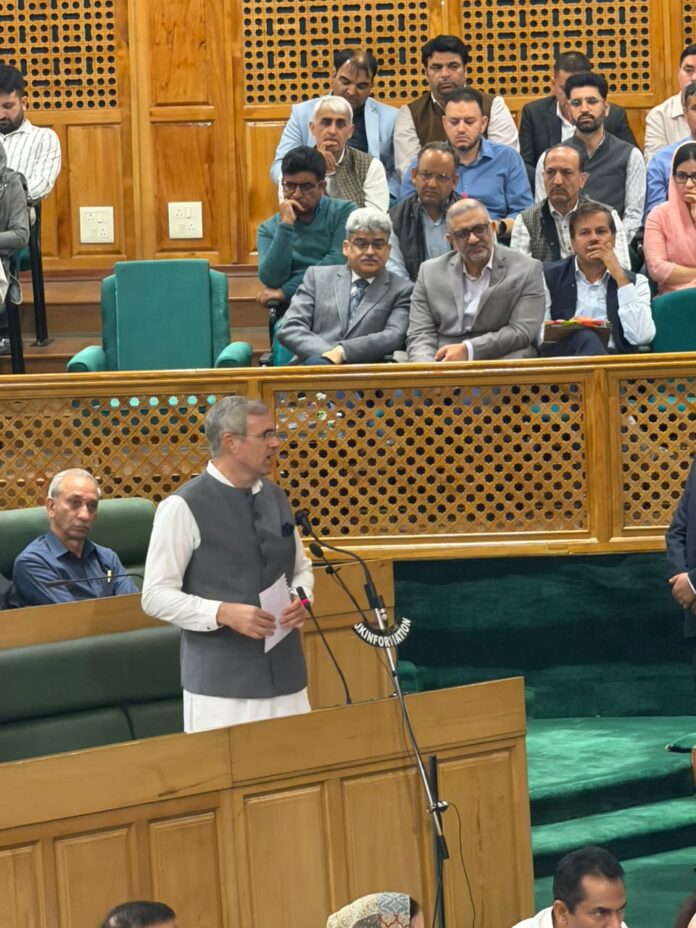
Jammu, May 1 (NVI) :The Jammu and Kashmir Cabinet on Friday approved a series of significant decisions, including a hike in Dearness Allowance (DA), key administrative reforms, and multiple development projects across departments.

The meeting, chaired by Chief Minister Omar Abdullah in Jammu, marked the final Cabinet session in the winter capital before the Civil Secretariat shifts to Srinagar for the next six months.

Among the major decisions, the Cabinet sanctioned a 2 percent increase in DA for government employees and pensioners, raising it from 58 percent to 60 percent.

The Cabinet also approved several infrastructure and public service initiatives, including the construction of three new grid stations and sewerage treatment plants in Baramulla and Rajouri, aimed at improving urban infrastructure and waste management systems.

In a major administrative reform, the Cabinet agreed to merge “The Jammu & Kashmir Cooperative Societies Act” and “The Jammu & Kashmir Self-Reliant Cooperatives Act” into a single unified legislation, simplifying governance of cooperative institutions in the Union Territory.

The Health and Medical Education Department received a boost as the Cabinet cleared the re-designation of Medical Superintendents as Professors, Deputy Medical Superintendents as Associate Professors, and Assistant Medical Superintendents as Assistant Professors. This move is expected to enhance academic capacity and increase postgraduate (PG) seats in Government Medical Colleges.

The Cabinet further approved cadre review and restructuring of the Jal Shakti Department, along with new recruitment rules for State Motor Garages.

Decisions were also taken to safeguard properties belonging to Kashmiri migrants in Jammu, and to regularize lecturers in the Education Department.

In addition, promotions of Jammu and Kashmir Administrative Services (JKAS) officers across various ranks—including Under Secretaries, Additional Secretaries, and Special Secretaries—were cleared, subject to approval by Lieutenant Governor Manoj Sinha.

The Cabinet also approved the creation of a supernumerary post of District Judge and sanctioned the establishment of nine posts of District Ayush Officers across various districts, including Pulwama.

Several development proposals from the Public Works, Housing & Urban Development, and Rural Development departments were also given the green light.

All approved decisions will be forwarded to the Lieutenant Governor for final assent.

The meeting was attended by all Cabinet ministers and senior officials, including Chief Secretary Atal Dulloo. The next Cabinet meeting is scheduled to be held in Srinagar after the Civil Secretariat resumes functioning there from May 4.(NVI)

Hizbul terrorist commander from Kashmir ‘dead’ in Pakistan
Ahmed Sajad, originally from Baramulla in Kashmir, has died in mysterious circumstances in Islamabad, according to reports

terrorist
Representative pic of a terrorist

Islamabad, May 1: Reports of the death of yet another anti-India terrorist in Pakistan surfaced tonight, hours after the killing of a top commander of Jaish-e-Mohammad (JeM) by unknown gunmen in the country.

According to these reports, Ahmed Sajad, a commander of Hizbul Mujahideen (HM) terror outfit has died in mysterious circumstances in Islamabad.

While details are not available immediately, it is suspected that he may have been killed by someone.

It is extremely difficult to ascertain the full details since the Pakistani establishment always suppresses information about such incidents related to the terrorists whom the Pakistani military and its intelligence agency ISI grooms and uses as tools against India.

It is, however, known that Ahmed Sajad originally hailed from Baramulla district of Kashmir and had been living in Pakistan after illegal exfiltration decades back.

He has been involved in planning and execution of several terrorist acts in Jammu and Kashmir and rest of India.

The news about Ahmed Sajad surfaced hours after Maulana Salman Azhar, a top commander of JeM and close aide of the outfit’s chief Masood Azhar, was shot dead by some unknown gunmen in Bahawalpur in Punjab province of Pakistan.

He was shot while travelling in a car.

JeM has the headquarters in Bahawalpur and Salman Azhar used to operate from there, planning and overseeing execution of terrorist attacks in India, according to sources.

Salman Azhar’s killing came three days after Sheikh Yusuf Afridi, a senior commander of Lashkar-e-Taiba (LeT) terrorist outfit, was gunned down by unknown gunmen in Khyber Pakhtunkhwa Province of Pakistan.

Afridi, a close associate of LeT chief Hafiz Saeed, was shot at from close range by some gunmen who fled fro the scene immediately.

Afridi was linked to various attacks in India. He was a key figure in LeT’s regional structure and was involved in recruitment and coordination of the outfit’s activities in the region.

These attacks come after a series of such incidents in various parts of Pakistan over the last few years in which a number of anti-India terrorists have been eliminated.

All the three terror outfits — HM, JeM and LeT — propped up and fully supported by the Pakistani establishment through its Army and intelligence agency ISI. (NVI)

Centre approves ₹243 crore for PM SHRI Schools in J&K for 2026–27

Noida
File photo

Jammu, Apr 30 (NVI): The Centre has approved an outlay of ₹243 crore for Jammu and Kashmir under the PM SHRI – Schools for Rising India scheme for the financial year 2026–27, officials said on Thursday.

The approval was granted during a meeting of the Project Approval Board (PAB) chaired by Union Secretary, Department of School Education and Literacy, Sanjay Kumar. The meeting was attended by Commissioner Secretary, School Education J&K, Ram Nivas Sharma, along with senior officials of Samagra Shiksha.

The Board reviewed the financial and physical progress under the scheme for the previous year and noted that out of ₹200.11 crore available for 2025–26, ₹194.53 crore had been utilised and released to executing agencies, including PWD (R&B), primarily for civil works and allied activities.

The PAB appreciated the improvement in academic performance in the Union Territory, highlighting a 10 per cent increase in Board examination results at the secondary and higher secondary levels.

It also commended the overall progress made in implementation of the scheme.

Officials said the Ministry of Education has assured continued support for effective execution of the programme. At present, the PM SHRI scheme covers 396 schools across Jammu and Kashmir, mostly at the high and higher secondary levels.

They also dismissed reports in a section of the media regarding low expenditure under the scheme as incorrect.(NVI)

Holy relics of Tathagatha Buddha reach Leh for major ceremony on Buddha Purnima tomorrow

By Arun Kumar Das

Leh (Ladakh), April 30: Marking commencement of historic spiritual celebration in the Union Territory of Ladakh, the holy Piprahwa relics of Tathagatha Buddha have been brought here amid deep spiritual fervour and an atmosphere imbued with devotion.

A warm and reverential welcome was accorded by Lieutenant Governor of UT Ladakh Vinai Kumar Saxena to the sacred relics when these arrived at Leh Airport from New Delhi, where the Holy Relics are originally preserved.

The reception ceremony was marked by traditional performances, ceremonial honours, and sacred rituals.

The relics, brought from Delhi by Drukpa Thuksey Rinpoche and Khenpo Thinlas Chosal of Matho Monastery in a special Air Force aircraft, were received by the Lieutenant Governor in the presence of prominent religious and public figures, including Khamtak Rinpoche, Rigyal Rinpoche, President Ladakh Gonpa Association Ven. Dorje Stanzin and representatives of various social, religious and political organisations.

The Ladakh Police accorded a ceremonial guard of honour, while monks performed special prayers.

The Lieutenant Governor offered prayers on behalf of the people of Ladakh, invoking peace and well-being for all.

Following the ceremonial reception, the relics were taken in a grand procession to Jivetsal, the designated venue for public exposition, beginning May 1, which marks the 2569th Buddha Purnima.

The event witnessed overwhelming community participation from across Ladakh, reflecting unity, faith, and collective reverence, as thousands of devotees, dressed in traditional attire, lined the route up to Jivetsal to catch a glimpse of the sacred relics.

Describing the occasion as highly auspicious, LG Saxena stated that the arrival of the holy relics has blessed the entire region.

He noted that while the relics have been exhibited internationally in the past, it is for the first time that the relics have been brought out from their original place of preservation, for exposition within India.

Over the years, the sacred Piprahwa relics of Lord Buddha have been exhibited in several countries, including Thailand, Mongolia, Vietnam, Russia, Singapore, Bhutan, Sri Lanka, and Myanmar, drawing global attention and devotion.

In Ladakh, the relics will be available for public veneration at Jivetsal from May 2 to May 10, followed by exposition in Zanskar on May 11 and 12, and thereafter at the Dharma Centre in Leh from May 13 to 14, before being flown back to Delhi on May 15.

The Home Minister Amit Shah, apart from Union Ministers, Ambassadors, Chief Ministers of Buddhist-majority states, and representatives of various Buddhist organisations will be visiting Leh for the veneration.

The Piprahwa relics have gained renewed global significance in recent years. After 127 years in colonial possession, a significant collection of associated gems and offerings were repatriated to India in July 2025, from a British family and a private collection.

In anticipation of the influx of devotees and tourists, the Lieutenant Governor has been closely monitoring preparations and has directed extensive beautification and infrastructure measures across Leh.

Plantation drives, placement of flower pots, and city-wide cleanliness initiatives have been undertaken in a mission mode to ensure a pleasant, aesthetic, and spiritually enriching experience for all visitors.

MUST READ