By Khalid Rasool
Balochistan is one of the hardest tests of Pakistan’s claim to democratic governance. The province faces two crises at once: a violent insurgency that has taken civilian and security-force lives, and a long-running human-rights emergency of alleged enforced disappearances, arbitrary detention, restricted assembly and suppressed dissent. Neither can be ignored, and neither excuses the other.
Violence against civilians is never justified by political grievance. But an insurgency does not give a state unlimited authority to silence critics, bypass due process or treat political activism as a security crime. The question is a simple one: can a state defeat an insurgency while protecting the rights of the people it claims to defend?
When citizens disappear
Enforced disappearance is among the gravest allegations in the Balochistan conflict. The Human Rights Commission of Pakistan (HRCP), after a fact-finding mission to the province, published a report titled Balochistan: Neglected Still, which found that incidents of disappearance continued unabated and that the province remained politically short-changed.
It went further, stating that the state’s security agencies faced grave allegations of human rights violations, including a role in enforced disappearances and the dumping of mutilated bodies of the disappeared, and that provincial and federal authorities had failed for years to hold any state functionary accountable.
Amnesty International has documented individual cases that fit this pattern. It reported that Jiand Baloch, chairperson of the Baloch Students Organization, was forcibly disappeared from his home on 24 July 2026, with his family threatened and assaulted during the raid, and that this marked the third time he had been forcibly disappeared as part of a pattern targeting him for his peaceful activism.
Cases like this raise a question for every democratic society. What becomes of the rule of law when a citizen can vanish before being charged, tried or convicted? A justice system begins with a person’s right to know why they are held and where. Where that right is denied, what remains is force, not law.
Families of the disappeared have tried, for years, to make that point heard in the capital itself.
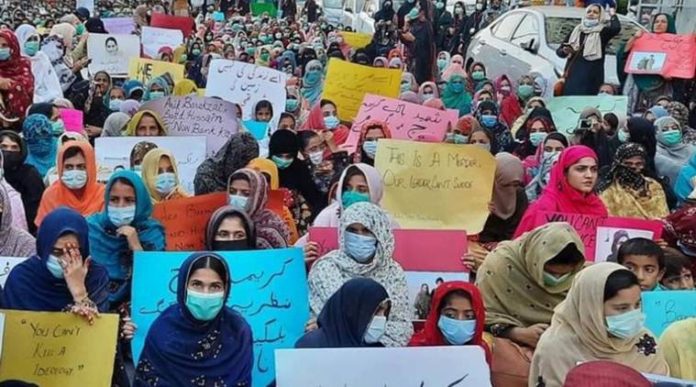
Relatives of missing Baloch have camped outside Islamabad’s National Press Club for weeks at a time; one such sit-in demanding an end to enforced disappearances and the release of Baloch Yakjehti Committee (BYC) leaders stretched past its 51st consecutive day, with participants describing police barricades, harassment and the use of force against women and children who had gathered peacefully.
Journalists, including those at the BBC, have long reported on these families’ journeys and vigils. The state’s response to them is part of the story.
Students and young activists under pressure
The targeting of students and young activists is especially disturbing, because universities and civil society should be places of debate, disagreement and political participation. When peaceful activism is treated first as a security threat, the damage reaches beyond individual detainees. Fear spreads through campuses, families, newsrooms and civil-society organisations, and a generation learns that speaking is dangerous.
Amnesty has described Jiand Baloch’s case as part of a wider pattern of targeting Baloch students.
It also documented the case of Dad Shah, brother of the Baloch human-rights defender Fozia Baloch: he was forcibly disappeared from his home in Karachi on 21 April by officials allegedly belonging to the Counter Terrorism Department, and despite eyewitnesses, police failed to investigate adequately.
Amnesty added that his family members were subsequently harassed and arbitrarily detained by law enforcement for raising his case.
These are allegations, and allegations of this gravity demand transparent investigation — not dismissal, denial or political counter-accusation.
When anti-terrorism laws replace evidence
The greatest democratic danger appears when extraordinary security legislation becomes a routine tool against political dissent.
On 22 June 2026, an Anti-Terrorism Court in Quetta sentenced Dr. Mahrang Baloch — the physician-turned-rights campaigner who leads the Baloch Yakjehti Committee — and fellow activist Sibghatullah Shahji to life imprisonment over their alleged roles in a 2024 sit-in protest in Gwadar during which a Frontier Corps member was killed.
Amnesty International called the conviction an affront to fair-trial rights, following an expedited trial held in secret on prison grounds where no direct evidence was presented tying the pair to the violence.
UN human rights experts went further, warning that Dr. Baloch’s trial was marred by serious due-process failures: it was moved to a jail, she was denied the chance to attend in person, and she was represented by state-appointed counsel rather than a lawyer of her choosing.
They noted that she still faces dozens of other pending police complaints — a volume of litigation her own lawyers have struggled simply to track.
The state’s position deserves a fair hearing. Pakistani authorities have accused some activist networks of links to militancy and defend their actions as lawful counter-terrorism. That is exactly why open courtrooms matter.
A person accused of terrorism should be prosecuted when evidence exists, and prosecuted in public, with independent observers and a real defence. Terrorism legislation must never become a substitute for evidence. A state with powerful security laws owes the strongest possible commitment to judicial safeguards.
The problem of civilian authority
Pakistan’s civil-military relationship has been debated for decades, and in Balochistan it matters most because security policy dominates the political environment. Citizens and international observers are entitled to ask who exercises real civilian oversight over intelligence agencies, counter-insurgency operations and detention practices.
Dismissing every provincial politician as a tool of the military would oversimplify a complicated system, and many elected representatives sincerely try to serve their constituents.
But the institutional question stands. Can elected bodies independently investigate allegations against powerful security agencies? Can a provincial government order the release of a detainee, or even learn where he is held? Where the answer is no, elections produce office-holders, not authority, and the gap between the two is where accountability disappears.
HRCP’s own report pointed to precisely this erosion: it found that the heavy, permanent presence of security forces — including inside institutions like Balochistan University — undermined the provincial government and civilian administration, even after constitutional reforms meant to give the province greater say over its own affairs. Democracy is more than the holding of elections.
It requires accountability, independent institutions, freedom of expression, and the ability to challenge government policy without fear.
Security cannot be a blank cheque
Pakistan’s security concerns in Balochistan are real. Security forces have repeatedly reported operations against militants in Kalat district, including one in early September 2026 in which the military said it killed twelve fighters linked to an India-backed network and destroyed a cache of weapons and explosives at the site.
Attacks on civilians are crimes, and militant groups must answer for them — as they must for the March 2025 hijacking of the Jaffar Express, in which Baloch Liberation Army militants seized a train carrying hundreds of passengers; Pakistani forces reported killing dozens of militants in the multi-day operation that followed, while more than twenty hostages were killed before the remaining passengers were freed.
But because terrorism is a serious threat, the state must be careful to distinguish armed violence from peaceful dissent.
A student activist is not automatically a militant. A journalist is not automatically an enemy of the state. A human-rights defender is not automatically a terrorist. And a family asking where a missing relative is held is not committing rebellion.
The tragedy of collective suspicion
Excessive securitisation carries a hidden cost: a whole population begins to feel it is seen only through the lens of suspicion. When peaceful demonstrations are restricted, activists detained, journalists pressured and families denied information, political alienation deepens.
HRCP has documented these concerns directly, while Amnesty describes a wider crackdown affecting Baloch activists and peaceful protest.
The result is a vicious cycle. Repression breeds distrust, distrust breeds alienation, alienation makes reconciliation harder, and prolonged conflict is then justified as a permanent security problem.
Every disappeared son becomes a recruiting argument for those who preach violence. Breaking the cycle takes political courage, and the state, being the stronger party, must move first.
Balochistan is not merely a security file
The international conversation must move beyond military operations and casualty statistics.
At its centre are human beings: families searching for missing sons, students afraid to speak, activists in detention, journalists trying to report, lawyers defending unpopular clients, and communities demanding answers from institutions that hold enormous coercive power.
Their rights cannot depend on whether their opinions are popular in Islamabad, Quetta or anywhere else.
What the international community should demand
The world should apply one standard to every actor. Militant groups must be held accountable for killing civilians, kidnapping, extortion and attacks on public institutions.
The state must be held accountable for unlawful detention, enforced disappearance, torture, extrajudicial killing and violations of fair-trial rights, wherever such acts are established. There can be no selective human rights.
This is not a call for foreign intervention or political engineering. It is a call for four concrete things:
Independent investigation of disappearances, with real powers and public findings.
Transparent trials open to media and independent observers.
Access for credible human-rights monitors, including UN mechanisms.
Meaningful civilian oversight of intelligence agencies and detention practices.
Pakistan’s sovereignty deserves respect. But sovereignty has never meant immunity from scrutiny when fundamental rights are at stake.
The real test of the state
A state’s strength is not measured by the checkpoints it holds or the critics it silences. It is measured by whether its institutions can withstand criticism without resorting to arbitrary power.
If Pakistan wants lasting peace in Balochistan, it must address both halves of the crisis: the violence of armed groups and the grievances arising from alleged abuses by state institutions.
Security without justice cannot create stability. Development without political participation cannot end alienation. Elections without civilian oversight cannot guarantee accountability. And counter-terrorism without due process turns the rule of law into an instrument of fear.
Balochistan stands at a crossroads. One road leads to deeper militarisation, greater distrust and an endless cycle of accusation and retaliation. The other leads through credible investigations, fair trials, protection for peaceful politics, freedom for journalists and lawyers, real provincial participation, and accountability for abuses regardless of who commits them.
The world’s intellectual community should put one question to Pakistan: can the state protect its territorial integrity without sacrificing the dignity and rights of its citizens? The answer will decide far more than the future of Balochistan. It will show what kind of political system Pakistan wants to be. A state is strongest not when its citizens fear it, but when they can trust its institutions.