Friday, April 3, 2026
Home Blog Page 61

Pakistan nurturing ISIS-K: Afghan Minister

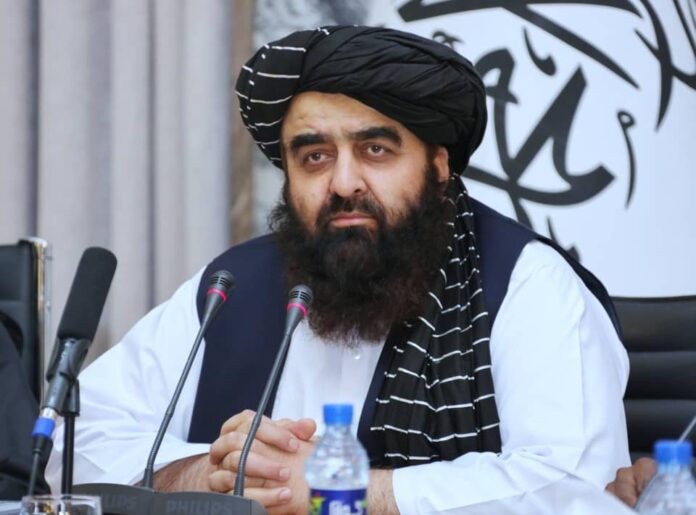
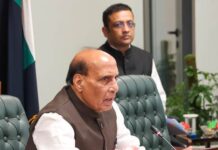
Afghanistan's Acting Foreign Minister Mullah Amir Khan Muttaqi

New Delhi, Oct 9 (NVI) Pakistan has become a major hub of illicit drug trafficking whose revenues are used to strengthen the deadly terrorist organisation ISIS-K to cause destabilisation in Afghanistan, the Taliban regime’s Acting Foreign Minister Mawlawi Amir Khan Muttaqi has said.

These significant remarks slamming Pakistan were made by Muttaqi at the Joint Session of the 7th Moscow Format meeting, ahead of his visit to India to discuss ways to strengthen bilateral ties, including in the spheres of security, political, economic and trade.

He said Pakistan is a leading country worldwide in opium poppy cultivation, and from the revenues of the illicit drug trade, terrorist organizations such as ISIS-K are being strengthened.

ISI-K has been carrying out sustained campaign of terrorism in Afghanistan in an attempt to destabilise the Taliban regime which seized power militarily in August 2021.

Insisting that there are no bases or strongholds of any irresponsible armed groups, including ISIS, inside Afghanistan, Muttaqi said his country’s problems lie beyond its borders, in a clear reference to Pakistan.

He underlined that regional countries must work together to take action against ISIS and other groups that threaten the security of Afghanistan and the entire region.

He said the international community must take serious steps to prevent these major problems, because the situation is a grave threat to the whole world. (NVI)

Balochistan: BLA says it killed 5 Pakistani soldiers in attack

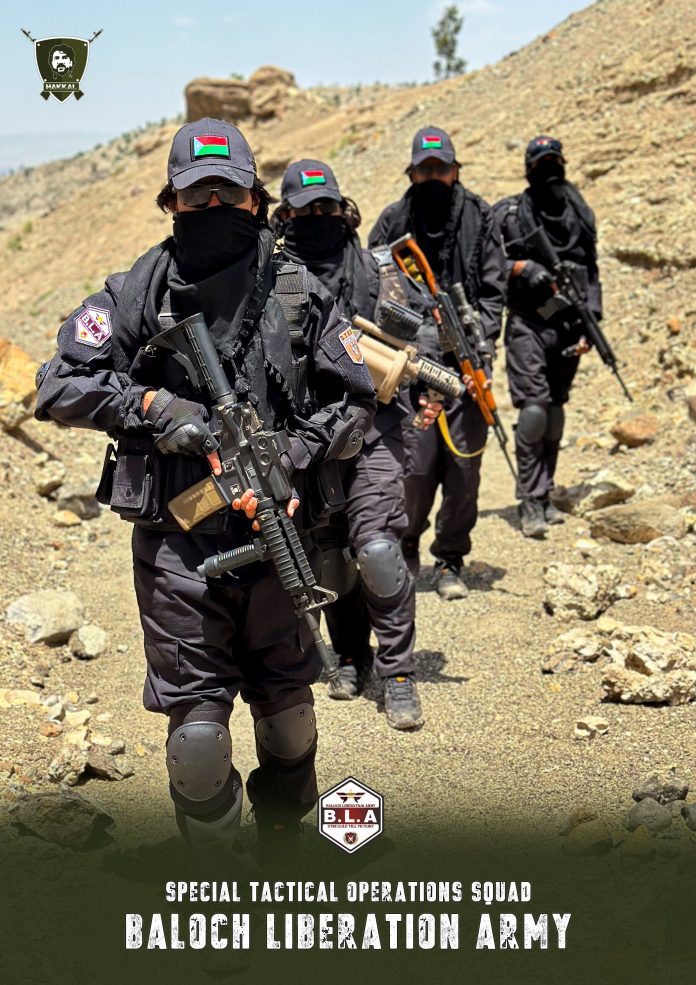
Special Tactical Operations Squad (STOQ) of Baloch Liberation Army (BLA).

Quetta, Oct 8 (NVI) Baloch Liberation Army (BLA) has claimed to have killed 5 Pakistani soldiers and injured several others in an attack in Kharan in Balochistan.

In a statement, BLA spokesman Jeeyand Baloch said the outfit’s fighters attacked a post of the occupying Pakistani army in Garak area of Kharan simultaneously from two sides.

The freedom fighters targeted the positions of the occupying army with automatic and modern weapons,  he said.

As a result, five personnel of the occupying army were killed on the spot and several others were injured, the spokesman said.

“The Baloch Liberation Army accepts responsibility for this attack and reiterates its determination to continue these effective strikes on the enemy,” he added. (NVI)

Afghanistan’s Acting Foreign Minister in India; marks huge development

Afghanistan's Acting Foreign Minister Mullah Amir Khan Muttaqi

New Delhi, Oct 9 (NVI) Afghanistan’s Acting Foreign Minister Mullah Amir Khan Muttaqi is in Delhi on a visit in response to an official invitation, marking a huge development that will have far-reaching implications for the region, particularly upsetting Pakistan.

Muttaqi is the highest-ranking leader of the Taliban regime, which is ruling Afghanistan since August 2021 after seizing power militarily, to undertake visit to India for strengthening bilateral relations.

He is expected to hold talks with External Affairs Minister S Jaishankar to discuss how the two countries can engage better in various spheres, including security, political, economic and trade.

Muttaqi arrived in New Delhi after his visit to Russia where he attended the ‘Moscow Format’ conclave, in which Indian Ambassador also participated on behalf of the country.

The visit, which has immense symbolism and message, comes months after the government of India established contact with the Taliban regime, with whom ties were very bitter during their earlier tenure from 1996 to 2001.

Jaishankar and Muttaqi have already held one telephonic conversation in May after the latter condemned the Pahalgam terror carnage carried out by Pakistani terrorists.

Prior to that, Indian Foreign Secretary Vikram Misri paid a visit to Kabul to meet Muttaqi in February.

The fact that the Taliban regime is engaging with India and favouring deepening of relations is a huge setback to Pakistan which has been humiliating and trying to isolate Afghanistan.

A major country like India hosting such a high-ranking leader of the Taliban regime also marks a significant development since the current regime of Afghanistan is yet  to be recognized officially by most of the nations, including New Delhi.

Pakistan will surely be watching the visit closely.  (NVI)

Killed 25 Pakistani soldiers, including Lt Colonel, injured 14 in twin attack: TTP

Peshawar, Oct 8 (NVI) Tehreek-e-Taliban Pakistan (TTP) tonight claimed claimed that 25 Pakistani soldiers, including a Lt Colonel, were killed and 14 injured in a twin attack by it in Dogar area of Orakzai district in Khyber Pakhtunkhwa province.

Giving details, TTP spokesman Muhammad Khorasani said that on October 6, Mujahideen of the Tehreek-e-Taliban Pakistan launched a major counterattack on the Jogi military fort using light and heavy weapons,.

The attack resulted in the death of 5 soldiers inside the fort and the injury of 12 soldiers, he said.

The next day, a military convoy under the command of a Lieutenant Colonel was sent as reinforcements to the Fort.

It was ambushed by the TTP on the way.

It resulted in the killing of 18 soldiers and injuries to four, he said.

“The attack was so intense that the enemy had no chance to recover,” the spokesman said.

Some injured personnel have been reported to have died, bringing the death toll to more than 20, he added. (NVI)

BLF chief warns US against investing in Pasni port of Balochistan

Allah Nazar Baloch, Chief of Baloch Liberation Front (BLF). File Photo

Quetta, Oct 8 (NVI) Dr. Allah Nazar, the underground guerrilla chief of Balochistan Liberation Front (BLF), has warned the US against investing in the Pasni port of Pakistan-occupied Balochistan, saying the investments would not be safe.

He issued an audio message to comment on the reports that the Pakistani military, led by Field Marshal Asim Munir, has offered access to the US to the Pasni Port on the coast of the Arabian Sea.

“Balochistan has become a quagmire. Nobody’s investments will be safe here whether it is from America or Britain,” the rebel leader said.

He slammed Pakistan’s military leadership for “selling” land and resources of Balochistan, which is under illegal occupation since 1948.

“Recently, Asim Munir has presented our ancestral land as a gift, the land our elders called our mother and father. It is a disgrace for Pakistan’s General Asim Munir and for those so-called representatives of Balochistan sitting in parliament to be selling samples of Balochistan’s resources in America,” the BLF chief said.

Urging the maximum number of Baloch people to join the armed struggle to liberate Balochistan from Pakistan, he cautioned against relying on international powers, saying that “global powers act only in their own interests.”

BLF is one of the main armed Baloch organisations fighting militarily for the independence of Balochistan. (NVI)

Big hit for Pakistan Army; 14 soldiers killed in attack in Khyber

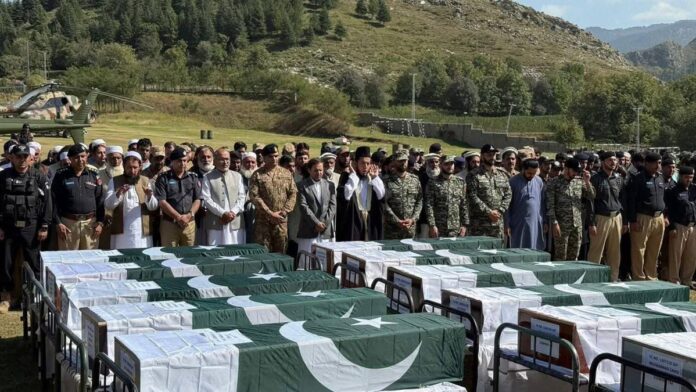
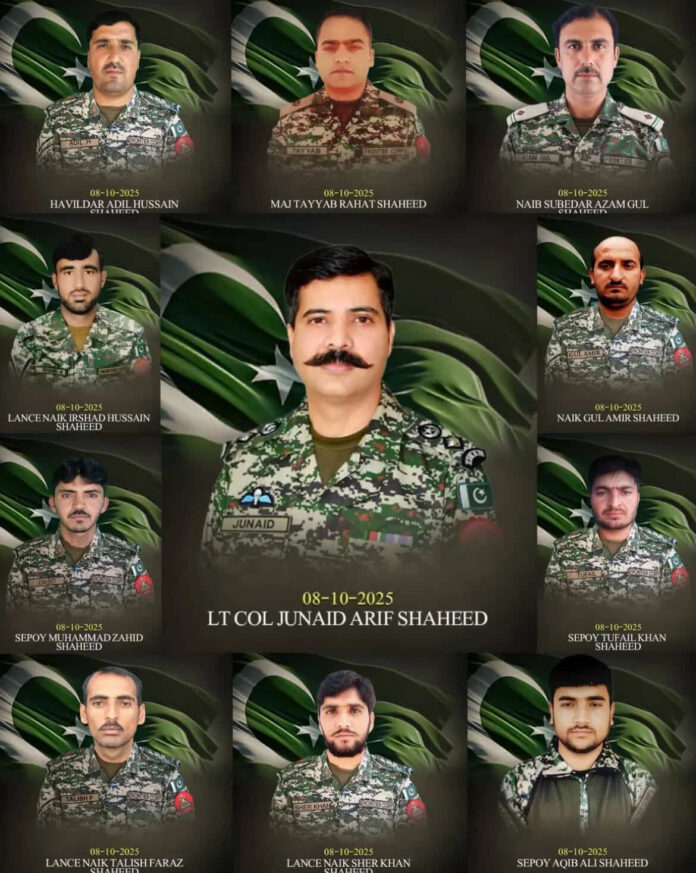
Peshawar, Oct 8 (NVI) Pakistan army today suffered a big hit in Khyber Pakhtunkhwa province as its 14 soldiers, including a Lt Colonel and a Major, were killed and several were injured or went missing after being attacked suspectedly by Tehreek-e-Taliban Pakistan (TTP).

The casualties were caused when a unit of the Pakistan Army was ambushed while on its way to conduct an operation against TTP in Orakzai district of Khyber Pakhtunkhwa Province early morning, according to sources on the ground.

The Army unit came under heavy fire from different sides, leaving 39-year-old Lt Colonel Junaid Arif, his Second-in-Command Major Tayyab Rahat (33) along with 12 other soldiers dead.

The Pakistan Army confirmed the killing of only 11 soldiers.

No outfit claimed responsibility for the attack so far but TTP is suspected to be involved considering its predominance in Khyber Pakhtunkhwa.

The TTP, with which several other small armed Jihadi groups have affiliated, has been causing casualties among the Pakistani forces every day through its multiple attacks under ‘Operation Al-Khandaq’. (NVI)

Digital Propaganda War Against India: The Silent Frontline of Cyber Terrorism

Column 

By Dr Nisar Ahmed Siddiqui

In today’s interconnected world, wars are no longer fought only with guns, missiles, and soldiers. A new battlefield has emerged, one that is invisible yet dangerously potent: the digital realm. Here, misinformation replaces bullets, fake narratives substitute for grenades, and armies of bots wage psychological warfare. India, as one of the world’s largest democracies and fastest-growing economies, finds itself a prime target of this sophisticated form of cyber terrorism.

A recent investigation by the research body Digital Forensics Research and Analytics Center (DFRAC) has laid bare how a network of social media accounts and websites has been meticulously engineered to malign India’s global image. This is not a spontaneous outpouring of anger or a few disjointed voices of dissent. It is a coordinated, cross-border campaign designed to project India as unstable, oppressive, and divisive. In short, it is weaponized propaganda aimed at weakening India from within and isolating it abroad.

Lies in the Age of Virality

The propaganda playbook is simple yet devastating: repeat a lie often enough, and it becomes accepted as truth. In the age of social media, where speed matters more than accuracy, misinformation spreads like wildfire. The DFRAC report reveals nine key accountssuch as “Deep State Press,” “Neon White Cat,” “Indian Invasion,” and “Codex India” which have been systematically pumping out anti-India narratives.

Their methods are disturbingly calculated. Sensitive incidents, such as communal clashes or diplomatic disputes, are amplified and distorted to appear as deliberate state actions. Memes, edited clips, and AI-generated images are injected into online discourse to confuse, provoke, and polarize. A killing arising from a personal dispute becomes a symbol of “state-sponsored violence.” A visa policy update is twisted into “ethnic cleansing of immigrants.” These distortions are then circulated across platforms, copied and reposted by allied accounts, creating the illusion of widespread global consensus.


This digital machinery thrives on two psychological levers fear and resentment. By portraying Indians abroad as “job stealers” and “frauds,” accounts like “Neon White Cat” and “Indian Invasion” aim to stoke resentment against India’s skilled diaspora. Simultaneously, fake media handles such as “Deep State Press” attempt to paint India as a hegemon conspiring against global peace, tapping into fears of India’s rise.

Cross-Border Conspiracies

What makes this campaign especially dangerous is its cross-border orchestration. While some accounts originate in Western nations like the United States and New Zealand—often linked to separatist elements pushing agendas like Khalistan—others have connections to Bangladesh. Handles such as “Intellectual Caveman” and “Lara” amplify divisive narratives by mocking Indian traditions, denigrating cultural practices, and spreading falsified reports that target the unity between India and its neighbors.

This reveals an uncomfortable truth: the propaganda against India is not just homegrown discontent spilling into cyberspace. It is a deliberate attempt by foreign actors and hostile networks to meddle in India’s internal cohesion and external reputation. The involvement of figures like Ravinder Singh Johal, associated with Khalistani extremist Gurpatwant Singh Pannun, underscores the seriousness of this campaign. When fringe separatist movements find digital platforms to amplify their cause, they acquire a dangerous reach far beyond their actual strength on the ground.

Information Warfare: A Threat to Democracy

Why should Indians be concerned about a handful of trolls and fake accounts? Because in the age of hybrid warfare, narratives can be more lethal than bombs. Information warfare can:

Erode social trust: By deepening religious, regional, and caste divides, digital propaganda weakens the very fabric of India’s pluralistic democracy.

Damage India’s global reputation: False stories about human rights violations or “ethnic cleansing” can influence policymakers abroad, harm trade negotiations, and isolate India diplomatically.

Target the diaspora: Indian professionals abroad are unfairly branded as fraudsters or infiltrators, damaging the credibility of one of India’s greatest sources of soft power.

Undermine governance: By spreading conspiracy theories about India’s leaders and policies, propaganda campaigns aim to delegitimize institutions and sow mistrust in government.

The danger is compounded by the use of advanced technology. Deepfakes, AI-generated content, troll armies, and bot-driven hashtag campaigns ensure that misinformation is no longer easily distinguishable from fact. When falsehoods are dressed as “news” and presented with slick graphics, they can sway even discerning minds.

The Silent Victims: Indians Abroad

Perhaps the most troubling aspect of this campaign is its direct targeting of Indians living abroad. Social media handles routinely call for “mass deportations” of Indians from countries like Canada, the UK, and the US. This vilification not only endangers individual immigrants but also undermines India’s reputation as a trusted contributor to the global workforce.

Consider the Indian IT sector, a pillar of India’s soft power. Accounts like “Deep State Press” trivialize Indian tech professionals as “clerks” and accuse them of “stealing jobs.” Such narratives are not only baseless but also dangerous—they fuel xenophobia abroad and expose Indian workers to hostility.

Responding to the Digital War

India cannot afford to treat this as just another nuisance of the internet age. This is a war albeit one fought in pixels and hashtags. The first step is recognition: understanding that misinformation campaigns are deliberate attacks on national security.

Second, there must be an investment in digital literacy. Citizens should be equipped to identify fake news, recognize propaganda tactics, and avoid becoming unwitting amplifiers of malicious narratives.

Third, global cooperation is crucial. Just as nations collaborate against terrorism, they must also collaborate against cyber terrorism. Host governments should be engaged diplomatically to hold accountable those spreading propaganda from foreign soil. Platforms like X, Facebook, and Instagram must also be compelled to act faster and more transparently against coordinated inauthentic behavior.

Lastly, India needs to develop its own counter-narratives. Silence in the digital space is surrender. By proactively showcasing India’s achievements, diversity, and democratic resilience, the country can reclaim the narrative.

Propaganda may be intangible, but its consequences are real. It can weaken social bonds, incite hatred, and tarnish reputations built over decades. For a nation like India—diverse, democratic, and increasingly influential—the stakes are high. The digital frontline is as critical as the military frontier, and losing ground here could have devastating ripple effects across society and diplomacy.

The war against anti-India propaganda must be fought with facts, technology, and vigilance. Because in this era, safeguarding the truth is not just a moral duty—it is a matter of national security.

(The Author is a Journalist associated with DFRAC and the views expressed in the article are his only).

Pakistan’s new evil plan: Use ISIS to defame Baloch freedom struggle, destabilise Afghanistan, Iran

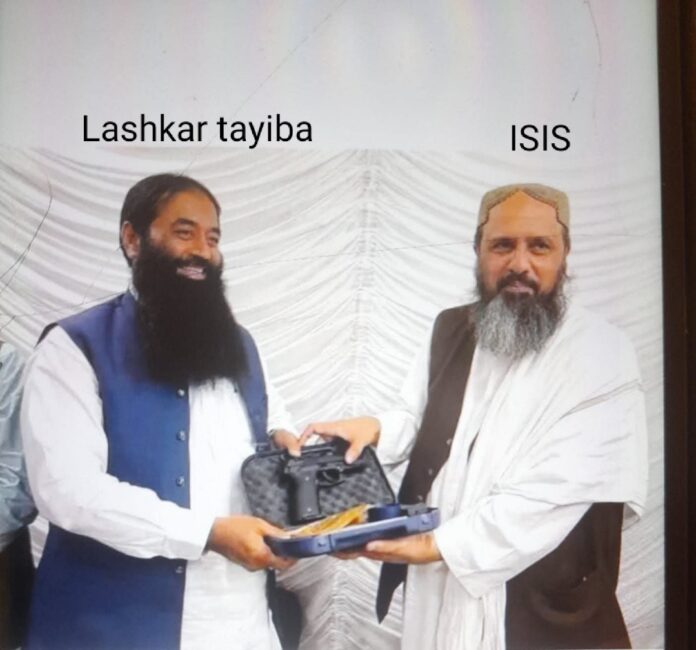
Mir Shafiq Mengal (right) presenting a pistol as a gift to Rana Mohd Ashfaq, a top commander of Lashkar-e-Taiba (LeT).

Quetta, Oct 7 (NVI) In a new evil design, Pakistani intelligence agency Inter-Services Intelligence (ISI) has launched an operation to strengthen the terror network of ISIS (Khorasan) or ‘Daesh’ in occupied Balochistan, with objectives to defame the Baloch freedom movement and target freedom fighters besides causing destabilisation in neighbouring Afghanistan and Iran.

ISI has entrusted this task to Mir Shafiq-ur-Rehman Mengal, a notorious terrorist and ISI asset who has close links with Lashkar-e-Taiba (LeT) too, according to sources.

Mengal has been mandated to strengthen bases and network of ISIS-K in Balochistan and facilitate supply of armaments to this deadly terrorist outfit.

For this purpose, Mengal will be also using the services and network of LeT and in return, help the latter in its terror activities in Kashmir.

Mengal, who is son of a former caretake Chief Minister of Nasir Mengal, has been working for the ISI for a long period and at its behest, he has led a ‘Death Squad’ which targets Baloch people.

At a certain level, he has also helped Islamic State Khorasan Province (ISKP) in arranging safe houses, funds and arms in Balochistan.

Under the plan, ISIS terrorists would carry out civilian killings through explosions and targeted attacks in Balochistan, for which the Pakistani military will blame Baloch freedom fighters and defame them and their movement for independence.

It must be noted here that the Baloch freedom fighters do not target innocent civilians and they focus their attacks only on the occupying Pakistani forces and their agents and proxies in Balochistan.

Also, since the Pakistani military has been on the receiving end and suffering in its war against the Baloch freedom fighters, it will use ISIS terrorists as proxies to target Baloch cadres.

Pakistani military has been suffering huge casualties daily due to incessant attacks by the daring and audacious Baloch freedom fighters.

According to the sources, the devious plan of the Pakistani military is also aimed at causing instability in Afghanistan and Iran through terror acts of ISIS, while Pakistan will have a clear alibi.

ISKP has already been carrying out a lot of terror acts in Afghanistan. The Taliban regime of Afghanistan has been saying that the ISKP terrorists use Pakistan as their base for launching attacks in the neighbouring country taking advantage of the porous border.

Using proxy war to destabilise a neighbouring country is nothing new in the context of the coward Pakistani military. It has been carrying out proxy war, using jihadi terror groups, against India for nearly 4 decades as it doesn’t have the courage to face the Indian armed forces directly. (NVI)

TTP claims to have killed and injured 793 personnel of Pakistani forces in September

Cadres of Tehreek-e-Taliban Pakistan (TTP). (File Pic)

Peshawar, Oct 6 (NVI) Tehreek-e-Taliban Pakistan (TTP) has claimed to have killed and injured at least 793 personnel of Pakistan Army, paramilitary and police, mostly in Khyber Pakhtunkhwa Province, during the month of September.

These killings and injuries were inflicted in 359 attacks/operations during the month, it said in a statement.

The maximum 96 attacks/operations were carried out in South Waziristan in Khyber Province, where the heaviest damage was inflicted upon the Pakistani forces in terms of men and material.

Among other places, Bajaur saw 66 operations while North Waziristan witnessed 56 attacks, Dera Ismail Khan 24, Khyber district 19, Tank 18, Chitral 14 and Bannu 12.

The group carries out such attacks under its special operation called ‘Al-Khandaq’. (NVI)

Pakistan: TTP claims killing of 9 soldiers, injuring several others

Fighters of Tehreek-e-Taliban Pakistan (TTP). File Pic

Peshawar, Oct 5 (NVI) Tehreek-e-Taliban Pakistan (TTP) has claimed to have killed more than 9 Pakistani soldiers and injured several others in 6 ‘operations’ in Khyber Pakhtunkhwa Province of Pakistan over the last few days.

These operations included 2 in South Wazirsitan and one each in North Waziristan, Khyber, Bannu and Bajaur districts of Khyber Pakhtunkhwa Province.

Giving details, TTP spokesman Muhammad Khorasani said 3 Pakistani soldiers were killed and dozens injured in an attack by the TTP fighters on the main military camp in Ladha on October 3.

Five military vehicles, a solar plant and other equipment were also destroyed in the attack, he said.

After the operation, the Pakistani military carried out a drone attack on the TTP fighters who were returning, killing one of them, named Pir, Khorasani said.

In a separate operation in Azam Warsak, one officer was killed in a sniper attack by the TTP fighters, the  spokesman said.

In Spin Wam area of North Waziristan, the TTP fighters blew up a military vehicle near the Shukra military post, using a landmine, he said, adding there is a strong possibility of casualties.

In Bara area of Khyber district, a military officer was killed in a sniper attack on a group of personnel cutting trees near a post, the spokesman said.

The TTP also carried out an ambush on a Pakistani military convoy in Azad Mandi area of Bannu district, he said, adding there is a strong possibility of casualties and property loss.

In Loi Mamond area of Bajaur district, the Pakistan army tried to attack the ‘Mujahideen’ from Damangi and Gabri but the timely and vigorous response resulted in the killing and injuries to 4 soldier. (NVJ)

MUST READ