Tuesday, September 22, 2026
Home Blog Page 86

J&K Police Launch Major Search Operation at 23 JKNOP-Linked Sites

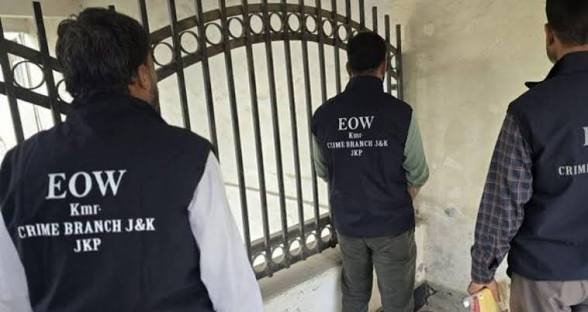
Srinagar, July 10 (NVI): Police on Friday conducted searches at 23 locations linked to Jammu and Kashmir Non-Operational Personnel (JKNOPs) in Kunzer area of Baramulla district as part of efforts to maintain public order and strengthen the security grid, officials said.

The searches were carried out at the residences of 23 JKNOPs, their family members, other associated structures and the houses of close associates falling under the jurisdiction of Police Station Kunzer, they said.

According to police, the operation was aimed at ascertaining any recent developments, identifying possible communication with handlers from across the border, gathering evidence related to ongoing investigations and assessing activities that could pose a threat to the area’s security.

During the searches, police seized several electronic devices, including mobile phones, for technical examination and forensic analysis, officials said.

They said the searches were conducted in accordance with legal procedures in the presence of Executive Magistrates and independent witnesses.

Police said such preventive and investigative measures would continue as part of sustained efforts to maintain peace, uphold the rule of law and counter threats to security in the district.(NVI)

Chief Secretary Reviews Central Schemes, Pushes Timely Project Completion in J&K

Srinagar, Jul 10 (NVI): Jammu and Kashmir Chief Secretary Atal Dulloo on Friday reviewed the implementation of key Centrally Sponsored Schemes (CSS) and flagship infrastructure projects across the Union Territory, directing departments to ensure timely completion of projects and saturation of all eligible beneficiaries under welfare schemes.

Chairing a meeting of Administrative Secretaries, Dulloo assessed the physical and financial progress of schemes spanning education, health, power, digital connectivity, rural and urban development, housing, social welfare, tourism, skill development, water supply, transport, fisheries and infrastructure.

He directed departments to closely monitor targets, remove implementation bottlenecks and ensure optimum utilisation of funds for effective delivery of public services.

The Chief Secretary stressed the need for outcome-oriented governance, saying projects should be completed within stipulated timelines while maintaining quality standards. He also called for stronger coordination among implementing agencies, regular field inspections and continuous engagement with the Centre for timely approvals and release of funds.

During the meeting, officials informed that over one lakh youth have received industry-oriented training under the Pradhan Mantri Kaushal Vikas Yojana (PMKVY), while implementation of the PM-SETU programme has begun to modernise Industrial Training Institutes.

The power sector review highlighted progress under the PM Surya Ghar Muft Bijli Yojana, with thousands of rooftop solar installations commissioned across the Union Territory. The meeting also reviewed the rollout of smart metering and works under the Revamped Distribution Sector Scheme (RDSS).

Officials said work under the BharatNet project and the 4G saturation programme is progressing to improve digital connectivity in rural and remote areas.

The Finance Department briefed the meeting on financial inclusion initiatives, including the Pradhan Mantri Jan Dhan Yojana and Pradhan Mantri Jeevan Jyoti Bima Yojana, while the Social Welfare Department presented the progress under the Pradhan Mantri Matru Vandana Yojana and POSHAN 2.0.

The meeting also reviewed the implementation of major flagship programmes, including the Jal Jeevan Mission, PMAY (Urban and Gramin), Swachh Bharat Mission, Ayushman Bharat, National Health Mission, AMRUT and tourism and fisheries infrastructure projects.

Dulloo reiterated the need for transparent, accountable and result-oriented implementation of Centrally Sponsored Schemes to ensure that the benefits of development reach all sections of society across Jammu and Kashmir.—(NVI)

1.70 Lakh Devotees Visit Amarnath Shrine in First Eight Days: J&K LG Sinha

Srinagar, Jul 10 (NVI): Jammu and Kashmir Lieutenant Governor Manoj Sinha on Friday reviewed arrangements for the ongoing Amarnath Yatra at the Baltal base camp and directed the administration to adopt a zero-tolerance approach against overcharging, fake registrations and any form of fraud targeting pilgrims.

During his visit, Sinha inspected the base camp hospital, registration counters, accommodation facilities and other amenities to assess the arrangements for the annual pilgrimage.

He directed all departments to ensure seamless coordination so that pilgrims face no inconvenience during registration, accommodation, movement and darshan. The safety, comfort and convenience of devotees should remain the administration’s top priority, he said.

The Lieutenant Governor warned that strict action should be taken against anyone found exploiting pilgrims. He instructed officials to register FIRs against service providers or government employees involved in overcharging, fake registrations or other fraudulent practices.

Sinha also ordered a sanitation audit along the Baltal route and stressed uninterrupted drinking water supply and high standards of cleanliness throughout the pilgrimage.

Officials informed him that elaborate arrangements have been made for security, healthcare, accommodation, sanitation, electricity and drinking water, while RO water facilities have been strengthened along the route.

Interacting with pilgrims, Sinha said around 1.70 lakh devotees have paid obeisance at the holy cave shrine during the first eight days of the yatra. He also said the administration had successfully facilitated a large number of devotees who arrived without prior registration.

The Lieutenant Governor said the 100-bed hospitals at Baltal and Chandanwari are functioning round the clock and are treating around 1,300 to 1,400 OPD patients daily.

He urged pilgrims to follow all advisories issued by the administration and the Shri Amarnathji Shrine Board, assuring them that the administration remains fully committed to ensuring a safe, smooth and hassle-free pilgrimage.

Senior officials of the Shri Amarnathji Shrine Board, civil administration, police, Army and other agencies attended the review meeting.(NVI)

Rise of Pasmanda Representation: A New Chapter in Indian Muslim Politics

Shariq Adeeb, Ansari National Working President of the All India Pasmanda Muslim Mahaz.

Column

By Shariq Adeeb Ansari

History does not announce itself. It accumulates through quiet struggles, patient advocacy, and the gradual accumulation of conviction across generations until one day the world looks different.

Only then does one trace the path to understand how such change became possible.

For those of us who have dedicated decades to the Pasmanda movement, the political developments unfolding in India today possess precisely that quality – the quiet arrival of a transformation that has long been overdue.

The appointments of Pasmanda Muslims, including Danish Azad Ansari, Kaiful Wara, Methab Saifi, and others to positions of meaningful political responsibility are not isolated events.

They are the visible expression of a much deeper historical current.

They represent the gradual and hard-earned entry of the artisan, the weaver, the labourer, and the craftsman into the corridors of political decision-making from which they had, for far too long, been excluded.

The fact that political parties have begun entrusting individuals from these communities with important responsibilities, individuals who only a generation ago might scarcely have been considered for such positions, is itself evidence of how profoundly the political discourse surrounding Indian Muslims has changed.

A Transformation Built Through Persistence

Conversations of this magnitude do not transform themselves. They require individuals who are willing to speak even when no one appears willing to listen.

In 2017, when the Pasmanda question had virtually disappeared from mainstream political discourse, and when the very existence of Pasmanda Muslims as a distinct and numerically overwhelming social reality within Indian Islam remained largely invisible to policymakers, political parties, and the media, I wrote a formal letter to the Honourable Prime Minister Narendra Modi, presenting a detailed account of the condition of Pasmanda Muslims and the urgent necessity of recognising their legitimate concerns.

This was not a politically convenient moment. There was no reward to anticipate and no wave of public opinion to ride.

It was an act of conviction rooted in the belief that nearly 88 percent of Indian Muslims belong to backward, artisanal, and Dalit communities, and that this social reality deserved to be placed before the highest constitutional office in the country, regardless of whether the political establishment was prepared to acknowledge it.

To my considerable surprise, and to Prime Minister Modi’s credit, that representation was not ignored.

During a BJP Parliamentary Party meeting in Bhubaneswar, Odisha, the Prime Minister publicly referred to Pasmanda Muslims, naming a community that the political establishment had long treated as invisible.

It was a moment of considerable historical significance. For the first time in recent memory, the highest levels of Indian political leadership were seriously engaging with a social reality that activists such as my late father, Abdul Majid Adeeb Ansari, had devoted their lives to bringing into public consciousness.

Sustained Dialogue and Policy Engagement

I did not regard that moment as a conclusion.

I continued writing to the Prime Minister’s Office, continued updating it about the realities of Pasmanda life, and continued presenting the argument that 88 percent of Indian Muslims – weavers, cobblers, farmers, labourers, and artisans whose hands have shaped much of this nation’s material culture – cannot remain peripheral to any serious conversation about Muslim welfare or political representation.

These communications were not merely petitions. They constituted sustained intellectual and civic engagement, grounded in empirical data, constitutional principles, and the historical record painstakingly assembled by my father’s generation at great personal sacrifice.

The Structure of Exclusion

The exclusion of Pasmanda Muslims was never formally codified in law. Rather, it functioned through the cumulative weight of social hierarchy and through the unspoken assumption that political representation of Muslims naturally belonged to the Ashraf elite.

Many distinguished individuals from Ashraf communities have made significant contributions to public life, and this deserves fair acknowledgment.

Yet the remarkable diversity of Indian Muslim society, including its artisan communities, Dalit communities, and numerically dominant backward-class populations, has rarely been reflected in political leadership.

For decades, democracy claimed to speak on behalf of Indian Muslims while leaving much of their internal social diversity politically invisible.

The Central Argument of the Pasmanda Movement

The Pasmanda movement emerged to confront this contradiction.

Its foundational argument was both simple and transformative: the majority of Indian Muslims are Pasmanda, and any politics that claims to represent Muslims while ignoring Pasmanda realities rests upon an incomplete understanding of Indian Muslim society.

This was never a call for division. Rather, it was a demand for intellectual honesty and democratic fairness. Genuine inclusion must be grounded in social reality rather than symbolic representation alone.

The All India Pasmanda Muslim Mahaz has consistently advanced this argument through public campaigns, intellectual engagement, grassroots organisation, and sustained dialogue with policymakers, maintaining its commitment even during years when the movement received little recognition from mainstream institutions.

A New Political Recognition

Today, that recognition is steadily expanding.

Political parties across ideological lines increasingly recognise that Pasmanda participation is not merely an act of inclusion but a democratic necessity.

The recent decision of the Uttar Pradesh unit of the Indian National Congress to assign organisational responsibility to a Pasmanda leader represents one among several encouraging developments.

Such steps deserve appreciation irrespective of political affiliation because every genuine expansion of representation strengthens democratic institutions.

Any serious discussion of the growing visibility of Pasmanda concerns would be incomplete without acknowledging Prime Minister Narendra Modi’s role.

Whether one agrees or disagrees with his broader political positions, the historical record is clear. His public engagement with the Pasmanda question compelled political parties, journalists, academics, and administrators to engage with a social reality that had long remained confined to activist circles.

As a result, the scope of political debate widened, making it increasingly difficult to dismiss Pasmanda concerns as peripheral. It is equally important that history honestly records the role played by years of sustained correspondence and documentation submitted by this organization in shaping that dialogue.

Representation Must Lead to Policy

This moment should not be mistaken for the completion of a journey. It should be understood as the beginning of a new phase.

Appointments are meaningful, but they are not sufficient.

Representation that does not translate into public policy ultimately remains symbolic.

Symbolism, however encouraging, cannot feed families, improve educational opportunities, create employment, or expand opportunities for the young Pasmanda Muslims who have waited far too long for full recognition within their own country.

The challenges that remain in education, skill development, employment, social mobility, and the structural dismantling of caste-based disadvantage within Muslim society are immense. Addressing them will require the same seriousness, patience, and determination that have carried the movement to its present stage.

A Personal Commitment

I write these words not merely as a political observer but as someone whose life has been profoundly shaped by the Pasmanda movement.

My late father, Abdul Majid Adeeb Ansari, devoted his life to this cause. He popularised the term “Pasmanda,” built the institutional foundations of the movement, and sustained its intellectual vision through years when few outside the movement paid attention.

To witness his life’s work bearing fruit, and to see a conversation that he helped initiate from the margins, and that I sought to carry into the highest offices of political power, now occupy a place within the national political discourse, is deeply meaningful.

This is not simply political satisfaction. It is a moral vindication that belongs not to any individual but to the countless ordinary men and women who continued believing in this cause long before it became politically fashionable.

The Road Ahead

That moment has arrived. Yet it demands far more than celebration. It demands continued vigilance, sustained advocacy, and an unwavering commitment not to mistake symbolic progress for structural transformation.

The Pasmanda movement was founded upon the refusal to accept partial truths as complete truths. That conviction must continue to define its future.

The winds of change are undoubtedly real. However, lasting institutions are not built by favourable winds alone. They are built through sustained effort, thoughtful advocacy, and unwavering commitment.

The foundation has already been laid through years of patient correspondence, public engagement, and an enduring faith in the constitutional promise of the Republic of India.

The responsibility before us now is to build upon that foundation with the same patience, courage, and conviction, ensuring a more just, more representative, and more inclusive democratic future for Pasmanda Muslims.

Ends

(Shariq Adeeb Ansari is the National Working President of the All India Pasmanda Muslim Mahaz. He has been actively engaged in advocating political representation, social justice, educational advancement, and institutional inclusion for the Pasmanda Muslim community, which constitutes the numerical majority of Indian Muslims yet remains historically underrepresented within many Muslim institutional structures.)

NIA Chargesheets Shabir Shah, Five Other Separatist Leaders in 1996 Srinagar Violence Case

(Representational Image)

Srinagar, Jul 10 (NVI): The National Investigation Agency (NIA) on Friday filed a chargesheet against six separatist Kashmiri leaders, including Shabir Shah and late Syed Ali Shah Geelani, in connection with a 1996 case involving mob violence and firing on police personnel during a funeral procession in Srinagar, officials said.

The chargesheet, filed before the Special NIA Court in Jammu, also names late Hurriyat leader Abdul Gani Lone, Mohammad Yaqoob Vakil, Javed Ahmad Mir and Shakeel Ahmad Bakshi.

The agency said the accused have been booked under provisions of the erstwhile Ranbir Penal Code related to criminal conspiracy, attempt to murder, rioting and assault on public servants, along with Section 13 of the Unlawful Activities (Prevention) Act.

According to the NIA, proceedings against Geelani, Lone and Vakil have abated following their deaths during the pendency of the case. However, the chargesheet details their alleged roles in the conspiracy and unlawful assembly, supported by evidence collected during the investigation.

The case pertains to an incident on July 17, 1996, when a funeral procession of slain militant Hilal Ahmad Beigh allegedly turned violent near Naaz Crossing in Srinagar.

The NIA alleged that the procession, led by Hurriyat leaders, was infiltrated by armed militants who opened indiscriminate fire on police personnel, while members of the mob resorted to heavy stone-pelting, injuring several policemen and damaging government vehicles.

The investigation further alleged that the accused raised anti-India, pro-Pakistan and secessionist slogans and delivered speeches advocating armed struggle, leading to large-scale violence.

According to the agency, the violence was part of a pre-planned criminal conspiracy to use the funeral procession to promote separatist ideology, mobilise public support against the Government of India and incite violence against law enforcement agencies.

The case was originally registered at Shergarhi police station in Srinagar on the day of the incident. The NIA re-registered the case in April this year after taking over the investigation on the directions of the Ministry of Home Affairs.

Further investigation is underway, the agency said.(NVI)

Rain, Thunderstorms Likely Across J&K Till July 12; Brief Showers May Continue Thereafter

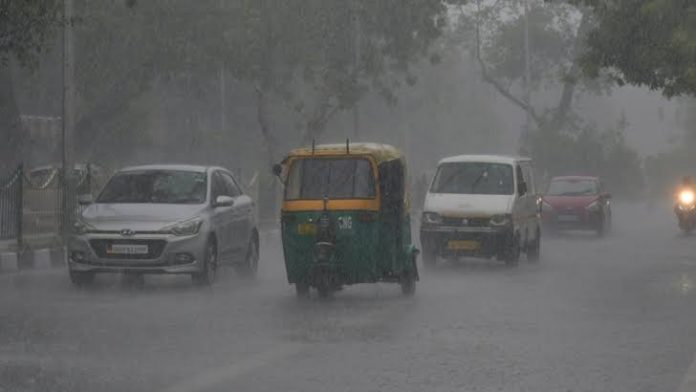
Street in Delhi after heavy rains.

Srinagar, July 10 (NVI): A fresh spell of rain and thunderstorms is likely to affect several parts of Jammu and Kashmir over the next few days, with the impact expected to intensify between July 11 and 12 due to a fresh Western Disturbance, according to a weather forecast.

The forecast said there is a possibility of thundershowers and rain in parts of the Union Territory, particularly in hilly areas, during the late afternoon and evening on Thursday. Rain is also likely along the Amarnath Yatra routes via Sonamarg and Pahalgam.

Between July 11 and 12, a fresh Western Disturbance is expected to influence weather conditions across most parts of Jammu and Kashmir, bringing intermittent rain and thunderstorms. While widespread heavy moisture from the southeast is not expected, moisture associated with the Western Disturbance may trigger moderate rainfall, with isolated high-intensity showers also possible.

The forecast added that the likelihood of cloudbursts is lower than in recent days, though authorities and the public have been advised to remain cautious as the atmosphere continues to hold significant moisture.

From July 13 to 15, no major weather activity is expected, although brief rain showers may occur at isolated places across the Union Territory.(NVI)

J&K Police Cracks Down on Fake News, Issues Warning Over Rumour-Mongering

Srinagar, July 10 (NVI): Jammu and Kashmir Police on Friday dismissed as “false and misleading” reports circulating on social media regarding two individuals, stating that both are in lawful custody in connection with a criminal case.

Police said the two men, along with another associate, were arrested in connection with FIR No. 55/2026 registered at Heerpora police station in Shopian district of Kashmir and are currently in lawful custody.

In a statement, police appealed to the public not to believe or share unverified information on social media, warning that strict legal action would be taken against those found spreading rumours or misinformation.

The police also advised people to rely only on official sources for authentic information.(NVI)

Five Amarnath Pilgrims Injured as Vehicle Meets with Accident in J&K’s Udhampur

Holy Cave Shri Amarnath Ji

Shivam Bakshi

Udhampur, July 10 (NVI): Five pilgrims on their way to the Amarnath cave shrine were injured after a vehicle in the Pahalgam-bound convoy met with an accident on the Jammu-Srinagar National Highway in Udhampur district on Friday, officials said.

The accident took place near Toldi Nallah on the Udhampur-Chenani stretch of NH-44 when an Ertiga car, bearing registration number MP13ZY-2836, met with an accident, they said.

The injured pilgrims were immediately evacuated and shifted to a nearby hospital for treatment.

Officials said one of the injured, who sustained serious injuries, was referred to a hospital in Jammu for specialised treatment, while the condition of the other four was stated to be stable.

The identities of the injured and the exact cause of the accident were being ascertained, the officials added.—(NVI)

Heavy Rainfall Likely in J&K from July 11-13; Flash Floods, Landslides Possible

File photo

Srinagar, July 9 (NVI): Jammu and Kashmir is likely to witness a spell of intense rainfall between July 11 and 13 due to the interaction of a Western Disturbance with a monsoon low-pressure system, weather forecasters said on Thursday.

The peak of the rainfall activity is expected during July 11 and 12, with very heavy rain forecast over the Jammu region, while the Kashmir Valley is likely to receive moderate to heavy showers.

Forecasters have also warned of the possibility of flash floods, landslides and intense rain spells in vulnerable areas during the period, advising people to remain cautious and follow weather advisories issued by the authorities.

The forecast is broadly consistent with official weather warnings for the region.—(NVI)

Wild Bear Kills 68-Year-Old Man in J&K Rajouri’s Upper Reaches

File Photo

Shivam Bakshi

Rajouri, July 9 (NVI): A 68-year-old man was killed after being attacked by a wild bear in the upper reaches of Darhal in Jammu and Kashmir’s Rajouri district on Thursday, officials said.

The deceased was identified as Mohammad Amin, son of Ali Mohammad, a resident of Rajouri. He was attacked by the bear at Dhok Jangwala in the Panj Katha area, they said.

He succumbed to his injuries following the attack, officials added.—(NVI)

MUST READ