COLUMN
It is a long-held belief that an authoritarian or a totalitarian system, be it fascism, Nazism, or socialism, offers a perfect condition for a genocide to be carried out in a secretive, effective, and ruthless way. These political systems are, in essence, established to further racial or highly guiding ideologies and political tyranny by festering hatred and encouraging violence. The worst and nightmarish example is the Holocaust resulting from the modus operandi of all these systems with a certain and, indeed, necessary combination.
Few could imagine that genocide is a possible occurrence in an increasingly globalized and capitalist world. For, in our perception, capitalism has ideological foundations embedded in the free market, fair competition and equal opportunities, heralding the great achievement of democracies around the world.
Within the context of globalization, capitalism seems to have reached the eventual realization of humanistic ideals bound by a common vision, praxis, and community on Earth—a centuries long dream of enlightenment. It is therefore difficult to imagine the practice of genocide, a crime against humanity, occurring in such a world, given globalization has meant that humanity is interconnected economically, thanks to the digital revolution and to the vast influence of mass media. As such, genocide is plainly unthinkable in such an interconnected and open world as opposed to the world of the Nazis, where the Holocaust was carried out under the cloak of secrecy.
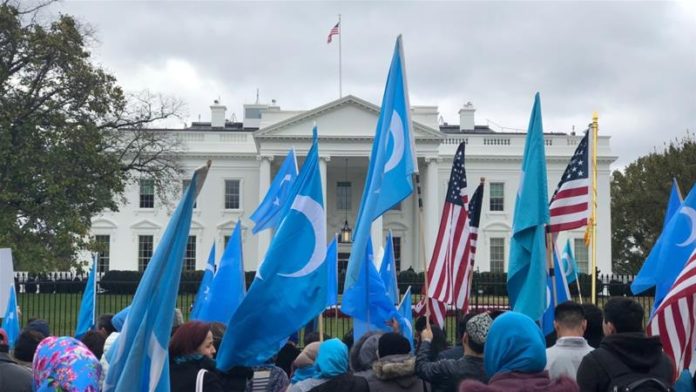
The Uyghur genocide, currently being perpetrated by China, challenges this self-prophetic, if not self-delusional, conviction that genocide is not possible in a globalized world driven by capitalism in the embedded principles of democracy and fairness in a supposedly free, transparent and equitable market. It has also revealed the sophisticated and often overlooked negative aspects of capitalism in the age of globalization, playing an important role in it and further allows it to thrive.
The essence of capitalism is not actually a free market but capital, the use of existing wealth to create more wealth within the principle of efficiency. To increase capital is a priority for any ideologies, economics, societies, cultures, and states. When motivated by the same desire to increase its wealth, this is driven by the rule of efficiency, which requires the optimization of resource-use to best serve an economy. As capital remains an overarching motivation behind globalized capitalism, the mechanisms of how wealth is generated—where supply comes from, who originally owns it, how it is created and gained, and how it is distributed—becomes less important. There is the presumption that unobservable market forces still regulate the demand and supply of goods to reach equilibrium automatically through the magical work of an invisible hand to increase capital. Again, capital is the ultimate goal, internally regulating all economic activities, considerations and thoughts.
In this sense, China seems a strange anomaly in global capitalism. Politically, China is a one party-state, ideologically a socialist state with communist and atheist ideologies, led by the Chinese Communist Party (CCP). The CCP remains in a strong position to control the market through central planning. Considered from this point of view, China’s economic practices seem at odds with the global capitalist system, which operates in the spirit of free and fair competition in a globally unrestricted market, with certain regulations and demand on transparency.
Over the past decades, China has progressively embraced opportunities of free-market economics, reducing levels of control by the CCP on some aspects of the market, to a certain extent. However, the CCP has not fully loosened its grip on its domestic market, when it comes to exerting its influence over prices, production, stocks, and other areas. As such, it is a pro-market economy but not a fully fetched free market economy.
The CCP elites still command many big state-owned companies and other international corporates, of which Huawei is a good example. Further, the critical point is that the alleged freedom of the Chinese market is conditional of the market and particularly of businesses to support and propagate only the interests of the CCP. In this regard, China is actually an authoritarian state where capitalism exists only under strong political control, while supporting the wealth generation of the CCP and its members who are loyal to it. An example of this is providing government subsidies for companies loyal to the CCP, an instrument considered by the US as unfair trade practices as one of the main contested factors during the US-China trade negotiations.
Internationally, most countries participating in globalization attempt to capitalize on their own resources and engage in free trade with other countries, negotiating agreements that are mutually beneficial to both economies, and hence increasing the wealth of both parties. China takes this further, seeking to expand its authoritarian agenda by taking control of other regions, trade routes and resources. Additionally, as recognized by the Trump Administration through the commencement of a trade war with China by increasing tariffs, based on unfair trade practices, including intellectual property theft, forced technology transfer, and lack of market access for American companies in China, etc. Strictly speaking, China’s trade comes with conditions, another example being its debt trap diplomacy, successfully thriving in investment-desperate countries in Latin America, Africa, and Asia.
The CCP holds the same expectation of the international community as of its own citizens, prohibiting any questioning of how its exerts its authoritarianism on its own citizens and also neighboring regions like Tibet, Taiwan, East Turkistan (aka East Turkistan) and more recently Hong Kong. China, under the leadership of the CCP, therefore, trades by its own rules under the guise of free trade, without relinquishing the absolute control of the CCP over everything internally, and further seeking to control what it not rightfully theirs to control externally. Xi Jinping and the CCP propagate this as being the Chinese Dream, or when the Olympics were in China in 2008, “One World, One Dream.”
Within this context of global capitalism, the Uyghur genocide has evolved slowly but surely before the very eyes of the world since 2018. Western countries largely have either suppressed or delayed raising their concern over the Uyghur genocide, and Muslim or Turkic/Turkish governments have not advocated against the Uyghur genocide. One may wonder over the underlying element in these three worlds—Western, Islamic and Turkic/Turkish—to be indifferent to the Uyghur crisis. It is nothing but the economic interest among them that binds them together more than ever in their similar reaction to the Uyghur genocide. The Belt and Road Initiative (BRI), as China’s multi-billion ambiguous master plans to global trade through taking advantage of globalization, is a great example of this synergy.
This project spans three continents and touches over 60% of the world’s population, including Muslims and Turkic peoples, with whom Uyghurs feel cultural, religious, and historical affinities. None of these countries has ever spoken up, let alone criticized, the Uyghur crisis. As examples, the Saudi government have openly supported of the suppression of Uyghurs by China while the Indonesian and Pakistani governments are pretending that they are amnesiac to know if Uyghurs have any issues in China.
The Uyghur genocide is, therefore, excluded from the agenda of the countries, which are part of this economic project. The globalized project, instead of making the Uyghur genocide highly visible, relevant, and significant, has made it invisible, irrelevant, and insignificant. China has successfully controlled them to be silence over the Uyghur genocide by craftily utilizing global capitalism and “free trade” successfully to advance its tyrannical agenda.
There is speculation that the CCP is perpetrating this genocide of Uyghurs in restive East Turkistan to safeguard the security of the BRI. East Turkistan is strategically crucial for China to launch and maintain the initiative in Central Asia and Middle East and beyond, thanks to its geographical borders and hence trade routes, and further the richness of its natural resources including cotton.
The CCP is, therefore, eliminating Uyghurs to strategically take advantage of this economic gold mine, and perpetrate the genocide under the guise of an anti-terrorism campaign against Uyghur’s in the region. However, the truth is that the Uyghur terrorism factor is not a cause but an effect of the BRI. So-called Uyghur terrorism is a dubious at best and fabricated at worst, a propagated allegation by the CCP, used as justification for the Uyghur genocide. Even if there was and still is the threat of Uyghur terrorism, China has the full capacity to eliminate it, at least, through the Shanghai Five, which was established in 1996 partly to crack down on Uyghur resistance and partly to push the US influence out of the region, and through other avenues, e.g., through its strategic cooperation with Pakistan, Afghanistan and other Central Asian countries, with which it has deep security cooperation, along with strong economic cooperation. More important, the Shanghai Five has noticeably been less active in recent years, meaning that there is no need for China to utilize this security framework to eliminate the non-existent Uyghur threat in the strictest sense of the word.
Many other countries in the West are outside of the orbit of BRI. To our knowledge, however, most of these countries are equally silent over the Uyghur genocide, among which the position of Germany is worth discussing briefly. Despite the comparison and resultant criticism of the Uyghur genocide by the Jewish community to the Holocaust, including a letter to the UK ambassador to China written by the Board of Deputies of British Jews, the silence of Germany is both surprising and unacceptable from a both a moral and economic perspective. As a country having had a dark stain on its history in relation to the Holocaust, it should have spoken out well in advance against the Uyghur genocide, emphasizing that any genocide is immensely costly—morally, politically and economically.
The German chancellor Angela Merkel, praised by some for her sympathy and acceptance of asylum seekers entered Germany during the refugee crisis in Europe in 2015, has never shown her sympathy, at least symbolically, for Uyghurs. German companies have never shown their clear and steadfast moral stance on the Uyghur abuses either.
For example, Volkswagen has defended its controversial presence in East Turkistan amid uproar over the Uyghur genocide. There is nothing new in the history of Volkswagen to cross moral red lines amidst genocides as happened in the Holocaust. However, it is outrageous to read this company is asserting that the region financially benefits for its presence in the region to “further economic growth” in the coming years.” Cui bono? While their position on the Uyghur genocide is morally scandalous, they are at least honest about one crucial thing: the intricate link between transnational corporations and genocide continues in the age of global capitalism well beyond the age of capitalism. Like Volkswagen, so many other transnational corporates are increasing their capital as an economic code written in their organizational DNA at all costs. Hence, they are obsessively attracted to cheap labor, even slave labor.
For China, to maintain the massive camps and prisons is a huge challenge. According to Adrian Zenz, spending on security-related construction tripled during 2017 in China’s far western region of East Turkistan. More than a million Uyghurs have either been sent to camps or transferred into other prisons inside and outside of East Turkistan, causing maintenance fees to skyrocket. Therefore, China is also desperately interested to secure financial means and resources to maintain these facilities. While carrying out the physical elimination of Uyghurs, it can also utilize the physical force of remaining Uyghurs as slave labor for economic benefits. This is the economy of genocide, though morally costly but economically beneficial, in which the demand and the supply match perfectly.
Hence, the Chinese government has used Uyghur inmates either in concentration camps or in prisons, as slave labor forces. In this secret business, there are many international, national and domestic companies involved in and profiting from the slave labor trade of Uyghurs. In March 2020, the Australian Strategic Policy Institute (ASPI) published a report called “Uyghurs for sale: ‘Re-education’, forced labor and surveillance beyond Xinjiang.” In this report, it states at least 83 foreign and Chinese companies are allegedly benefiting either directly or indirectly from the use of Uyghur workers outside East Turkistan.
Through enforced and monitored labor transfer programs, it is estimated at least 80,000 Uyghurs were transferred out of East Turkistan and assigned to factories in a range of supply chains including electronics, textiles, and automotive under the guise of “poverty alleviation.” These companies include, but are not limited to, such famous brands as Abercrombie & Fitch, Adidas, Amazon, BMW, Gap, H&M, Inditex, Marks & Spencer, Nike, North Face, Puma, PVH, Samsung, and UNIQLO. Few of them have publicly explained about their exploitation of the slave labor of Uyghurs, whose lives are destroyed, regardless of their economic utility values. These businesses show the same defiance as was shown in the attitude of Volkswagen. Nike and a few others stated they have stopped China-based suppliers hiring employees from the northwest amid forced labor allegations, with no verifiable evidence.
The question is this: would businesses continue to keep their silence over the use of cheap slave Uyghur labor if this revelation was not made public? The gravity of gaining profits through cutting labor costs when businesses are under pressure from stakeholders, stocks, and market. Further, would it be sufficient for them to stop their business practices in East Turkistan while keeping their silence over the Uyghur slave labor trade? International corporates will not risk losing their economic shares in such a vast market as in China’s for raising awareness of the plight of Uyghurs who have no economic value at all for them, apart from utilizing them for slave labor. Then, why should they consider it beneficial, taking such a huge economic risk to raise the moral issue of Uyghurs with their business partners, China?
This disturbing reality is also observable in China’s domestic management of Uyghur slave labor. To cope with increased costs of maintenance of the concentration camps, China would have simply liquidated Uyghurs altogether. However, amidst the growing international concern over the fate of Uyghurs in the camps and prisons and, subsequently, in the slave labor factories, Chinese authorities stopped denying the existence of concentration camps.
Instead, they made a crucial link between so-called re-education aiming to “improve” the employability skills of Uyghurs and slave labor force. The link creates a smokescreen that Uyghurs, who were “graduated” from the centers, are now provided with new employment opportunities in these factories as promised. It is not an evil genocide, but a “benign” humanitarian project. Under this pretext, the CCP has massively turned human lives into economic commodities—to turn their labor into a profit, despite being opposite to the Marxist theory of alienation of human life from its labor. This practice is aligned with the capitalist way of doing business—costs should, at least, be balanced with benefits for the sake of efficiency consideration. As such, the Uyghur genocide will become less costly or, at least, it becomes self-sustainable for China, to a certain extent.
In this globalized world, it is now certain that any goods produced in China, is open to ethical scrutiny—the implicit question one may ask oneself after seeing the label of “Made in China” on the product is this: is it produced by slave labor? If the product is of a big brand, the weight of scrutiny increases. The world may ignore the Uyghur genocide; however, any product made in China serves as an inescapable and undeniable reminder that it is potentially produced by slave labor.
The greatest economic benefits Uyghurs can produce in such a harsh, forced, and inhuman environment are obtained from their organs, the most lucrative health items in the global market. Therefore, it is not surprising that the organ harvesting has become a booming business sector in China, thanks to the Uyghur genocide, which costs 25000 Uyghur lives per year. In this sector, the CCP has established a secret network with the Muslim countries to lure their customers for halal organs. In addition, other Uyghur commodities extracted and utilized by China for profit include the selling of breast milk and wigs.
We can see from the Uyghur crisis that in a globalized world of capitalism, genocide is not something inconceivable, but a “necessary evil.” Especially when global businesses are partly controlled by China, taking advantage of the globally interconnected trade opportunities to serve its own interests. It is more so when this economy shrinks. Currently, China’s economic power is diminishing due to its tense trade war with the US exacerbated by COVID-19. To compensate the economic loses, the CCP is becoming desperate to exploit Uyghurs as much as possible to create new business sectors, totally unimaginable from a moral perspective but perfectly imaginable from a capital-accumulation perspective.
In the context of growing pressure from the US and Australia as trade relations sour sparked by COVID-19, this escalation may also make the genocide more urgent for China to attempt to complete. The sudden and mysterious increase in the number of COVID-19 cases and extremely harsh lockdown measures in Urumqi, the capital of East Turkistan, is concerning. This is the only outbreak of COVID-19 in China without a recognized source of the infection. It could be a great opportunity for China to complete the Uyghur genocide, which could relieve it of its financial burden to sustain the camps and prisons, despite their economic potentials.
COVID-19 has also exposed the CCP’s bullish behavior to counter pressure placed on it through economic threats, i.e. against Australia’s barley and beef industries, again utilizing global capitalism to attempt to control and contain pressure against it, clearly believing in its ability to buy its exemption from adhering to international law. With awareness of the CCP’s attempts at using economic leverage against its critics and foes, the world has gradually come to understand the moral costs of doing business with a state government currently committing genocide, in the name of achieving mutual business benefits.
The Uyghur genocide highlights and amplifies the dark side to global capitalism. In the area of globalized capitalism, international companies are doing business with China operating business in ways, unethically at best and evil at worst. The economically stronger it gets, the more aggressive it becomes both internationally and domestically, given the economic interconnectivity it uses and abuses to its own advantage, disrespecting the international rules, laws and customs. China, therefore, renders global capitalism increasingly vulnerable to immoral behavior with deceptive, coercive, and destructive measures.
Uyghur lives are becoming profitable commodities in a globalized world before eventually they are eliminated. This demonstrates that genocide not only happens in a global capitalist world, it is incentivized to thrive within it. The profit driven world makes it possible for the commodification of human lives and is less sensitized in such a way that the increase of capital provides incentive to decrease in the value of human lives. In such a world, there is no consideration of genocide as loss of innocent human lives—rather as Uyghurs currently are—human resources to be capitalized for profit as much as possible.
(The article was written by Mamtimin Ala, PhD of philosophy & activist of East Turkistan Independent movement)