Thursday, September 10, 2026
Home Blog Page 1045

Army Chief arrives in Nepal tmrw amid strained ties over border row

New Delhi (NVI): Army Chief General MM Naravane today arrived in Nepal for his three-day visit amid growing concerns over the strained relations between the two countries over border issues recently.

The COAS visit is expected to break the ice as the Army Chief will meet Nepal Prime Minister KP Sharma Oli and may hold talks over the controversy over road construction via Lipulekh for pilgrimage to Mansarovar in Tibet.

In a statement today, Gen Naravane said: “I am delighted to be visiting Nepal on their kind invitation, and to meet my counterpart General Purna Chandra Thapa, Chief of the Army Staff of the Nepali Army. I am sure this visit will go a long way in strengthening the bonds of friendship that the two Armies Cherish.

“I am also grateful for the opportunity to call on the Rt. Hon’ble Prime Minister of Nepal. It is going to be a great honour for me to be conferred the honorary rank of General of the Nepali Army by the Rt. Hon’ble President of Nepal. I am looking forward eagerly to this visit.”

The Indian Embassy in Nepal also responded to media queries today regarding the Army chief’s visit. Indian Embassy’s spokesperson in Kathmandu, Naveen Kumar said that Gen. Naravane’s visit would deepen the long-standing and customary bonds of friendship between the two Armies.

“His visit will provide an opportunity for both sides to discuss the bilateral defence partnership and explore avenues to further strengthen it for mutual benefit,” the Embassy said in another tweet.

-ARK
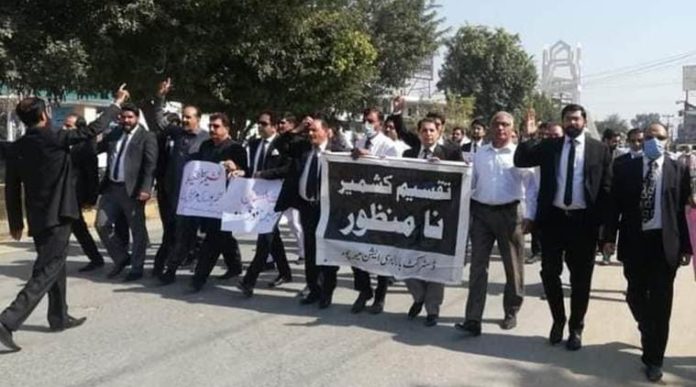
Lawyers in POJK protest against Pak’s move on Gilgit-Baltistan

A protest in Gilgit (File Pic)

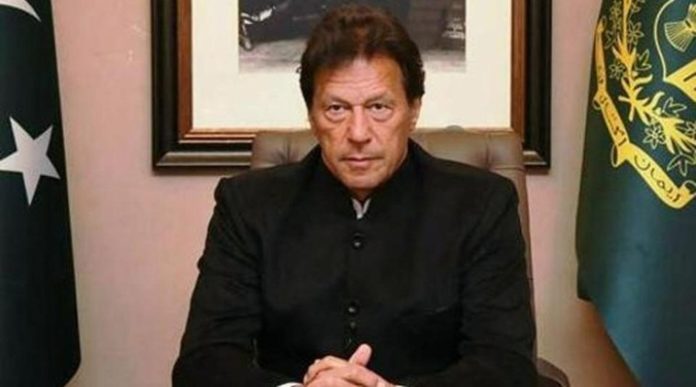
New Delhi (NVI): Amid severe criticism against the Pakistan government’s move to grant Provisional status to Gilgit-Baltistan, now lawyers in several parts of Pakistan Occupied Jammu Kashmir (POJK) have taken to the streets against Imran Khan’s decision.

Lawyers in Mirpur, Rawlakot and other parts of POJK today held protests against the Pakistan government’s decision to forcibly make Gigit-Baltistan its fifth province.

The protesting lawyers have condemned the decision as illegal and unconstitutional. A large number of people also attended the lawyers’ protest to express solidarity with them.

“Lawyers in Mirpur, Rawlakot & other parts of POJK have held protests against making Gilgit-Baltistan a provisional province of Pakistan. A large number of public also attended the lawyers protests. Pakistani move is condemned as illegal & unconstitutional by the lawyers,” tweeted Sajjad Raja, Chairman of National Equality Party of Pakistan-occupied Jammu Kashmir Gilgit Baltistan (NEPJKGBL).

Despite the ongoing protests within Gilgit Baltistan province as well as around the world, Pakistan PM Imran Khan on Sunday announced the granting of provisional-provincial status to Gilgit-Baltistan.

The same day, India slammed Pakistan for its attempt to accord provincial status to the “so-called Gilgit-Baltistan”, saying it is intended to camouflage the “illegal” occupation of the region by Islamabad.

Notably, Gilgit-Baltistan was annexed by Pakistan in October 1947 and since then it remains under illegal occupation.

There have been demands within Gilgit-Baltistan for freedom from Pakistan but those voices are suppressed with brute force by the Pakistani forces. There are numerous cases of brutality and atrocities to which the local populace of Gilgit-Baltistan are being subjected to.

-ARK

Gupkar Alliance criticises Centre over land laws, terms them ‘undemocratic’

LUBNA FAYAZ

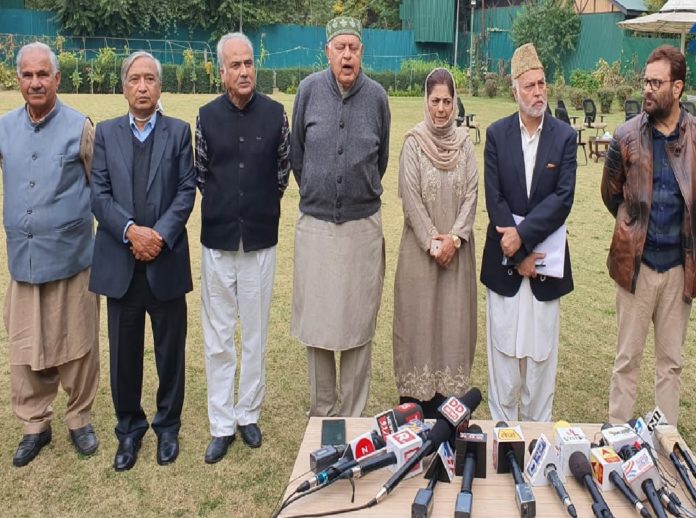
Srinagar (NVI): People’s Alliance for Gupkar Declaration, an amalgamation of various political parties in Jammu and Kashmir, has rejected the recently notified land laws by the Centre, claiming that they were aimed at “disempowering” the people of J&K.

In a statement here, the Gupkar alliance hit out at Centre over a statement of official spokesman on 26th October MHA Order and termed it as a “bizarre attempt to, distort facts, weave lies and mislead people”.

PAGD has termed the land laws regime of Jammu and Kashmir as “most progressive”, “pro-people” and “pro former” in the entire Indian subcontinent.

“The real object of repeal of the basic land laws and massive amendments to the other laws is to push in and implement the agenda of effecting demographic change and disempowering the people of Jammu and Kashmir,” a statement by the alliance read.

According to them, Jammu and Kashmir was first in the country to implement the concept of “land to tiller” by enacting Big Landed Estates Abolition Act 1952 followed by Agrarian Reforms Act 1976 restricting the landholding to twelve and half acres and ending the exploitative practice of “absentee landlordism” and whosoever calls it archaic would be guilty of ignorance of the history of Jammu and Kashmir.

“It is because of the timely land reforms that there are no starvation deaths occur in Jammu and Kashmir, no farmers suicides have been ever reported from Jammu and Kashmir and everyone in Jammu and Kashmir has available three fundamental necessities- food, clothing and shelter, the position that is now sought to be reversed by making massive assault on the land law regime,” the statement read.

PAGD has asked as to how can alienation of Land Act be termed as archaic when it prohibited transfer of land to a non state subject, thus protecting the interests of Permanent Residents of Jammu and Kashmir and at the same time made a provision for transfer of land by mortgage to organisations like Industrial Development Bank of India, Industrial Credit and Investment Corporation of India to keep pace with industrial development.

“The repeal of the Act now allows the land to be transferred to non State Subjects, denuding the residents of Jammu and Kashmir of their most precious rights. The claimed protection of rights in agricultural land, it is stated, is mere eyewash as the amendment introduced in Land Revenue Act provides for permission to sell the agricultural land almost at mere asking without difficulty. The abolition of Big Landed Estates Abolition Act 1952 and amendments in Agrarian Reforms Act 1976 is against farmers and to remove the ceiling on acquisition.

“The changes in Development Act and creation of ‘security zones’ to avoid adherence to the rules and regulations as regards construction activities in such zones and exclusion of oversight by expert bodies, environmental activists and civil society groups is bound to put at peril ecosystem in fragile environmental areas like Gulmarg, Pahalgam and Sonamarg already under pressure beyond their carrying capacity.” the statement read.

The alliance further claimed that the laws now introduced through amendments are not only “against” people of Jammu and Kashmir but “undemocratic”, “unconstitutional” and “backward looking” with only aim to disempowering people and change the demography.

-ARK

Imran’s move on Gilgit-Baltistan violates Pakistan Constitution

Imran Khan

COLUMN

Pakistan Prime Minister Imran Khan has violated the Constitution of his own country by announcing Provincial status for Gilgit-Baltistan, a mountainous region which is a part of undivided Jammu and Kashmir and legally part of India.

The Imran Khan government’s move amounts to officially merging Gilgit-Baltistan with Pakistan despite claims by Islamabad that it is a so-called ‘Azad’ region.

This goes against the spirit of the Pakistan Constitution, whose Article 257 states: “When the people of the State of Jammu and Kashmir decide to accede to Pakistan, the relationship between Pakistan and that State shall be determined in accordance with the wishes of the people of that State.”

Gilgit-Baltistan was annexed by Pakistan in October 1947 and since then it remains under illegal occupation.

There have been demands within Gilgit-Baltistan for freedom from Pakistan but those voices are suppressed with brute force by the Pakistani forces. There are numerous cases of brutality and atrocities to which the local populace of Gilgit-Baltistan are being subjected to.

India has denounced Pakistan’s move to declare Gilgit-Baltistan as its province, saying the decision is meant to “camouflage its illegal occupation” of the region.

“The Union Territories of Jammu and Kashmir and Ladakh, including the area of so-called ‘Gilgit-Baltistan’, are an integral part of India by virtue of the legal, complete and irrevocable accession of Jammu and Kashmir to the Union of India in 1947,” Anurag Srivastava, spokesperson of India’s External Affairs Ministry, said recently.

He said India “firmly rejects” Pakistan’s attempt “to bring material changes to a part of Indian territory, under its illegal and forcible occupation”.

“We call upon Pakistan to immediately vacate all areas under its illegal occupation,” the MEA spokesman said.

Confident that India, China will resolve problems on own: Russia

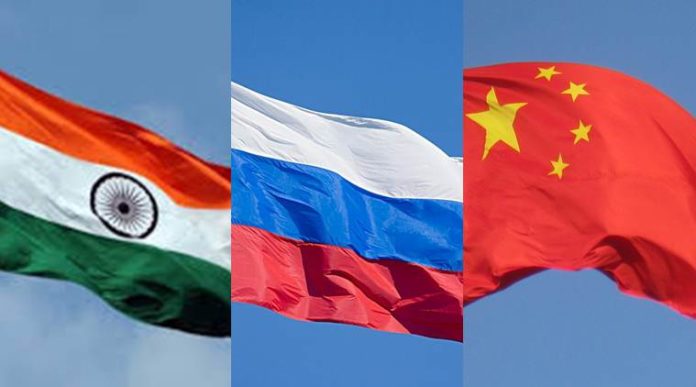
New Delhi (NVI): Amidst the military face-off between India and China, Russia today said it has “special but independent relations” with both the countries and “would encourage our largest Asian partners to resolve differences by constructive dialogue.”

A press release issued by the Russian Embassy here said, “Disagreements between India and China don’t benefit both sides, but provide some dishonest elements with an opportunity to interfere in their bilateral dialogue.”

Making it clear that it will take no sides, Russia said, “We are confident that both countries (India and China), well-known with their ancient history and wisdom, are capable of dealing with the problem on their own.”

It added, “Professional experts on the Russian foreign policy may wish to agree that Russia doesn’t develop any relations at the expense of other countries. Russia doesn’t practice a hidden agenda, interference in domestic affairs and regime change efforts as well as illegal unilateral sanctions.”

This comes as India and China are locked in an eyeball-to-eyeball situation on the Ladakh border in the wake of Chinese aggression launched in May this year with an aim of altering the Line of Actual Control.

Describing the Russian-Indian as “unique”, press release said, “It is true that Indians think that Russians are India’s permanent friends. It is the same for the Russians.”

It particularly referred to the COVID-19 pandemic situation and said, “We are witnessing how much our mutual support means when it comes to helping repatriation of national of both countries, supplies of vital medicines as well as deep cooperation on vaccines.”

Noting that the Russian-Indian strategic partnership is crossing the 20th anniversary this year, it said, “Russia enjoys productive and trusted relations with all political forces” of India.

“While major early bilateral steps were made when the Indian National Congress was in power (establishing diplomatic ties even before the Indian independence was officially announced; large contribution in the accelerated industrialization; mutual support in crucial events of the Cold war, including in 1971), the Declaration of the Strategic Partnership was signed during the tenure of the Prime Minister Atal Bihari Vajpayee, which took our cooperation forward,” the press release said.

“Now we can speak about indeed special partnership, which becomes a source of support of national development strategies of both countries, including ‘Make in India’ and ‘Atmanirbhar Bharat’ — be it unparalleled joint endeavors in nuclear power sector or trusted defence cooperation with real technology transfer, advanced localization of production and even cooperation with third countries,” it said.

The Embassy said coinciding global priorities make Russia and India truly like-minded.

“Our multilateral partnership in the framework of G20, BRICS, SCO, etc. is based on the solid ground of our common priority to proceed towards just and equal multipolar world with the central role of the United Nations and international law as well as undivided security,” it said.

Another Hindu girl abducted, forcibly converted in Pakistan

Images tweeted by Pak activist Rahat Austin

New Delhi (NVI): As Pakistan protests against France over French President Emmanuel Macron’s criticism of radical Islamist ideology, the Muslim majority country has failed to protect its minorities, especially innocent Hindu girls who are being forcibly kidnapped and converted.

A Hindu girl Sonia was abducted by armed men a few days ago and was brought in Barjhudndi Sharif, KandhKot, in Sindh province of Pakistan for conversion to Islam, according to Pakistan based Human Rights activist Rahat Austin.

In a tweet, Austin shared the pictures of the girl while stating that her parents are so poor that they cannot even fight a case to bring her back.

“A Hindu girl Sonia was abducted by armed men few days ago. Today she brought in Barjhudndi Sharif, KandhKot, Sindh Pakistan for conversion to Islam. Her family is so poor to persue their child. Now I understand why Hindus used to buried their daughters alive during Islamic reign,” the activist tweeted.


The plight of minority and non-Mulsim girls remain unchanged in Pakistan as they are forcibly kidnapped, converted and then raped by persons who are much older than them.

In another such instance, a video recording of a 13-year-old Christian girl Arzoo Raza alias Arzoo Fatima, surfaced recently in which she is heard embracing Islam and marrying Ali Azhar, 44, “on her own will”. The video footage has taken many by surprise.

-ARK

2nd phase of voting in Bihar today

Representational Image

New Delhi (NVI): Voting was conducted for the crucial second phase of the Bihar assembly elections today. Over 2.85 crore voters are eligible to decide the fate of nearly 1,500 candidates across 94 assembly segments in the state.

A voter turnout of 46.78 per cent was recorded till 5 pm in the second phase today.

In the first phase of Bihar assembly polls held on October 28, a voter turnout of 55.69% was recorded, according to the Election Commission. Polling was held in 71 assembly constituencies amid tight security and COVID-19 guidelines in place.

-ARK

Four more youths from South Kashmir go missing

Cop goes missing along with rifle from south Kashmir
Representational Image

LUBNA FAYAZ

Srinagar (NVI): Four more youths from South Kashmir districts of Pulwama and Shopian have gone missing since the past week, some of whom have reportedly joined militant ranks.

Sources told NVI that Umer Khanday, a resident of Tulbagh in Pampore, Pulwama; Amir Ahmed Malik from Hadergund of Zainapora in Shopian; Shahnawaz Ahmad from Sambora in Pulwama and Umer Malik from Sugan in Shopian have gone missing.

16-year-old Umer Mushtaq, who was studying in class 11th went missing from his home in the last week of October, locals from Tulbagh said.

Police officials, when contacted, said that the family of Umar has filed a missing report at police station Pampore on October 26.

Amir Ahmed Malik, 22, who is a resident of Haidergund in Shopian went missing from his home after he left home to play cricket with his friend, locals from Haidergund said.

Umer Malik, who is from the Sugan area of Shopian, the native place of Al Badr commander Zeenat ul Islam, and falls in the Zainapora in Shopian, which as one of the most volatile areas and home to dozens of militants, including Saddam Padder and Waseem Shah has also gone missing in the last week.

Sources said that the duo has joined the Al-Badr terror outfit.

Another police official told NVI that they are investigating the incidents from all possible angles. “It is early to say if they have joined militancy,” the official said.

Pertinently, South Kashmir has become the hotbed of militancy post-2016, when the Kashmir valley saw a revival of militant recruitment. Since then, despite the killings of hundreds of Militants, many more have joined the terror outfits.

The security forces in J&K have been trying to stop militant recruitment. “Many youths have surrendered, we want the youth to return to the mainstream and give up arms,” an Indian Army official told NVI.

-ARK

Vienna terror attacks: Austrian embassy in New Delhi to remain closed till Nov 11

Austrian Embassy in New Delhi

New Delhi (NVI): Following the terror attack in Vienna that left several dead or injured, the Austrian embassy in New Delhi today said that it will remain closed for the public till November 11 as a precautionary measure.

“As a precautionary measure the Austrian Embassy New Delhi will remain closed to the public until 11th November 2020. We ask for your understanding,” read a statement on the Austrian Embassy’s website.

At least three people were killed in the dastardly attacks that shook Vienna last evening One more person succumbed to the injuries, taking the casualties to four. While one attacker was shot dead, a manhunt was launched to nab the other attacker. At least 15 people were injured in the attack that has been condemned by world leaders including Prime Minister Narendra Modi.

Meanwhile, the Indian embassy in Austria has also issued a caution for the Indian community. The Indian Embassy in Austria assured that they were in touch with authorities for the safety of the Indian community in Vienna.

“The Embassy would like to assure the Indian community in Vienna that we are in touch with authorities for your safety. All are advised to exercise caution since terrorists may still be at large,” the Indian Embassy in Vienna tweeted.

-ARK

First phase of Malabar naval exercise begins in Bay of Bengal

Malabar exercise to commence in Arabian Sea tmrw
(File photo)

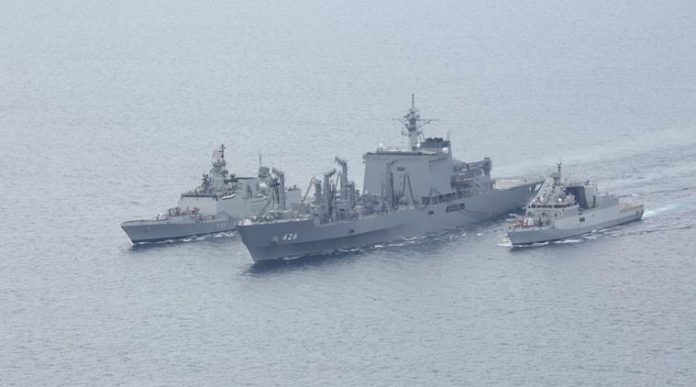
New Delhi (NVI): The first phase of quadrilateral naval exercise – Malabar 2020, commenced off Visakhapatnam in the Bay of Bengal today. With an eye on China, the navies of four Quad countries — India, the US, Japan, and Australia — will participate in the crucial naval drill to push for free and fair Indo-Pacific and enhanced interoperability in the region.

The exercise will witness the resolve of the four countries towards an open Indo-Pacific and countering the growing Chinese assertiveness in the region.

The naval exercise, being conducted from Nov 3 to 6 will showcase high-levels of synergy and coordination between the 4 friendly navies, the Ministry of Defence said in a statement yesterday.

The 24th edition of the naval exercise is scheduled in two phases. Phase 1 of the exercise involves participation by the Indian Navy (IN), United States Navy (USN), Japan Maritime Self Defence Force (JMSDF), and Royal Australian Navy (RAN).

Phase 2 of MALABAR-20 is scheduled to be conducted in the Arabian Sea in mid-November 2020, as per the MoD.

MALABAR series of maritime exercises commenced in 1992 as a bilateral IN-USN exercise. JMSDF  joined MALABAR in 2015. The 2020 edition will now witness the participation of the RAN in this joint maritime exercise, the ministry said.

Phase-1 will witness the participation of Indian Navy units with United States Ship (USS) John S McCain (Guided-missile destroyer), Australian Ship (HMAS) Ballarat (long-range frigates) with integral MH-60 helicopter, and Japan Maritime Self Defence Ship (JMSDF) Onami (Destroyer) with integral SH-60 helicopter.

The Indian Navy participation in Phase 1 will be led by Rear Admiral Sanjay Vatsayan, Flag Officer Commanding Eastern Fleet. Indian Navy units participating in the exercise include destroyer Ranvijay, frigate Shivalik, Off-Shore Patrol Vessel Sukanya, Fleet Support Ship Shakti and submarine Sindhuraj. In addition, Advanced Jet Trainer Hawk, long-range maritime patrol aircraft P-8I, Dornier maritime patrol aircraft, and helicopters will also be participating in the exercise.

The exercise, being conducted as a ‘non-contact, at sea only’ exercise in view of COVID-19 pandemic, will showcase the high-levels of synergy and coordination between the friendly navies, which is based on their shared values and commitment to an open, inclusive Indo-Pacific and a rules-based international order. MALABAR 20 Phase 1 would witness complex and advanced naval exercises including surface, anti-submarine and anti-air warfare operations, cross deck flying, seamanship evolutions and weapon firing exercises, the MoD said.

-ARK

MUST READ