Column
By Ajay Kaul
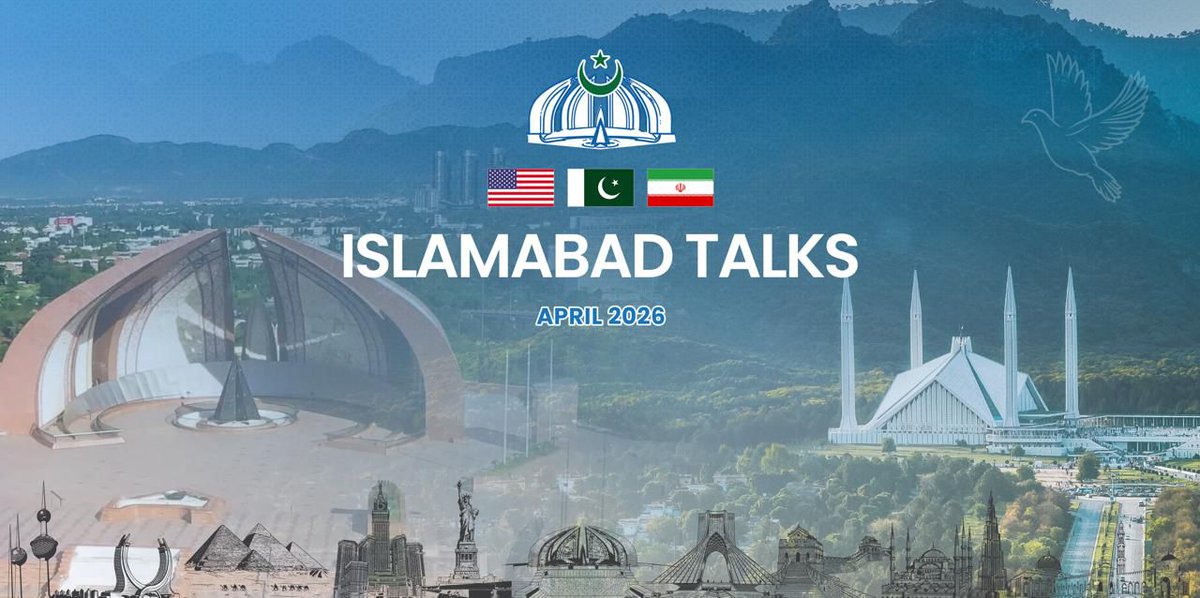
New Delhi, Apr 20: Pakistan is again getting its capital Islamabad ready to host the 2nd round of talks between the US and Iran aimed at ending the war in West Asia, which is on pause till Wednesday.
Security has been tightened massively and curbs imposed in Islamabad, as well as in the adjoining garrison township of Rawalpindi, ahead of the talks expected tomorrow.
The hectic preparations are underway even as Iran has been maintaining that it is not going to participate in the negotiations because of the “unreasonable” and “unacceptable” demands put by the US.
The American side, meanwhile, has announced that its delegation, led by Vice President JD Vance, will be reaching Islamabad for the talks.
Significantly, April 22 is the date when the two-week ceasefire announced by US President Donald Trump would end and he has threatened to “start bombing again” if a deal with Iran is not achieved by then.
One round of talks has already been held in Islamabad on April 11 and 12, which failed to yield any result as both the US and Iran maintained hard stance regarding their demands.
However, that round of talks, spanning 21 hours, resulted in a face-to-face clarity regarding the objectives each side aims to achieve.
Since then, both sides have maintained aggressive posturing, due to which the Strait of Hormuz, the critical lifeline of global fuel supplies, remains blocked.
A new crucial element has been added by the claimed seizure of an Iranian cargo vessel on Sunday night by the US Navy in the Arabian Sea, after firing and disabling it.
The vessel was en route from China to Iran.
Iran has vowed to retaliate for this aggression, while declaring that if its ports are made unsafe, it will strike hard against the enemy.
Pakistan finds relevance:
Whether or not the next round of talks place in Islamabad tomorrow, Pakistan’s politico-military leadership, particularly Army Chief Field Marshal Asim Munir who is effectively the real Supreme leader of the country, are already basking in the new-found importance at the international stage.
Hosting of one round of direct negotiations at top levels between the US and Iran, who are bitter enemies since nearly five decades, has brought Pakistan in focus of countries around the world as they eagerly want normal energy flows to resume through the blockaded Strait of Hormuz.
The mediatory role in the deadliest war of the 21st century has given a sort of relevance to Pakistan, which was virtually a pariah and seeped into acute economic crisis.
It was an outcaste at the international stage, rightly so, for promoting global terrorism and its dubious record in relation to acquisition of nuclear weapons.
For years, the Financial Action Task Force (FATF), a global watchdog for international terrorism, had kept Pakistan in the ‘Grey List’ (watch list) for its financing terrorism, a matter of absolute shame for any nation.
Pakistan: Host to the World’s most wanted terrorist:
While all eyes are currently on Pakistan in the context of US-Iran talks, just 15 years back, the same country was exposed in front of the world by America for hosting the most wanted global terrorist Osama bin Laden.
The US, despite having strategic partnership with Pakistan, had to conduct a top-secret surgical military operation in Abbottabad, close to Islamabad, in the dead of a night to hunt down the Al Qaeda chief in May 2011.
Such was the state of trust the US had in the Pakistani military leadership that it had to keep it in the dark during the entire operation to locate, track and then swoop down on Laden who was lodged in a house, near a cantonment of Pakistan Army.
In fact, Pakistan was caught cheating its ally, the US, as well as other western countries, who were frantically searching for the Al Qaeda chief for 10 long years in Afghanistan while he was living comfortably with his family in a three-storeyed house, obviously with the patronage of the Pakistani military.
The operation exposed to the entire world how Pakistan had been double-crossing the US and others in relation to international terrorism, which it claimed to be fighting.
Interestingly, Trump, in January 2018, during his first term as the US President, had spoken publicly about how Pakistan had been cheating America for decades.
On January 1, 2018, Trump had tweeted: “The US has foolishly given Pakistan more than $33 billion in aid over the last 15 years and they have given us nothing but lies and deceit, thinking of our leaders as fools. They give safe haven to the terrorists we hunt in Afghanistan, with little help. No more!
Ironically, the same Donald Trump has either forgotten those words of his or is deliberately ignoring Pakistan’s history of “deceit” while reposing so much trust in the dubious military leadership of Pakistan.
So, his new-found deep affection for the leadership of the same Pakistan is intriguing.
Convincing the US and Iran:
It has surprised many that the Politico-Military regime of Pakistan managed to convince Trump as well as the Islamic leadership of Iran to have a conversation, at least one round, amid the raging war which started on February 28 and caused devastation in West Asia and led to deep economic distress around the world.
The surprise is mainly in relation to the kind of trust reposed by Trump in Asim Munir, considering his close connections with Iranian Revolutionary Guards Corps (IRGC), which is linked directly to the Islamic regime of the country.
It has been interesting to see Trump go gung-ho regarding Asim Munir, whom he has been describing as a “great military leader”.
May be, it has got something to do with the shameless boot-licking of Trump by Asim Munir, especially since the time the Pakistani military suffered a severe blow due to the ‘Operation Sindoor’ conducted by India in May last year.
‘Operation Sindoor’ was launched to target major terror installations in Pakistan in retaliation to the ghastly terror attack in Pahalgam in Kashmir but it led to a brief war in which Pakistani military facilities were hit badly by India.
Unable to face the might of the Indian military, Asim Munir, along with Pakistan Prime Minister Shehbaz Sharif, ran to Trump for help, pleading that millions of lives would be lost due to the war.
Trump, who likes weak people as per his own public admission, immediately adopted Munir and Shehbaz Sharif, and offered his patronage to make them subservient.
To please Trump, Sharif and Munir even went to the extent of officially proposing his name for the Nobel Peace Prize, which he eagerly wanted but was rejected.
History of relations between US and Iran:
The US, along with its lackey Israel, and Iran have been having intensely hostile relations since 1979 after the Islamic Revolution due to which the West lost its influence on the Persian nation.
That animosity turned into a destructive war on February 28 after the US and Israel launched joint air strikes on Iran, assassinating its Supreme Leader Ayatollah Ali Khamenei, revered by millions of Shia Muslims.
As Iran retaliated by conducting missile and drone attacks at Israel as well as the American military and economic assets in West Asia, the entire region got engulfed in a massive armed conflict which carried on for 40 days.
The disastrous effects were felt even beyond the region and across the world as global energy supplies got disrupted severely, with oil and gas facilities being struck in Iran, Israel and various countries of the Gulf, including Saudi Arabia, Qatar, UAE, Bahrain and Kuwait and the Strait of Hormuz being choked by Iran.
Fuel shortages and inflation hit many countries across the world, with the serious possibility of catastrophic effect on economies across the globe.
The US, too, could not escape the damaging impact. Not only did it suffer military casualties but its economy too was hit badly, leading to a major spike in essential commodities like fuel.
More than anything, the US suffered a massive blow to its image of being invincible. The biggest humiliation was the fact that the US could not prevent Iran from shutting down the Strait of Hormuz or reopen the critical maritime passage for normal navigation, even as Trump kept describing the American military as the “most powerful” ever.
Pakistan provided a face-saver:
As war raged, hurting America’s economy and causing military casualties, criticism and attacks against Trump and his policies mounted domestically to such an extent that there were demands and moves by dozens of US Congress members (Parliamentarians) for his urgent impeachment.
Trump faced questions as to why he waged the war and why he was wasting billions of US taxpayers’ money on an unnecessary and evil conflict.
Despite that, Trump maintained his jingoistic demeanor but he was clearly battered and needed a face-saver to wriggle out.
And that is where Pakistan came in handy. So, as soon as Pakistan proposed to mediate, Trump grabbed the offer, as if he was keenly waiting.
Iran, which suffered tremendous loss of its leadership and infrastructure, also agreed to the talks, but with “deep distrust” in the US because of the “repeated betrayals”.
But, perhaps it agreed to talk with the intent of extracting the maximum benefits, having suffered severely due to the America-imposed sanctions over the last four decades.
Pakistan’s Lack of Credibility:
There can be nothing more ironic than Pakistan portraying itself as a ‘peace maker’ considering its history of being a war-monger and a destabilizing factor in the region.
Even the majority of people in Pakistan would not be able to digest that the country’s Army chief is a peacenik, since they face extreme atrocities and human rights violations at the hands of the military each day.
The Pakistani military and its intelligence agencies are notorious within the own country for brutally suppressing dissent, including through abductions and killings.
Interestingly, Sharif and Munir projected themselves as ‘peace makers’ even as the Pakistani military continues to engage in killing of innocent Pashtuns in Khyber Pakhtunkhwa and Baloch people in occupied Balochistan and other places.
Just a few days before Asim Munir started the mediation drama, his military was engaged in aerial bombings on civilian installations, including hospitals, schools and mosques, in neighbouring Afghanistan.
In one such extremely criminal act, the Pakistani military last month bombed a drug rehabilitation centre in Afghanistan’s capital Kabul, killing over 200 and injuring over 400 patients and medical staff.
The belligerence of the Pakistani military increased so much that China, a common friend, had to step in to stop it from conducting attacks in Afghanistan and broker peace between the two countries.
So, at a time Pakistan was projecting itself as a ‘peace maker’ in the war between the US and Iran, it was itself being hosted as a ‘war monger’ by China which has been making efforts to stop it from attacking Afghanistan.
The last round of the trilateral talks were held in Beijing only a few days before the first round of Islamabad talks between the US and Iran.
Isn’t it interesting?
Promoter of terrorism:
For the Pakistani military leadership, of whom Trump has become a huge fan, peaceful activities are the last thing it would indulge in.
Its history shows that it has been using terrorism and subversive activities as integral part of the country’s policies vis-a-vis neighbours, be it India or Afghanistan.
With respect to India, the Pakistani military has been, as a policy, indulging in activities like terrorism, drug peddling and circulation of fake currency in an attempt to cause destabilisation, besides bloodshed, in the country.
One of the major terror attacks engineered by Pakistan may still be fresh in the memory of the Trump administration, since it had condemned it.
It was the ghastly massacre of 26 innocent people, including 25 tourists, by three Pakistani terrorists, in the famous tourist destination of Pahalgam in Kashmir just a year back on April 22.
Even earlier, the Pakistani military has engineered thousands of terror strikes and subversive activities across India, including attacks on Parliament and Jammu and Kashmir Assembly.
Among the biggest ones was the targeting of Mumbai in November 2008 where multiple places, including the iconic Taj Hotel, were targeted and 166 people killed, including the American nationals.
Similarly, the Pakistani military has, for decades, sponsored and promoted terrorism in Afghanistan, even against the US.
When the US-led international forces were in Afghanistan from 2001 to 2021, many attacks on them were engineered by the Pakistani intelligence agencies.
The US intelligence agencies, like the CIA, are quite aware of this fact.
Atrocities committed by Pakistani military in occupied territories:
While it claims to be a ‘peace maker’, Pakistan continues to occupy, since nearly eight decades, several territories and regions, like parts of Jammu and Kashmir, Gilgit-Baltistan and Balochistan.
These regions witness extreme forms of atrocities and oppression by the Pakistani military and its notorious intelligence agency ISI.
In occupied parts of Jammu and Kashmir and Gilgit-Baltistan, the Pakistani military and its secret agencies suppress even the freedom to life, leave aside other basic necessities.
The Pakistani military and its secret agencies also carry out extreme atrocities against the Baloch people in occupied Balochistan on daily basis, including abductions, rapes and extra-judicial killings.
Thousands of youth, including girls, are abducted by the Pakistani military every year in Balochistan and most of them never see the light of the day again even as their loved ones keep waiting endlessly.
Some of them may be freed after years but the extreme torture leaves them in a vegetable state.
Similar abuses are carried out by the Pakistani military in Sindh too.
Abuses at home:
Even domestically, the military regime of Pakistan has been carrying out brutal crimes and human rights abuses against its own people, particularly in Khyber Pakhtunkhwa Province.
On the pretext of targeting militants, the Pakistani military conducts aerial bombings and kills civilians and children.
Muslim religious scholars are also not spared, with State-sponsored personnel indulging in their killings in a recurrent manner.
Elsewhere also, anyone criticizing the military is silenced by threats or eliminations.
Nuclear aspect:
Donald Trump has been claiming that is trying to prevent Iran, an Islamic country, from acquiring nuclear weapons. This again highlights the double-standards he practices.
Iran has been emphasizing that it has no intention of having nuclear weapons and is not working on any such programme.
It gave this assurance even during the talks on the nuclear issue, mediated by Oman which backed the claim. Despite that, Trump ordered a military strike at Iran.
On the other hand, Trump is silent about the nuclear weapons possessed by his favourite Pakistan, which pose a serious threat to India and the region.
Pakistan, an Islamic country which has become a darling of Trump, built atomic bombs with stolen technology and illegal proliferation by North Korea.
In fact, Dr A.Q. Khan, considered as the ‘Father’ of Pakistan’s Nuclear bomb, had been exposed by the West for indulging in illegal nuclear proliferation over a decade back.
It has also been assessed even by the American establishment officials and experts that Pakistan’s nuclear weapons constitute a major threat as there is a looming risk of these falling into the hands of terrorists and other non-State actors because of the complicity between the Pakistani military regime with them.
Pakistan Objectives:
Pakistan’s move to become a mediator between the US and Iran is a well-calculated one, amidst the deep financial crisis it has been facing.
One of the main objectives would be to gain closeness with the Administration of Trump. By being in the good books of Trump, the notorious military regime of Pakistan must be aspiring to carry out, with more impunity, its nefarious activities, within as well as in respect of India and Afghanistan.
It must be hoping that by using the mask of a ‘peace maker’, it would be able to hide the extreme forms of atrocities, abuses and human rights violations in occupied Balochistan, Khyber Pakhtunkhwa.
So, one may expect these atrocities to increase.
By claiming moral high ground, the Pakistani military regime would also be hoping to continue its ill-intentioned cross-border activities against India and Afghanistan.
Economic benefits:
For several years now, Pakistan has been facing a deep economic crisis, so much so that it has been surviving on the doles from the International Monetary Fund (IMF) and some Islamic countries like Saudi Arabia and United Arab Emirates (UAE) and China.
These nations have lately been pressing Pakistan to return their loans, which is to the tune of billions of dollars.
This has led to a severe problem for Pakistan.
In fact, when the energy supplies from West Asia got disrupted, the Pakistan government had to resort to a partial shutdown of the country. It ordered partial closure of the government institutions, educational institutions and closure of many fuel stations, to save energy.
In view of the acute shortage of energy, even the much-trumpeted Pakistan Super League (PSL), an annual cricket tournament, was drastically scaled down, with the venues being limited to 3 from 10.
By gaining closeness with the Trump administration, Pakistan would be hoping for financial help from the US as well as other countries.
Some billions of dollars have already started pouring into Pakistan from Saudi Arabia and IMF.
So, whether or not its mediation achieves the objectives portrayed, Pakistan is set to gain in a major way, despite having no credentials at all.